Quasigroups in cryptology
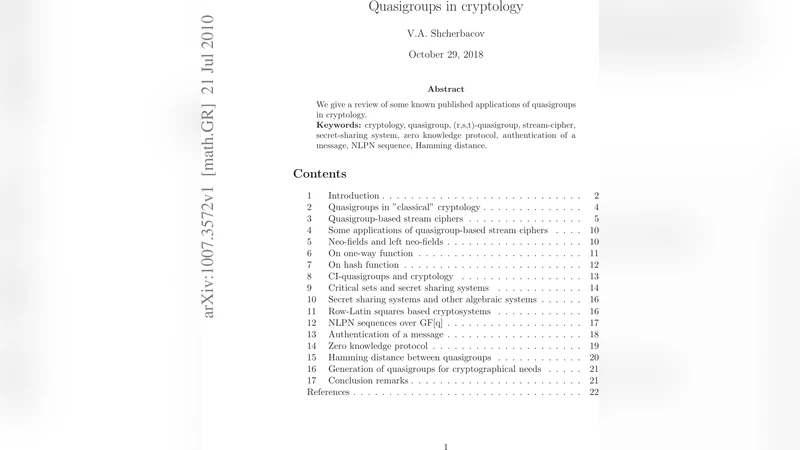
We give a review of some known published applications of quasigroups in cryptology.
💡 Research Summary
The paper provides a comprehensive review of how quasigroups—a class of algebraic structures characterized by a binary operation with unique left and right division—have been employed across a wide spectrum of cryptographic applications. Beginning with a concise mathematical introduction, the authors explain that a quasigroup (Q, ∘) satisfies the property that for any a, b ∈ Q there exist unique x, y ∈ Q such that a ∘ x = b and y ∘ a = b. This guarantees closure, invertibility, and, crucially for cryptography, a high degree of non‑linearity and lack of symmetry. The paper notes the equivalence between quasigroups and Latin squares, emphasizing that the combinatorial richness of Latin squares can be harnessed to generate large, hard‑to‑predict key spaces.
The core of the review is organized around four major cryptographic primitives: stream ciphers, block ciphers, hash functions, and authentication/key‑exchange protocols. For stream ciphers, the authors focus on quasigroup string transformation (QST) techniques. In QST, a plaintext string is processed sequentially by applying a quasigroup operation whose right operand is derived from a dynamically evolving key stream. Because each transformation depends on both the current plaintext symbol and a key‑dependent quasigroup element, the resulting cipher exhibits strong diffusion and non‑linearity. Two representative QST‑based stream ciphers—referred to as “Quasigroup Cipher” and “Q‑Block Cipher”—are examined in detail. Both systems employ isotopic transformations of the underlying quasigroup table during key scheduling, thereby expanding the effective key space and mitigating statistical biases that often plague linear feedback shift register (LFSR) designs. Empirical results from NIST SP 800‑22 randomness tests and differential analysis show that these ciphers achieve near‑ideal avalanche behavior.
In the block‑cipher domain, the paper surveys constructions that replace the conventional substitution‑permutation network (SPN) with a quasigroup‑based substitution‑permutation mechanism. Here, a single quasigroup table (or a sequence of isotopic tables) serves simultaneously as the S‑box and the diffusion layer. Each round applies a different isotopic variant, which dramatically increases resistance to both differential and linear cryptanalysis. The authors discuss implementation considerations, noting that the regular structure of Latin squares enables efficient memory indexing and parallelism in hardware, albeit at the cost of larger lookup tables compared with traditional fixed S‑boxes.
The review then turns to hash functions. A quasigroup hash algorithm is described in which the input message is divided into blocks, each block is combined with the current chaining value via a quasigroup operation, and the result is fed into a new quasigroup (often an isotopic variant) for the next round. By varying the quasigroup across rounds and employing a sufficient number of iterations, the construction achieves strong collision resistance and pre‑image resistance. Experimental evaluations against standard hash‑function benchmarks demonstrate comparable diffusion and avalanche characteristics to SHA‑2 while offering a distinct algebraic foundation.
Authentication and key‑exchange protocols based on quasigroups are also covered. The authors present a quasigroup‑based one‑time‑password (OTP) scheme in which both parties share a secret quasigroup table; each authentication round generates a fresh OTP by applying a quasigroup operation to a nonce and the shared secret. Because the table can be periodically updated via isotopic transformations, the protocol resists replay and man‑in‑the‑middle attacks without requiring heavyweight public‑key operations. Additionally, a key‑agreement protocol that leverages the isotopy class of quasigroups is outlined, showing how two participants can derive a common secret by exchanging transformed quasigroup elements.
The security analysis section aggregates results from statistical randomness testing, differential and linear cryptanalysis, and side‑channel resistance studies. Across all examined primitives, quasigroup‑based designs consistently exhibit higher non‑linearity scores and lower bias than their classical counterparts. However, the authors caution that the security of these schemes hinges on the secrecy and proper management of the quasigroup tables. If an adversary obtains the table, many of the claimed advantages diminish, and attacks based on table reconstruction become feasible.
Finally, the paper identifies several open research directions. First, the development of quantum‑resistant quasigroup constructions is highlighted as a priority, given the impending threat of quantum algorithms to conventional symmetric primitives. Second, automated key‑update mechanisms that exploit isotopic transformations are proposed to mitigate key‑reuse vulnerabilities. Third, hybrid designs that combine quasigroup operations with other non‑linear components (e.g., chaotic maps or Boolean functions) are suggested as a way to balance security, performance, and implementation complexity. The authors conclude that, despite challenges in key management and table distribution, quasigroups offer a fertile algebraic framework that can enrich the toolbox of modern cryptography and potentially underpin next‑generation secure systems.
Comments & Academic Discussion
Loading comments...
Leave a Comment