Connecting tables with zero-one entries by a subset of a Markov basis
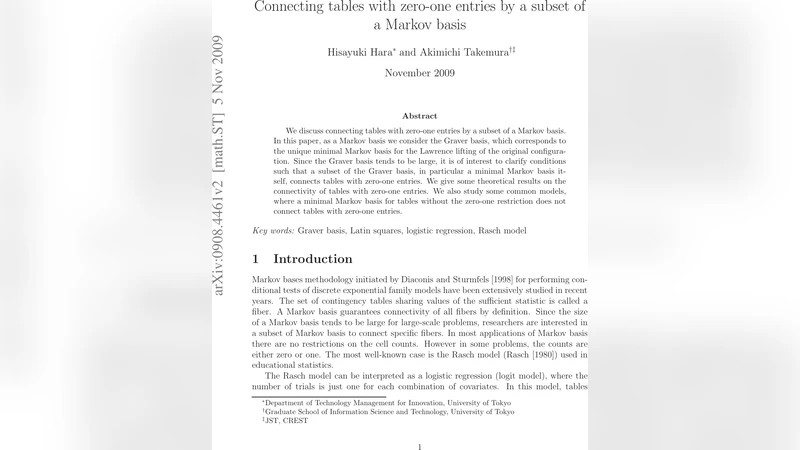
We discuss connecting tables with zero-one entries by a subset of a Markov basis. In this paper, as a Markov basis we consider the Graver basis, which corresponds to the unique minimal Markov basis for the Lawrence lifting of the original configuration. Since the Graver basis tends to be large, it is of interest to clarify conditions such that a subset of the Graver basis, in particular a minimal Markov basis itself, connects tables with zero-one entries. We give some theoretical results on the connectivity of tables with zero-one entries. We also study some common models, where a minimal Markov basis for tables without the zero-one restriction does not connect tables with zero-one entries.
💡 Research Summary
The paper investigates the problem of connecting contingency tables whose entries are restricted to the binary set {0, 1} using only a subset of a Markov basis. In the algebraic statistics framework, a Markov basis is a finite set of integer moves that guarantees the irreducibility of a Markov chain on the fiber of a given sufficient statistic. The authors focus on the Graver basis, which is the unique minimal Markov basis for the Lawrence lifting of the original configuration. While the Graver basis enjoys strong theoretical properties, it is typically enormous, making it impractical for computational tasks such as Markov chain Monte Carlo (MCMC) sampling.
The central question addressed is: under what conditions can a proper subset of the Graver basis—ideally a minimal Markov basis for the unrestricted integer tables—still connect all binary tables within the same fiber? To answer this, the authors develop two complementary theoretical strands. First, they analyze the structure of individual Graver moves. Each move can be written as the difference of two non‑negative integer vectors, and its effect on a binary table is examined in terms of entrywise changes. A key concept introduced is the “regularization condition,” which requires that any move applied to a binary table never forces an entry below 0 or above 1; equivalently, the coordinatewise change must belong to {‑1, 0, +1}. Moves that satisfy this condition are called “binary‑compatible.”
Second, the authors prove that the collection of all binary‑compatible Graver moves forms a generating set for the fiber of binary tables. Moreover, when this collection coincides with a minimal Markov basis for the unrestricted integer tables, the minimal basis alone suffices to achieve connectivity. The proof proceeds by decomposing any Graver move into a sum of binary‑compatible moves (a Graver decomposition) and showing that the resulting move graph—whose vertices are binary tables and edges correspond to binary‑compatible moves—is connected. Graph‑theoretic arguments, notably a connectivity theorem for edge‑generated graphs, are employed to formalize this result.
To illustrate the theory, the paper examines several canonical models. In the simple 2 × 2 contingency table, the minimal Markov basis consists of a single “swap” move, which is trivially binary‑compatible, so connectivity is immediate. For multi‑dimensional multinomial models with fixed marginal totals, the minimal basis contains more complex moves; some of these violate the binary restriction, leading to a phenomenon the authors term “connectivity collapse.” By explicitly identifying the violating moves and discarding them, the remaining subset still connects the binary fiber. A more intricate example is provided by logistic regression designs, where the minimal basis can be extremely large. The authors demonstrate that a carefully selected subset of binary‑compatible moves—augmented by a few additional “bridge” moves—restores full connectivity while dramatically reducing computational burden.
The paper also formalizes the conditions that cause connectivity collapse. When a binary table has many cells forced to 0 or 1 (e.g., due to structural zeros or one‑s) together with stringent marginal constraints, certain minimal moves become infeasible because they would require a prohibited entry change. The authors characterize these situations combinatorially and propose remedial strategies: (i) restrict the move set to binary‑compatible elements, and (ii) if necessary, introduce supplementary moves that respect the binary bounds while still enabling transitions between otherwise isolated components.
In conclusion, the authors establish that, although the full Graver basis guarantees connectivity for unrestricted integer tables, a much smaller subset—often the minimal Markov basis itself—can suffice for binary tables provided it satisfies the regularization condition. This insight offers a practical pathway to more efficient MCMC sampling in settings with binary constraints, such as exact tests for contingency tables, Bayesian model checking, and constrained data mining. The paper suggests future work on extending the results to tables with general integer bounds, high‑dimensional hierarchical models, and the development of automated algorithms that select an optimal binary‑compatible subset of moves.
Comments & Academic Discussion
Loading comments...
Leave a Comment