Filtrations in abelian categories with a tilting object of homological dimension two
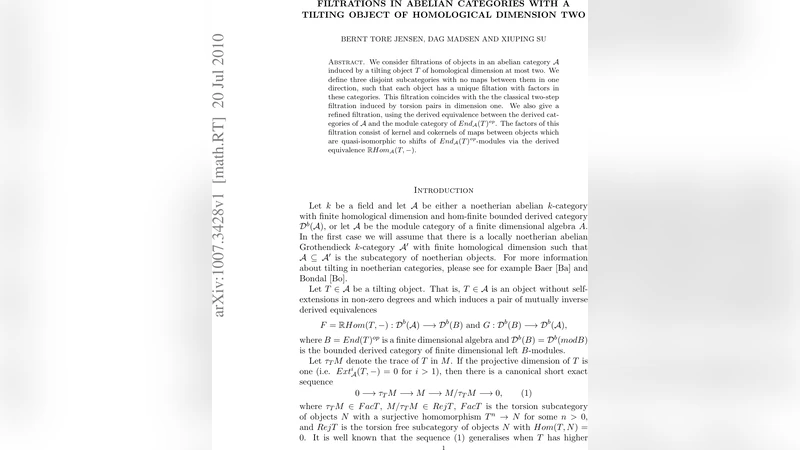
We consider filtrations of objects in an abelian category $\catA$ induced by a tilting object $T$ of homological dimension at most two. We define three disjoint subcategories with no maps between them in one direction, such that each object has a unique filtation with factors in these categories. This filtration coincides with the the classical two-step filtration induced by torsion pairs in dimension one. We also give a refined filtration, using the derived equivalence between the derived categories of $\catA$ and the module category of $End_\catA (T)^{op}$. The factors of this filtration consist of kernel and cokernels of maps between objects which are quasi-isomorphic to shifts of $End_\catA (T)^{op}$-modules via the derived equivalence $\mathbb{R}Hom_\catA(T,-)$.
💡 Research Summary
The paper investigates how a tilting object T of homological dimension at most two shapes the internal structure of an abelian category 𝒜. In the classical situation where T has homological dimension 1, the presence of a tilting object yields two torsion pairs (𝒯,ℱ) and (𝒯′,ℱ′). Each object X∈𝒜 then admits a unique two‑step filtration
0 → tX → X → fX → 0,
with tX∈𝒯 and fX∈ℱ, and there are no non‑zero morphisms from ℱ to 𝒯. The authors ask how this picture changes when the homological dimension of T is allowed to be 2.
The first major contribution is the definition of three mutually orthogonal full subcategories
𝒜₀, 𝒜₁, 𝒜₂ ⊂ 𝒜.
These are described in terms of vanishing of Hom and Ext groups with respect to T:
- 𝒜₀ consists of objects X with Hom𝒜(T,X)=0 and Ext¹𝒜(T,X)=0 (i.e. “torsion‑free” with respect to the first two derived functors).
- 𝒜₂ consists of objects Y with Ext²𝒜(T,Y)=0 and Ext¹𝒜(T,Y)=0 (i.e. “torsion” with respect to the last two derived functors).
- 𝒜₁ is the complement, containing objects for which none of the above vanishing conditions hold simultaneously.
A crucial orthogonality property is proved: for i>j we have Hom(𝒜ᵢ,𝒜ⱼ)=0. This mirrors the one‑directional vanishing in the classical torsion pair and guarantees that any morphism respects the order 𝒜₀ → 𝒜₁ → 𝒜₂.
Using these subcategories the authors construct, for every object X∈𝒜, a unique three‑step filtration
0 ⊂ X₀ ⊂ X₁ ⊂ X₂ = X,
with X₀∈𝒜₀, X₁/X₀∈𝒜₁ and X/X₁∈𝒜₂. The construction proceeds by taking the maximal subobject of X that lies in 𝒜₀, then the maximal subobject of the quotient that lies in 𝒜₁, and finally observing that the remaining quotient automatically belongs to 𝒜₂. The uniqueness follows from the orthogonality condition: any alternative filtration would produce a non‑zero morphism from a later piece to an earlier piece, contradicting Hom(𝒜ᵢ,𝒜ⱼ)=0 for i>j. When the homological dimension of T is 1, the subcategory 𝒜₁ collapses, and the construction reduces to the familiar two‑step torsion filtration, confirming that the new theory genuinely extends the classical case.
The second, more sophisticated part of the paper exploits the derived equivalence induced by the tilting object. The functor
ℝHom𝒜(T,–) : 𝒟ᵇ(𝒜) → 𝒟ᵇ(Mod‑End𝒜(T)ᵒᵖ)
is an exact triangle equivalence, with quasi‑inverse –⊗ᴸ_T End𝒜(T)ᵒᵖ. By transporting the three subcategories through this equivalence, the authors obtain a concrete description of the filtration factors in terms of modules over the endomorphism algebra B = End𝒜(T)ᵒᵖ.
Specifically:
- Objects of 𝒜₀ become complexes concentrated in degree 0 that are quasi‑isomorphic to B‑modules; thus they are identified with the “torsion‑free” B‑modules under the derived functor.
- Objects of 𝒜₂ correspond to complexes concentrated in degree 2, i.e. shifts of B‑modules by two places; they represent the “torsion” side of the picture.
- Objects of 𝒜₁ are realized as kernels or cokernels of morphisms between a degree‑0 complex and a degree‑2 shifted complex. In other words, each 𝒜₁‑factor is the homology of a short exact triangle of the form
B⁰ → B²
Comments & Academic Discussion
Loading comments...
Leave a Comment