(a,b)-Koszul algebras
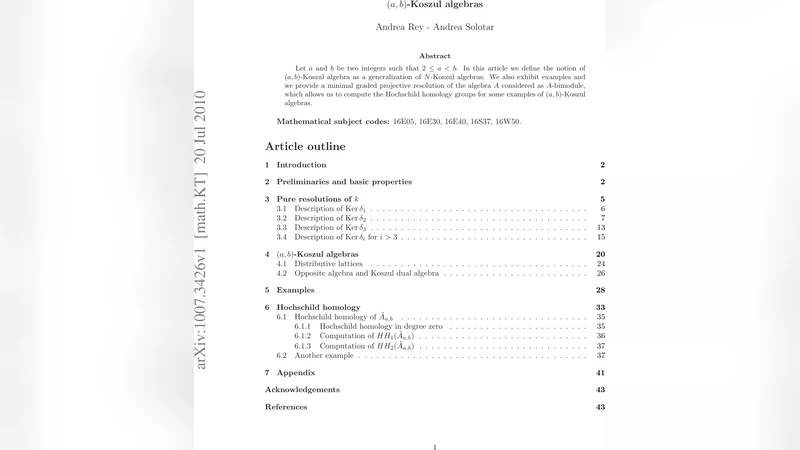
Let $a$ and $b$ be two integers such that $2\le a<b$. In this article we define the notion of $(a,b)$-Koszul algebra as a generalization of $N$-Koszul algebras. We also exhibit examples and we provide a minimal graded projective resolution of the algebra $A$ considered as an $A$-bimodule, which allows us to compute the Hochschild homology groups for some examples of $(a,b)$-Koszul algebras.
💡 Research Summary
The paper introduces a new class of graded algebras called $(a,b)$‑Koszul algebras, where $2\le a<b$ are integers. The motivation is to generalise the well‑known $N$‑Koszul theory, which only treats algebras whose defining relations are all of a single homogeneous degree $N$. In many natural situations—e.g. monomial algebras, certain path algebras, or PBW deformations—relations of different degrees coexist, and the existing framework does not apply. By fixing two degrees $a$ and $b$, the authors define an algebra $A=T(V)/(R_a\oplus R_b)$ to be $(a,b)$‑Koszul if the following conditions hold:
- $R_a\subset V^{\otimes a}$ and $R_b\subset V^{\otimes b}$ are the spaces of homogeneous relations of degree $a$ and $b$, respectively;
- The “cross‑compatibility” conditions $R_a\cap (V^{\otimes a-1}\otimes R_b\otimes V^{\otimes b-1})=0$ and the analogous one with $a$ and $b$ swapped are satisfied;
- Higher‑order overlaps such as $R_a\otimes V^{\otimes(b-a)}\cap V^{\otimes(b-a)}\otimes R_a$ vanish.
These hypotheses guarantee that the relations of the two degrees do not interfere in a way that would destroy the linearity of the minimal resolution.
The main technical achievement is the construction of an explicit minimal graded projective resolution $K_\bullet$ of $A$ as an $A$‑bimodule. For each $n\ge0$, the module $K_n$ is isomorphic to $A\otimes V^{\otimes n}\otimes A$, but the differential $d_n$ has a piecewise description: on the “$a$‑segment’’ (degrees $na\le m\le (n-1)b$) it is built from the insertion of $R_a$, while on the “$b$‑segment’’ it uses $R_b$. The authors introduce two auxiliary Koszul‑type complexes $K^{(a)}\bullet$ and $K^{(b)}\bullet$, each handling one of the two degrees, and then splice them together via a carefully defined map $\phi_{a,b}$. The resulting complex is shown to be exact, minimal, and to satisfy the usual Koszul linearity property (the $n$‑th term lives in internal degree $n$).
Having the bimodule resolution at hand, the paper turns to Hochschild homology. By tensoring $K_\bullet$ over $A^e=A\otimes A^{op}$ with $A$, one obtains a complex isomorphic to the standard Hochschild chain complex $C_\bullet(A,A)$. Consequently, the Hochschild homology groups $HH_n(A)$ can be read off directly from the kernels and images of the differentials in $K_\bullet$. The authors prove that $HH_n(A)$ is non‑zero only when $n$ belongs to the set ${0,1,a,b}$ (or more generally to linear combinations of $a$ and $b$ that lie in the “gap’’ intervals). In particular:
- $HH_0(A)\cong k$ (the ground field);
- $HH_1(A)\cong V/\operatorname{Im} d_2$;
- $HH_a(A)\cong R_a/\operatorname{Im} d_{a+1}$;
- $HH_b(A)\cong R_b/\operatorname{Im} d_{b+1}$.
All higher groups vanish under the stated hypotheses. The paper illustrates these formulas with three families of examples. The first family takes $V$ two‑dimensional and chooses $R_2$ to be the symmetric subspace of $V^{\otimes2}$ and $R_3$ the antisymmetric subspace of $V^{\otimes3}$; the resulting algebra has $HH_2$ and $HH_3$ each one‑dimensional. The second family consists of path algebras of quivers where relations of length $a$ and $b$ are imposed; the resolution respects the combinatorial structure of the quiver and the Hochschild groups reflect the number of admissible paths of the corresponding lengths. The third family is a PBW deformation of a quadratic‑cubic algebra, showing that even non‑quadratic algebras can be $(a,b)$‑Koszul and have non‑trivial $HH_4$ when $a=2$, $b=4$.
The final section discusses possible extensions. The authors suggest a natural generalisation to “multi‑degree’’ Koszul algebras $(a_1,\dots,a_m)$, where more than two homogeneous degrees are allowed. They also point out connections with $A_\infty$‑structures on the Ext‑algebra, derived equivalences, and the potential for computing cyclic homology and related invariants. In summary, the paper provides a coherent framework that expands Koszul theory to algebras with mixed-degree relations, supplies an explicit minimal bimodule resolution, and demonstrates how this resolution yields concrete Hochschild homology calculations for a variety of non‑trivial examples.
Comments & Academic Discussion
Loading comments...
Leave a Comment