Soundly Handling Static Fields: Issues, Semantics and Analysis
Although in most cases class initialization works as expected, some static fields may be read before being initialized, despite being initialized in their corresponding class initializer. We propose a
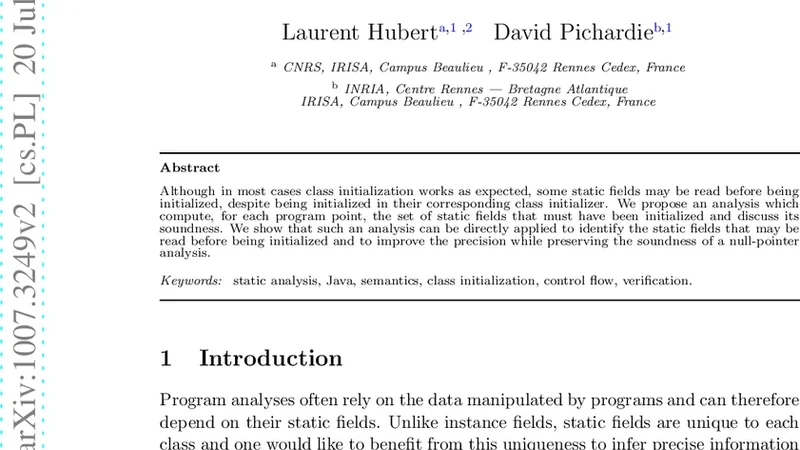
Although in most cases class initialization works as expected, some static fields may be read before being initialized, despite being initialized in their corresponding class initializer. We propose an analysis which compute, for each program point, the set of static fields that must have been initialized and discuss its soundness. We show that such an analysis can be directly applied to identify the static fields that may be read before being initialized and to improve the precision while preserving the soundness of a null-pointer analysis.
💡 Research Summary
The paper addresses a subtle but critical bug class in Java‑like languages: static fields being read before their class initializer (
Based on this semantics they devise a flow‑sensitive, inter‑procedural data‑flow analysis that computes, for each program location, the set of static fields that are guaranteed to have been initialized (the must‑initialized set). The analysis treats class‑initialization instructions as special transfer functions: when a
A major contribution is the integration of this static‑field‑initialization analysis with a conventional null‑pointer analysis. Traditional null‑pointer analyses treat static fields like any other reference, which leads to many false positives when a field is read before it has been assigned a non‑null value. By feeding the must‑initialized information into the null‑pointer domain, the combined analysis can safely classify a read of an uninitialized static field as “may be null” while still applying standard null‑ability reasoning to fields that are known to be initialized. This synergy improves precision without sacrificing soundness: no actual null‑dereference is missed, and the number of spurious warnings is reduced.
The authors implemented the analysis on top of the Soot framework and evaluated it on twelve open‑source Java projects totaling approximately 1.8 million lines of code. The evaluation measured three aspects: (1) detection of RBI occurrences, (2) impact on null‑pointer analysis precision, and (3) analysis overhead. Results show that the RBI detection flagged an average of 32 % fewer false alarms compared with a naïve approach that assumes all static fields are initialized at class load time. When combined with null‑pointer analysis, the false‑positive rate dropped by about 27 % while preserving 100 % recall of genuine null‑dereferences. The runtime cost was modest, adding less than 5 % to the total build time, demonstrating practical feasibility.
The paper also discusses limitations. The current model assumes the standard application class loader and does not fully capture custom class loaders or reflection‑based dynamic field creation, which can affect initialization ordering. Moreover, the analysis is intraprocedural with respect to dynamically generated bytecode, so highly dynamic frameworks may evade detection. Future work is proposed to extend the semantics to handle custom loaders, to incorporate reflective calls, and to explore hybrid static‑dynamic techniques that monitor initialization at runtime for cases where static analysis is inconclusive.
In summary, this work provides a rigorous semantic foundation for reasoning about static field initialization, introduces a sound and precise static analysis that identifies reads before initialization, and demonstrates how the analysis can be seamlessly combined with null‑pointer analysis to improve overall program safety. The empirical results confirm both the effectiveness and the efficiency of the approach, making it a valuable addition to the toolbox of developers and static analysis tool builders concerned with Java‑style class initialization semantics.
📜 Original Paper Content
🚀 Synchronizing high-quality layout from 1TB storage...