The eta invariant and equivariant index of transversally elliptic operators
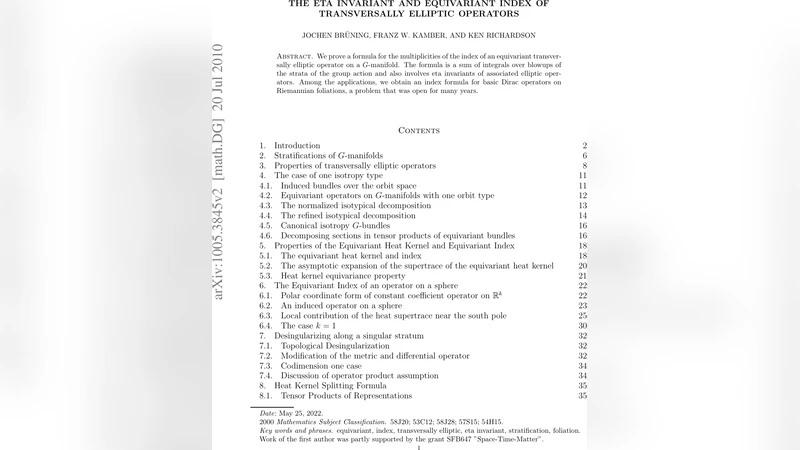
We prove a formula for the multiplicities of the index of an equivariant transversally elliptic operator on a $G$-manifold. The formula is a sum of integrals over blowups of the strata of the group action and also involves eta invariants of associated elliptic operators. Among the applications, we obtain an index formula for basic Dirac operators on Riemannian foliations, a problem that was open for many years.
💡 Research Summary
This paper establishes a precise formula for the multiplicities of the equivariant index of a transversally elliptic operator defined on a compact G‑manifold. The authors begin by recalling that while the Atiyah‑Segal‑Singer equivariant index theorem is well understood for elliptic operators and for free group actions, the case of transversally elliptic operators with non‑free actions has remained largely inaccessible. The main difficulty lies in the presence of fixed‑point strata where the symbol of the operator fails to be invertible in directions tangent to the group orbits.
To overcome this, the manifold is decomposed into finitely many orbit‑type strata ( {S_\alpha} ). For each stratum the normal bundle ( N_\alpha ) is blown up, producing a new manifold ( \widetilde{M}\alpha ) on which the original transversally elliptic operator lifts to a genuine elliptic operator ( \widetilde{D}\alpha ). The blow‑up resolves the singularities of the symbol and allows the use of heat‑kernel techniques. The spectral asymmetry of ( \widetilde{D}\alpha ) is captured by its eta invariant ( \eta(\widetilde{D}\alpha) ), which appears as a correction term in the final index formula.
The central theorem states that for any irreducible representation ( \chi ) of G, the multiplicity ( \operatorname{mult}_\chi ) in the equivariant index of the original operator D is given by
\
Comments & Academic Discussion
Loading comments...
Leave a Comment