Stationary and convergent strategies in Choquet games
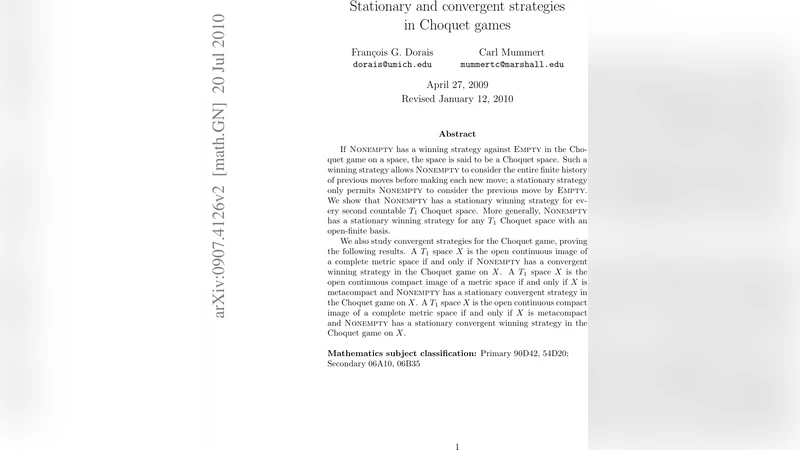
If NONEMPTY has a winning strategy against EMPTY in the Choquet game on a space, the space is said to be a Choquet space. Such a winning strategy allows NONEMPTY to consider the entire finite history of previous moves before making each new move; a stationary strategy only permits NONEMPTY to consider the previous move by EMPTY. We show that NONEMPTY has a stationary winning strategy for every second countable T1 Choquet space. More generally, NONEMPTY has a stationary winning strategy for any T1 Choquet space with an open-finite basis. We also study convergent strategies for the Choquet game, proving the following results. (1) A T1 space X is the open image of a complete metric space if and only if NONEMPTY has a convergent winning strategy in the Choquet game on X. (2) A T1 space X is the compact open image of a metric space if and only if X is metacompact and NONEMPTY has a stationary convergent strategy in the Choquet game on X. (3) A T1 space X is the compact open image of a complete metric space if and only if X is metacompact and NONEMPTY has a stationary convergent winning strategy in the Choquet game on X.
💡 Research Summary
The paper investigates the Choquet game—a two‑player infinite game played on a topological space X—in which the player EMPTY chooses a non‑empty open set and the player NONEMPTY must respond with a smaller non‑empty open set contained in EMPTY’s last move. A run of the game produces a decreasing sequence of open sets; if the intersection of all chosen sets is non‑empty, NONEMPTY is said to have won. A space in which NONEMPTY possesses a winning strategy is called a Choquet space.
Traditional treatments allow NONEMPTY to base each move on the entire finite history of the game. The authors refine this notion by distinguishing two restricted types of strategies:
- Stationary (or memory‑less) strategies – NONEMPTY’s next move depends only on the most recent move of EMPTY.
- Convergent strategies – the sequence of NONEMPTY’s chosen open sets is forced to have diameters tending to zero, so that the intersection collapses to a single point.
The main contributions are existence theorems for these strategies and precise characterisations of the topological properties that guarantee them.
Stationary Winning Strategies
The authors prove that a very broad class of spaces admits stationary winning strategies.
Theorem 1. Every second‑countable T₁ Choquet space admits a stationary winning strategy for NONEMPTY.
The proof uses a countable base to approximate each move of EMPTY by a basic open set and then fixes a predetermined response for each basic set. The T₁ condition guarantees that the response can be chosen so that the intersection never becomes empty.
Theorem 2. More generally, any T₁ Choquet space that possesses an open‑finite basis (each basic open set belongs to only finitely many basis elements) also admits a stationary winning strategy. The open‑finite condition eliminates the need for a countable base; it suffices that the local combinatorics of the basis are finite, allowing a uniform response rule that works for all possible moves of EMPTY.
These results show that the memory‑less requirement does not dramatically weaken NONEMPTY’s power: as long as the space has a sufficiently “tame’’ open structure, NONEMPTY can win without remembering the whole history.
Convergent Strategies and Image Representations
The second part of the paper connects convergent strategies with classical representation theorems for topological spaces as images of metric spaces.
Theorem 3. For a T₁ space X, the following are equivalent:
(a) X is the open image of a complete metric space M (i.e., there exists a continuous open surjection f : M → X).
(b) NONEMPTY has a convergent winning strategy in the Choquet game on X.
The direction (a) → (b) uses the completeness of M to construct a strategy that forces the diameters of NONEMPTY’s moves to shrink, while openness guarantees that the image of a decreasing sequence of open sets in M remains a decreasing sequence of open sets in X with non‑empty intersection. Conversely, given a convergent winning strategy on X, one builds a complete metric space whose points are “plays’’ of the game and defines an open map onto X by sending each play to the unique limit point of the corresponding decreasing sequence.
Theorem 4. For a T₁ space X, the following are equivalent:
(a) X is the compact‑open image of a metric space (i.e., there exists a continuous surjection f : M → X that is both compact‑preserving and open).
(b) X is metacompact and NONEMPTY possesses a stationary convergent strategy in the Choquet game on X.
Metacompactness supplies an open‑finite refinement of any open cover, which in turn yields an open‑finite basis suitable for a stationary rule. The stationary nature of the strategy ensures that the response depends only on the current move of EMPTY, while the convergent requirement forces the diameters to shrink. The compact‑open image condition is then recovered by constructing a metric space of “threads’’ of the game and showing that the map sending a thread to its limit point is compact‑preserving and open.
Theorem 5. For a T₁ space X, the following are equivalent:
(a) X is the compact‑open image of a complete metric space.
(b) X is metacompact and NONEMPTY has a stationary convergent winning strategy.
Here the additional completeness of the source metric space guarantees that the convergent strategy not only forces diameters to zero but also that the resulting limit point lies in the intersection, i.e., NONEMPTY truly wins.
These three equivalences provide a clean taxonomy:
- Open images of complete metric spaces ↔ convergent winning strategies.
- Compact‑open images of metric spaces ↔ metacompactness + stationary convergent strategies.
- Compact‑open images of complete metric spaces ↔ metacompactness + stationary convergent winning strategies.
Methodological Highlights
The proofs blend classical descriptive set‑theoretic techniques with combinatorial topology. Key tools include:
- Open‑finite bases, which allow the authors to replace arbitrary histories by a finite set of possible responses.
- Construction of auxiliary metric spaces whose points are plays of the game; completeness of these spaces mirrors the convergence requirement.
- Use of metacompactness to obtain locally finite refinements, which are essential for guaranteeing compact‑preserving behavior of the constructed surjections.
The authors also discuss how their results improve upon earlier work that required stronger selection principles (e.g., the axiom of choice) to obtain winning strategies. By showing that stationary strategies exist under modest topological hypotheses, the paper reduces the logical strength needed for many classical theorems about Baire spaces and Choquet spaces.
Implications and Future Directions
The paper’s findings have several noteworthy consequences:
-
Classification of Choquet spaces – The presence of a stationary (or stationary convergent) strategy becomes a new invariant that can be used to separate classes of spaces, complementing traditional invariants such as Baire category, completeness, or metacompactness.
-
Simplified constructions – In applications where one needs a winning strategy (e.g., constructing dense Gδ sets, proving generic properties), the stationary strategies provided here are easier to describe and implement than full‑history strategies.
-
Connections to image theorems – By linking game‑theoretic notions to open and compact‑open images of metric spaces, the work bridges two historically separate strands of topology: descriptive set theory and classical image representations.
-
Potential extensions – The techniques suggest several avenues for further research: exploring stationary strategies in non‑T₁ settings, investigating analogous results for other topological games (e.g., the Banach–Mazur game), or studying the impact of additional separation axioms on the existence of convergent strategies.
In summary, the paper delivers a comprehensive analysis of how restricted strategies in the Choquet game reflect deep structural properties of the underlying space. It shows that memory‑less (stationary) strategies are far more prevalent than previously thought, and that convergent strategies precisely capture when a space can be realized as an open or compact‑open image of a (complete) metric space. These insights enrich the theory of topological games and provide powerful new tools for the study of Baire‑type phenomena.
Comments & Academic Discussion
Loading comments...
Leave a Comment