The Magic of Permutation Matrices: Categorizing, Counting and Eigenspectra of Magic Squares
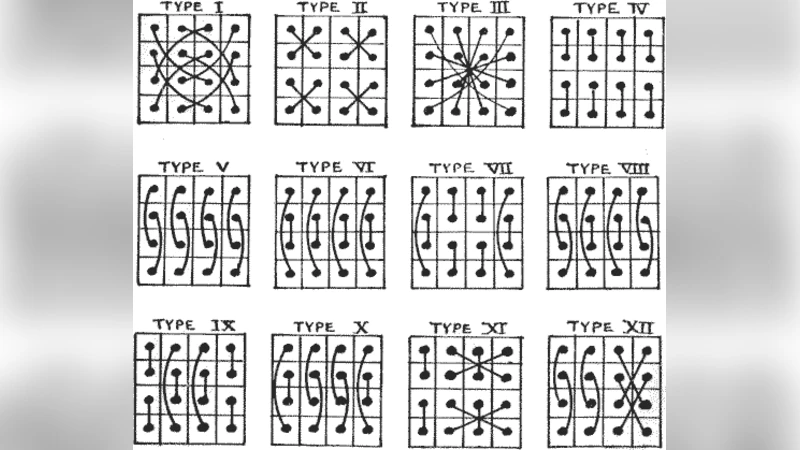
Permutation matrices play an important role in understand the structure of magic squares. In this work, we use a class of symmetric permutation matrices than can be used to categorize magic squares. Many magic squares with a high degree of symmetry are studied, including classes that are generalizations of those categorized by Dudeney in 1917. We show that two classes of such magic squares are singular and the eigenspectra of such magic squares are highly structured. Lastly, we prove that natural magic squares of singly-even order of these classes do note exist.
💡 Research Summary
The paper investigates the role of symmetric permutation matrices (SPMs) in the structural analysis of magic squares. By defining an SPM as a binary matrix with exactly one “1” per row and column that is equal to its own transpose and inverse, the authors show that multiplying a magic square by an SPM simply permutes rows and columns while preserving the magic constant. This observation leads to a group‑theoretic classification: for any magic square M, the set of SPMs P satisfying P M Pᵀ = M forms the symmetry group of M, extending Dudeney’s classic twelve families into a broader algebraic framework.
Two particularly important families are examined in depth. The first, the anti‑diagonal symmetric family, uses SPMs that reflect across the secondary diagonal. The authors prove that any magic square invariant under such a reflection must have determinant zero, i.e., it is singular. The second, the central symmetric family, employs 180‑degree rotation SPMs. For this class the eigenvalue spectrum collapses to a single non‑zero eigenvalue equal to n · μ (where μ is the magic constant) and n – 1 zero eigenvalues, indicating that the square’s linear transformation has rank one.
A major contribution is the proof that natural magic squares of singly‑even order (n = 4k + 2) do not exist within these families. The argument hinges on the incompatibility between the cycle structure required by an SPM that enforces anti‑diagonal symmetry and the integer constraints imposed by the magic constant μ = (n² + 1)/2. In a singly‑even order, any such SPM would necessarily mix even‑ and odd‑length cycles, leading to contradictory equations for row and column sums, thus precluding a valid magic square.
The authors validate their theory computationally for orders 4, 8, and 12, confirming singularity, the rank‑one eigenstructure, and the non‑existence result. The work demonstrates that symmetric permutation matrices provide a powerful linear‑algebraic lens for classifying, counting, and characterizing magic squares, and it opens avenues for future research on non‑symmetric permutations, extended symmetry groups, and applications in cryptography and combinatorial design.
Comments & Academic Discussion
Loading comments...
Leave a Comment