Development and Initial Validation of a Scale to Measure Instructors Attitudes toward Concept-Based Teaching of Introductory Statistics in the Health and Behavioral Sciences
Despite more than a decade of reform efforts, students continue to experience difficulty understanding and applying statistical concepts. The predominant focus of reform has been on content, pedagogy,
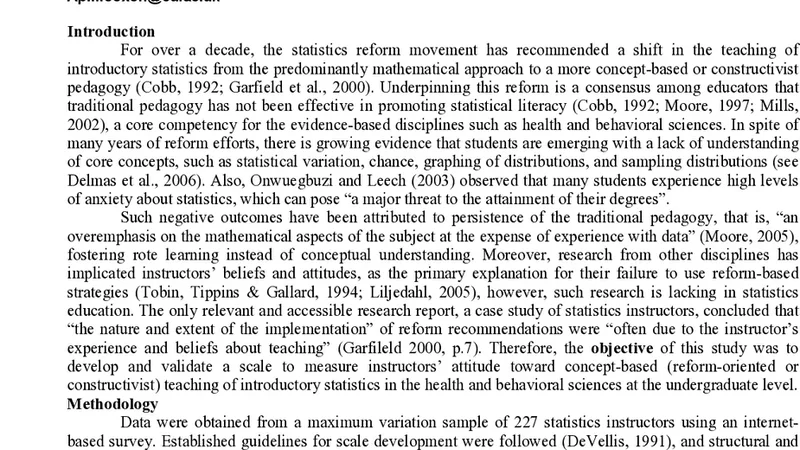
Despite more than a decade of reform efforts, students continue to experience difficulty understanding and applying statistical concepts. The predominant focus of reform has been on content, pedagogy, technology and assessment, with little attention to instructor characteristics. However, there is strong theoretical and empirical evidence that instructors’ attitudes impact the quality of teaching and learning. The objective of this study was to develop and initially validate a scale to measure instructors’ attitudes toward reform-oriented (or concept-based) teaching of introductory statistics in the health and behavioral sciences, at the tertiary level. This scale will be referred to as FATS (Faculty Attitudes Toward Statistics). Data were obtained from 227 instructors (USA and international), and analyzed using factor analysis, multidimensional scaling and hierarchical cluster analysis. The overall scale consists of five sub-scales with a total of 25 items, and an overall alpha of 0.89. Construct validity was established. Specifically, the overall scale, and subscales (except perceived difficulty) plausibly differentiated between low-reform and high-reform practice instructors. Statistically significant differences in attitude were observed with respect to age, but not gender, employment status, membership status in professional organizations, ethnicity, highest academic qualification, and degree concentration. This scale can be considered a reliable and valid measure of instructors’ attitudes toward reform-oriented (concept-based or constructivist) teaching of introductory statistics in the health and behavioral sciences at the tertiary level. These five dimensions influence instructors’ attitudes. Additional studies are required to confirm these structural and psychometric properties.
💡 Research Summary
This study addresses a notable gap in the statistics education reform literature: the lack of a validated instrument to assess university instructors’ attitudes toward concept‑based (constructivist) teaching of introductory statistics in health‑ and behavioral‑science programs. Drawing on theoretical frameworks such as the Theory of Planned Behavior and self‑efficacy theory, the authors designed the Faculty Attitudes Toward Statistics (FATS) scale.
The development process began with a comprehensive literature review and expert consultations that generated an initial pool of 45 items. After content‑validity review and a pilot test with 30 instructors, the pool was reduced to 25 items. The final questionnaire was administered online to 227 instructors from the United States and several international institutions. Respondents averaged 44 years of age, were 58 % male, and represented a mix of tenure‑track (63 %) and non‑tenure‑track faculty.
Exploratory factor analysis (principal‑axis factoring with Promax rotation) indicated a five‑factor solution accounting for 62 % of the variance. The factors were labeled: (1) Perceived Usefulness (6 items), (2) Self‑Efficacy (5 items), (3) Interest (5 items), (4) Support (5 items), and (5) Perceived Difficulty (4 items). Cronbach’s α for the total scale was .89; subscale alphas ranged from .71 to .84, confirming strong internal consistency.
Construct validity was examined in three ways. First, discriminant validity: instructors were classified into “low‑reform” and “high‑reform” groups based on self‑reported teaching practices. Independent‑samples t‑tests showed significant differences (p < .01) between the groups on all subscales except Perceived Difficulty, indicating that the scale captures attitudes that differentiate reform‑oriented teaching. Second, multidimensional scaling placed the five factors in a coherent two‑dimensional space, and hierarchical cluster analysis grouped Usefulness/Efficacy together and Interest/Support together, reinforcing the factor structure. Third, criterion‑related validity: age was negatively associated with reform‑oriented attitudes (β = ‑.23, p < .05), while gender, employment status, professional‑association membership, ethnicity, highest degree, and discipline showed no significant relationships. This pattern suggests that attitudes are more linked to career stage than to demographic characteristics.
The authors acknowledge several limitations. The sample, while international, was dominated by English‑speaking institutions, limiting cultural generalizability. The cross‑sectional design precludes causal inference, and self‑report data may be subject to social‑desirability bias.
In conclusion, the FATS instrument provides a reliable and valid means of measuring instructors’ attitudes toward concept‑based introductory statistics teaching. Its five dimensions—usefulness, self‑efficacy, interest, support, and difficulty—offer nuanced insight into the motivational and contextual factors that may facilitate or hinder reform implementation. Future work should conduct confirmatory factor analysis and test measurement invariance across cultures, as well as longitudinal studies to track how attitude changes translate into actual teaching practices and student outcomes.
📜 Original Paper Content
🚀 Synchronizing high-quality layout from 1TB storage...