Reform-Oriented Teaching of Introductory Statistics in the Health, Social and Behavioral Sciences-Historical Context and Rationale
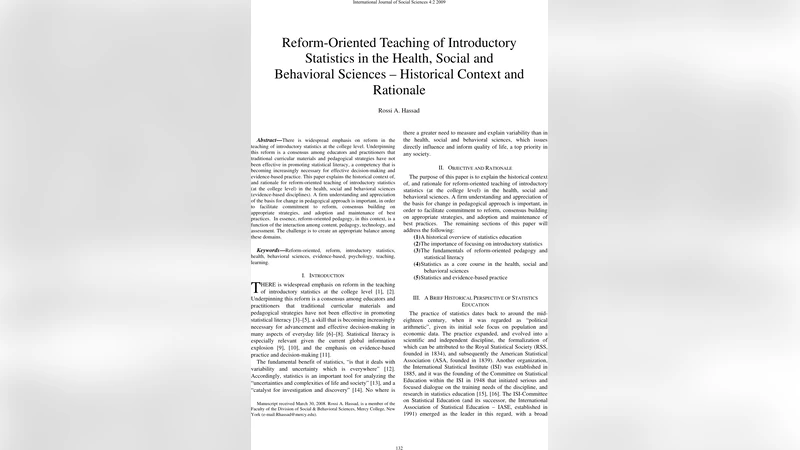
There is widespread emphasis on reform in the teaching of introductory statistics at the college level. Underpinning this reform is a consensus among educators and practitioners that traditional curricular materials and pedagogical strategies have not been effective in promoting statistical literacy, a competency that is becoming increasingly necessary for effective decision-making and evidence-based practice. This paper explains the historical context of, and rationale for reform-oriented teaching of introductory statistics (at the college level) in the health, social and behavioral sciences (evidence-based disciplines). A firm understanding and appreciation of the basis for change in pedagogical approach is important, in order to facilitate commitment to reform, consensus building on appropriate strategies, and adoption and maintenance of best practices. In essence, reform-oriented pedagogy, in this context, is a function of the interaction among content, pedagogy, technology, and assessment. The challenge is to create an appropriate balance among these domains.
💡 Research Summary
The paper addresses the growing consensus that traditional introductory statistics courses at the college level have failed to develop the statistical literacy required for evidence‑based practice in health, social, and behavioral sciences. It begins by situating the reform movement within a historical timeline: early statistics education emphasized mathematical rigor and procedural problem solving, while later decades introduced the concept of “statistical thinking” but largely retained lecture‑centric, textbook‑driven approaches, especially in the target disciplines. The authors argue that this legacy creates a disconnect between the statistical tools taught and the real‑world data challenges faced by professionals in these fields.
To bridge this gap, the authors propose a reform‑oriented pedagogy built on the interaction of four interdependent domains: content, pedagogy, technology, and assessment. Content shifts from abstract formulae to authentic research cases and publicly available datasets, allowing students to see why a particular method is appropriate. Pedagogy moves toward inquiry‑based, problem‑centered, and collaborative learning, encouraging learners to generate questions, explore data, and construct interpretations rather than passively receive information. Technology incorporates modern statistical software, simulation environments, and interactive visualization tools, providing immediate feedback and making abstract concepts concrete. Assessment combines formative checks with portfolio‑based evaluation, measuring not only correct answers but also the process of data analysis, interpretation, and decision‑making.
The paper stresses that these four components must be balanced. Over‑emphasizing any single element—such as technology without solid conceptual grounding, or traditional lectures without active learning—diminishes overall effectiveness. The authors outline practical steps for institutions: faculty development programs to train instructors in new methods and tools; curricular redesign that embeds data projects and case studies into existing courses; revision of grading policies to include process‑oriented assessments; and administrative support in the form of funding, infrastructure, and policy alignment.
Finally, the authors project the long‑term impact of such reform. Graduates equipped with robust statistical literacy are better prepared to conduct rigorous research, interpret findings accurately, and make evidence‑based decisions that improve public health outcomes, inform social policy, and advance behavioral science practice. The paper calls for ongoing research to monitor reform outcomes, suggesting both quantitative metrics (e.g., performance on authentic data tasks) and qualitative feedback (e.g., student confidence and perceived relevance) to ensure continuous improvement. In sum, the authors present a comprehensive rationale and actionable framework for transforming introductory statistics education into a catalyst for competent, data‑driven professionals in health‑related disciplines.
Comments & Academic Discussion
Loading comments...
Leave a Comment