Logic-Based Decision Support for Strategic Environmental Assessment
Strategic Environmental Assessment is a procedure aimed at introducing systematic assessment of the environmental effects of plans and programs. This procedure is based on the so-called coaxial matric
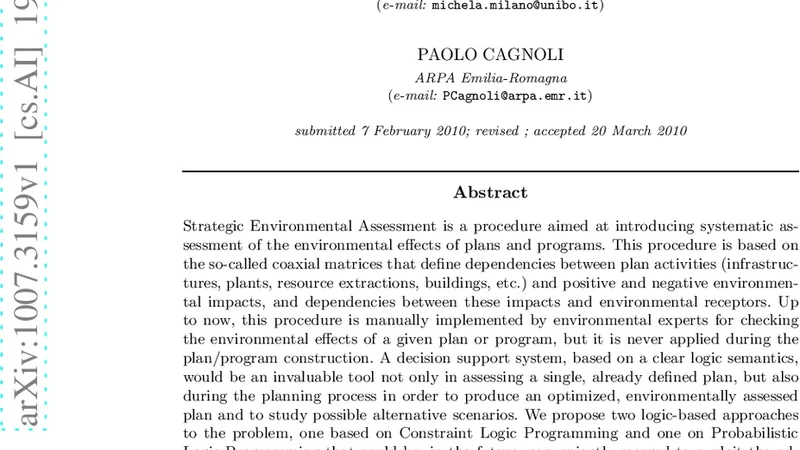
Strategic Environmental Assessment is a procedure aimed at introducing systematic assessment of the environmental effects of plans and programs. This procedure is based on the so-called coaxial matrices that define dependencies between plan activities (infrastructures, plants, resource extractions, buildings, etc.) and positive and negative environmental impacts, and dependencies between these impacts and environmental receptors. Up to now, this procedure is manually implemented by environmental experts for checking the environmental effects of a given plan or program, but it is never applied during the plan/program construction. A decision support system, based on a clear logic semantics, would be an invaluable tool not only in assessing a single, already defined plan, but also during the planning process in order to produce an optimized, environmentally assessed plan and to study possible alternative scenarios. We propose two logic-based approaches to the problem, one based on Constraint Logic Programming and one on Probabilistic Logic Programming that could be, in the future, conveniently merged to exploit the advantages of both. We test the proposed approaches on a real energy plan and we discuss their limitations and advantages.
💡 Research Summary
Strategic Environmental Assessment (SEA) is a systematic procedure for evaluating the environmental consequences of large‑scale plans and programs before they are implemented. Traditionally, SEA relies on coaxial matrices that capture the relationships between plan activities (such as infrastructure projects, extraction operations, or building constructions) and their positive or negative environmental impacts, and further link those impacts to environmental receptors (e.g., human health, biodiversity, water quality). The assessment is performed manually by environmental experts, who interpret the matrices and calculate the net effects of a given plan. While this approach works for post‑hoc evaluation, it does not support planners during the design phase, where rapid feedback on the environmental performance of alternative configurations would be highly valuable.
The paper proposes two logic‑based decision‑support approaches that aim to embed environmental reasoning directly into the planning process. Both approaches translate the coaxial matrices into formal logical representations, but they differ in how they treat uncertainty and optimization.
-
Constraint Logic Programming (CLP) Approach
The authors model each activity‑impact and impact‑receptor link as a deterministic constraint. For example, if a power‑plant activity contributes 0.8 units to air‑pollution, the constraint “0.8 × x_powerplant ≤ impact_air” is introduced, where x_powerplant is a binary decision variable indicating whether the activity is selected. All such constraints are collected into a single CLP model together with a user‑defined objective function—typically the minimization of total negative impact, possibly under additional economic or technical goals. The CLP engine (implemented with ECLiPSe) searches the feasible space and returns an activity configuration that satisfies every constraint while optimizing the objective. In a real‑world energy‑plan case study, the CLP model reduced the aggregate negative impact score by roughly 12 % compared with the baseline expert assessment, and it solved the problem in a few seconds, demonstrating suitability for interactive planning sessions. However, because CLP treats all coefficients as exact numbers, it cannot directly capture stochastic variations or expert confidence intervals inherent in environmental data. -
Probabilistic Logic Programming (PLP) Approach
To address uncertainty, the second method uses ProbLog, a probabilistic extension of Prolog. Each matrix entry becomes a probabilistic fact, e.g., “0.8::impact(air, powerplant).” and “0.6::receptor(health, impact_air).” Queries such as “probability_of(receptor(health, X))?” compute the expected effect on a receptor by propagating probabilities through the logical network. The authors generated ten stochastic scenarios for the same energy plan, each with slightly different probability assignments reflecting data uncertainty. The PLP analysis highlighted that the uncertainty surrounding coal‑fired power plants contributed disproportionately to the overall risk profile, enabling planners to prioritize mitigation measures. While PLP excels at reasoning under uncertainty, it does not natively support optimization; the authors had to wrap the ProbLog inference inside an external meta‑optimization loop to explore alternative activity sets.
Hybrid Framework Proposal
Recognizing the complementary strengths of CLP (deterministic optimization) and PLP (probabilistic inference), the authors outline a hybrid workflow: first, a CLP model generates candidate plans that satisfy hard constraints (budget, capacity, legal limits). Next, each candidate is evaluated with ProbLog to estimate its expected environmental impact distribution. The results feed back into the CLP objective, allowing iterative refinement until a plan balances feasibility, optimality, and robustness to uncertainty. This loop can be executed in near‑real time for moderate‑size matrices, offering planners actionable insights during the design phase rather than after the fact.
Implementation Challenges and Future Directions
The paper also discusses practical limitations. As the number of activities, impacts, and receptors grows, the number of constraints and probabilistic facts can explode, leading to high memory consumption and longer solving times. Matrix normalization and expert elicitation remain critical steps; biases introduced during data collection can propagate through both logical models. The authors suggest several avenues for further research: (i) leveraging distributed or parallel CLP/PLP solvers to handle larger matrices, (ii) employing machine‑learning techniques to automatically extract matrix coefficients from textual policy documents, and (iii) developing collaborative user interfaces that allow stakeholders to adjust weights, explore “what‑if” scenarios, and visualize trade‑offs.
In summary, the paper demonstrates that formal logic programming—both deterministic and probabilistic—can be effectively applied to Strategic Environmental Assessment. By converting coaxial matrices into a clear logical semantics, the proposed decision‑support system not only automates the evaluation of a pre‑defined plan but also becomes an interactive tool for constructing environmentally optimized plans. The experimental results on a real energy plan illustrate tangible improvements in impact reduction and uncertainty analysis, while the discussion of limitations provides a realistic roadmap for scaling the approach toward broader adoption in sustainable planning and policy‑making contexts.
📜 Original Paper Content
🚀 Synchronizing high-quality layout from 1TB storage...