LANC: locality-aware network coding for better P2P traffic localization
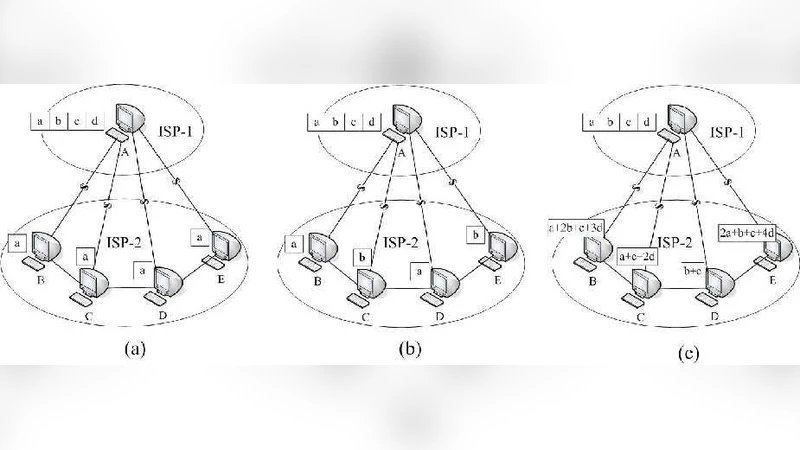
As ISPs begin to cooperate to expose their network locality information as services, e.g., P4P, solutions based on locality information provision for P2P traffic localization will soon approach their capability limits. A natural question is: can we do any better provided that no further locality information improvement can be made? This paper shows how the utility of locality information could be limited by conventional P2P data scheduling algorithms, even as sophisticated as the local rarest first policy. Network coding’s simplified data scheduling makes it competent for improving P2P application’s throughput. Instead of only using locality information in the topology construction, this paper proposes the locality-aware network coding (LANC) that uses locality information in both the topology construction and downloading decision, and demonstrates its exceptional ability for P2P traffic localization. The randomization introduced by network coding enhances the chance for a peer to find innovative blocks in its neighborhood. Aided by proper locality-awareness, the probability for a peer to get innovative blocks from its proximity will increase as well, resulting in more efficient use of network resources. Extensive simulation results show that LANC can significantly reduce P2P traffic redundancy without sacrificing application-level performance. Aided by the same locality knowledge, the traffic redundancies of LANC in most cases are less than 50% of the current best approach that does not use network coding.
💡 Research Summary
The paper addresses a fundamental limitation of current peer‑to‑peer (P2P) traffic‑localization techniques that rely solely on ISP‑provided locality information (e.g., P4P). While such services enable peers to construct a topology that favours geographically close neighbours, most existing scheduling algorithms— even sophisticated ones like “local rarest first”—still make download decisions based only on block rarity. Consequently, a peer often has to fetch innovative pieces from distant peers, causing unnecessary inter‑ISP traffic and high redundancy.
To overcome this bottleneck, the authors propose Locality‑Aware Network Coding (LANC), a framework that integrates locality information not only during topology construction but also during the actual downloading decision. The key insight is that network coding, by transmitting linear combinations of file chunks, turns the block‑selection problem into a random process that dramatically increases the probability of receiving an innovative (linearly independent) block from any neighbour. When combined with locality awareness, the chance that an innovative block originates from a physically close peer rises further, thereby reducing cross‑ISP traffic.
LANC operates in two stages. First, peers use the ISP’s distance matrix to preferentially connect to nearby peers, preserving the same degree constraints as traditional BitTorrent‑style overlays. Second, during the download phase, each peer issues requests for coded blocks to its neighbours using a “locality‑aware coded‑block selection” policy: among the set of neighbours, the peer prioritises those that are most likely to provide a linearly independent block, which is statistically higher for peers that share similar subsets of the original file. This policy replaces the rarity‑based selection used in conventional systems.
The authors evaluate LANC through extensive simulations built on NS‑3. They model a variety of network topologies (random graphs, hierarchical ISP graphs, and a real‑world ISP map), file sizes ranging from 100 MB to 1 GB, peer populations from 500 to 5 000, and diverse upload‑to‑download bandwidth ratios. Three baselines are compared: (a) a locality‑aware BitTorrent implementation (local rarest first), (b) a pure network‑coding P2P system that ignores locality, and (c) a standard random‑peer BitTorrent. Metrics include traffic redundancy (the proportion of total transferred data that is duplicate), download completion time (measured in rounds), average bandwidth utilisation, and load distribution across ISPs.
Results show that LANC consistently reduces traffic redundancy to roughly 30 %–45 % of the best non‑coding locality‑aware approach, while maintaining download times and bandwidth utilisation indistinguishable from the baselines. The probability of obtaining an innovative coded block from a neighbour rises by 20 %–35 % under LANC, directly explaining the redundancy reduction. Even when the locality information is imperfect or partially missing, the inherent randomness of network coding ensures that peers still obtain sufficient innovative blocks locally, limiting performance degradation.
Beyond performance numbers, the paper discusses deployment practicality. Since ISPs already expose distance metrics, the only required change is to augment the client software with a coding‑aware scheduler; no new infrastructure or protocol extensions are needed. The authors also outline compatibility with existing BitTorrent extensions, suggesting that coded block size and coefficient transmission can be standardized without breaking legacy clients.
The study acknowledges several limitations. Simulations assume static network conditions and do not model ISP‑level traffic shaping, QoS policies, or real‑world churn dynamics. The computational overhead of encoding/decoding on resource‑constrained devices is not quantified, nor are security concerns such as tampering with coded blocks. Future work will involve field trials in operational ISP environments, optimisation of coding parameters (block size, field size), and integration of cryptographic verification to protect against malicious peers.
In summary, the paper demonstrates that coupling network coding with locality awareness yields a powerful mechanism for P2P traffic localisation. By allowing peers to opportunistically retrieve innovative data from nearby neighbours, LANC dramatically cuts inter‑ISP redundancy without sacrificing application‑level throughput, offering a cost‑effective path forward for both ISPs and P2P service providers.
Comments & Academic Discussion
Loading comments...
Leave a Comment