On the existence of a category with a given matrix
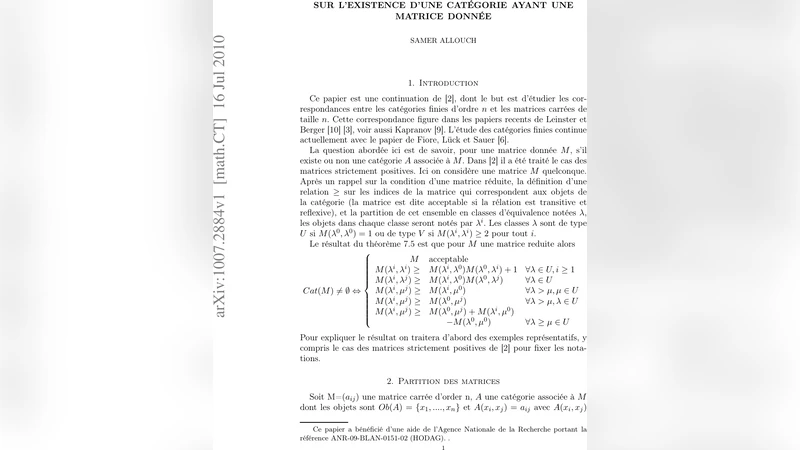
We classify the matrices M which correspond to finite categories
💡 Research Summary
The paper addresses a fundamental classification problem in finite category theory: given an integer matrix M, when does there exist a finite category whose hom‑set cardinalities are exactly the entries of M? The authors formalize the problem by fixing a finite set of objects X={x₁,…,xₙ} and defining an n × n matrix A=(aᵢⱼ) where aᵢⱼ = |Hom(xᵢ, xⱼ)|. By construction aᵢᵢ ≥ 1 because each object must have an identity morphism. The central contribution is a set of necessary and sufficient conditions on A that guarantee the existence of a category C with the prescribed hom‑set sizes.
First, the “identity minimality” condition requires that every diagonal entry be exactly 1. This encodes the uniqueness of the identity morphism for each object. Second, the authors derive a family of “composition inequalities” that capture the requirement that any pair of composable morphisms must yield a morphism in the appropriate hom‑set. Formally, for all i, j, k one must have
aᵢⱼ · aⱼₖ ≤ aᵢₖ · mᵢⱼₖ,
where mᵢⱼₖ denotes the number of distinct ways a morphism from xᵢ to xₖ can be obtained as a composition of a morphism xᵢ→xⱼ followed by one xⱼ→xₖ. In practice mᵢⱼₖ is bounded above by aᵢₖ, so the inequality can be rewritten without explicit reference to mᵢⱼₖ as aᵢⱼ · aⱼₖ ≤ aᵢₖ·aᵢₖ. The authors show that these inequalities are exactly the condition that every 2‑step path in the weighted directed multigraph defined by A can be “compressed” into a single edge without exceeding the prescribed weight.
The paper proves that the two conditions—identity minimality and the family of composition inequalities—are not only necessary but also sufficient. To establish sufficiency, the authors construct an explicit category C from a matrix satisfying the conditions. They interpret the entries aᵢⱼ as multiplicities of parallel arrows in a multigraph, then define composition by selecting a deterministic rule that respects the inequality constraints. The rule guarantees associativity because any triple of composable arrows can be reduced stepwise, and the inequalities ensure that the result always lands in the correct hom‑set. Thus any matrix meeting the criteria yields a bona‑fide finite category.
From an algorithmic standpoint, the paper presents a polynomial‑time decision procedure. Checking identity minimality is O(n), while verifying all composition inequalities requires O(n³) time, as each triple (i, j, k) must be examined. The authors also describe a “normalisation” process: if a matrix violates an inequality, one can minimally adjust the offending entries (typically by decreasing aᵢⱼ or increasing aᵢₖ) to obtain a nearby matrix that does satisfy the conditions. This leads to a constructive method for turning an arbitrary non‑negative integer matrix into a “category‑realizable” matrix, if possible.
The work situates itself within a broader literature on categorical incidence matrices, poset categories, and group‑action categories. For posets, the matrix is a 0‑1 upper‑triangular matrix with ones on the diagonal, automatically satisfying the composition inequalities. For categories arising from group actions, the matrix entries are constant across rows and columns, and the conditions reduce to familiar group‑theoretic constraints. By showing that these special cases are subsumed by the general theorem, the paper unifies several previously disparate results.
In conclusion, the authors deliver a complete characterisation of the matrices that can arise as hom‑set cardinality tables of finite categories. The three‑fold contribution—(1) a clean set of algebraic conditions, (2) a constructive proof of sufficiency, and (3) an efficient decision algorithm—provides both theoretical insight and practical tools. Potential applications include the design of database schemas (where tables correspond to objects and foreign‑key relationships to morphisms), the modelling of concurrent processes, and the analysis of type systems in programming languages, all of which can benefit from a systematic way to verify whether a prescribed interaction pattern can be realised as a genuine category.
Comments & Academic Discussion
Loading comments...
Leave a Comment