On variations of the brightness of type Ia supernovae with the age of the host stellar population
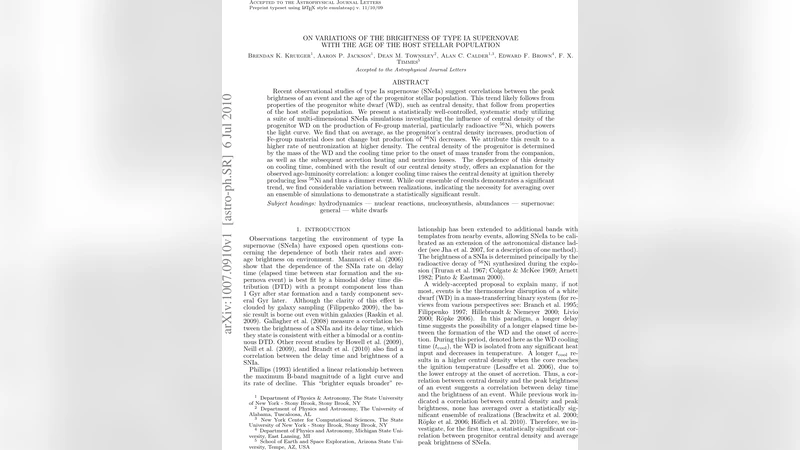
Recent observational studies of type Ia supernovae (SNeIa) suggest correlations between the peak brightness of an event and the age of the progenitor stellar population. This trend likely follows from properties of the progenitor white dwarf (WD), such as central density, that follow from properties of the host stellar population. We present a statistically well-controlled, systematic study utilizing a suite of multi-dimensional SNeIa simulations investigating the influence of central density of the progenitor WD on the production of Fe-group material, particularly radioactive Ni-56, which powers the light curve. We find that on average, as the progenitor’s central density increases, production of Fe-group material does not change but production of Ni-56 decreases. We attribute this result to a higher rate of neutronization at higher density. The central density of the progenitor is determined by the mass of the WD and the cooling time prior to the onset of mass transfer from the companion, as well as the subsequent accretion heating and neutrino losses. The dependence of this density on cooling time, combined with the result of our central density study, offers an explanation for the observed age-luminosity correlation: a longer cooling time raises the central density at ignition thereby producing less Ni-56 and thus a dimmer event. While our ensemble of results demonstrates a significant trend, we find considerable variation between realizations, indicating the necessity for averaging over an ensemble of simulations to demonstrate a statistically significant result.
💡 Research Summary
This paper addresses the long‑standing observational correlation between the peak luminosity of Type Ia supernovae (SNe Ia) and the age of their host stellar populations. The authors propose that the underlying physical driver is the central density (ρc) of the exploding white dwarf (WD), which itself is set by the WD’s mass and the cooling time it experiences before mass transfer begins. To test this hypothesis, they performed a statistically robust suite of multi‑dimensional (2‑D and 3‑D) hydrodynamic simulations of Chandrasekhar‑mass carbon‑oxygen WDs, systematically varying only the central density while keeping composition, accretion rate, and ignition conditions fixed.
The key findings can be summarized as follows:
-
Fe‑group mass is insensitive to ρc. Across the entire range of central densities explored (≈1–5 × 10⁹ g cm⁻³), the total mass of iron‑group elements (including stable isotopes such as ⁵⁶Fe and ⁵⁸Ni) produced in the explosion remains essentially constant. This indicates that the overall energetics of the thermonuclear runaway are not strongly dependent on the initial density of the core.
-
⁵⁶Ni yield declines with increasing ρc. The amount of radioactive ⁵⁶Ni, which decays to ⁵⁶Co and then to ⁵⁶Fe and powers the optical light curve, drops systematically as ρc rises. The authors attribute this to enhanced neutronization at higher densities: electron captures and β‑decays become more frequent, shifting the nuclear statistical equilibrium toward neutron‑rich isotopes and away from ⁵⁶Ni. Consequently, higher‑density progenitors produce dimmer supernovae.
-
Physical link to host age. The central density of a WD is a function of two astrophysical parameters: (a) the WD’s mass, which determines the gravitational compression, and (b) the cooling time (τcool) prior to the onset of Roche‑lobe overflow. Longer cooling times allow the core to become more degenerate and raise ρc at ignition. Since older stellar populations tend to host WDs that have cooled for longer periods, the model naturally explains the observed trend that SNe Ia in older (redder, more metal‑rich) galaxies are on average fainter.
-
Statistical variability. Although the ensemble average shows a clear ρc‑dependent trend, individual realizations exhibit substantial scatter. Variations in the initial convective pattern, small differences in accretion heating, and stochastic aspects of the flame propagation lead to ±10 % fluctuations in the ⁵⁶Ni yield for a given ρc. This underscores the necessity of averaging over many simulations to achieve statistically significant conclusions.
-
Implications for cosmology. The result provides a physically motivated correction term for the standardization of SNe Ia as distance indicators. By estimating the host galaxy’s stellar age, one can infer the likely cooling time of the progenitor WD, adjust the expected ⁵⁶Ni mass, and thus reduce systematic uncertainties in the derived luminosity distances.
The paper concludes with a roadmap for future work: incorporating uncertainties in nuclear reaction rates (especially electron‑capture cross sections), extending the parameter space to include sub‑Chandrasekhar mass explosions and different metallicities, and directly comparing simulated light curves and spectra with high‑quality observational datasets. Such efforts will refine the age‑luminosity relation and improve the precision of cosmological measurements that rely on SNe Ia.
Comments & Academic Discussion
Loading comments...
Leave a Comment