Weak solution of the Hele-Shaw problem: shocks and viscous fingering
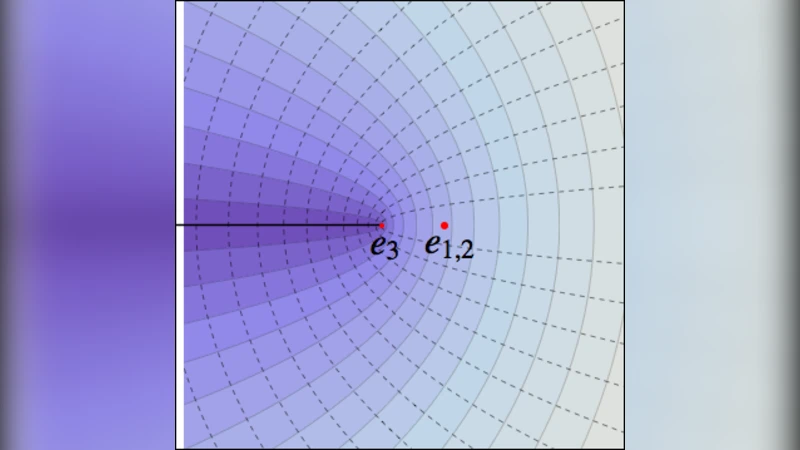
In Hele-Shaw flows, boundaries between fluids develop unstable viscous fingers. At vanishing surface tension, the fingers further evolve to cusp-like singularities. We show that the problem admits a {\it weak solution} where shock fronts triggered by a singularity propagate together with a fluid. Shocks form a growing, branching tree of a mass deficit, and a line distribution of vorticity where pressure and velocity of the fluid have finite discontinuities. Imposing that the flow remain curl-free at macroscale determines the shock graph structure. We present a self-similar solution describing shocks emerging from a generic (2,3)-cusp singularity – an elementary branching event.
💡 Research Summary
The paper revisits the classical Hele‑Shaw problem, which describes the motion of two viscous fluids confined between two closely spaced plates. In the limit of vanishing surface tension the fluid interface becomes linearly unstable, developing viscous fingers that sharpen into cusp‑like singularities in finite time. Traditional formulations, which assume a strong (classical) solution, break down at these singularities because the pressure field and the velocity become unbounded. The authors propose a fundamentally different approach: they construct a weak solution in which the singularity is regularized by the emergence of shock fronts that propagate together with the fluid.
The key idea is that when a cusp forms, a thin region of mass deficit is created along the interface. This deficit is interpreted as a line‑like shock that carries the missing mass while moving outward. Across the shock line the pressure and velocity experience finite jumps, yet the fluid remains incompressible and the macroscopic flow stays curl‑free. The curl‑free condition, imposed on scales larger than the shock thickness, uniquely determines the geometry of the shock network (the “shock graph”). In effect, the shock graph is a branching tree of line singularities that transports both mass deficit and a line distribution of vorticity.
Mathematically the authors start from the Laplace equation for the pressure together with Darcy’s law for the velocity. They introduce a new field representing the line mass deficit and enforce the jump conditions on pressure and velocity across the shock. By employing complex‑analysis techniques (conformal mapping, Riemann‑Hilbert problems) they derive a set of self‑consistent equations for the shock positions. The curl‑free constraint translates into a holomorphic condition for the complex potential, which fixes the angles at which shocks branch.
A central example is the generic (2,3)‑cusp, which in complex coordinates behaves like (z\sim t^{2/3}). Near this singularity the authors obtain an explicit self‑similar solution. The shock front splits into two branches that separate with a characteristic scaling (t^{1/3}). Using the Riemann‑Hilbert formulation they compute the exact shock trajectories, the magnitude of the pressure jump, and the associated line vorticity. The solution shows that the pressure remains continuous across the shock while its gradient (hence the velocity) jumps, and that the total flow still satisfies Laplace’s equation everywhere except on the shock line itself.
The paper also discusses how this weak‑solution framework could be validated experimentally. High‑resolution imaging of Hele‑Shaw cells, combined with laser‑induced fluorescence or particle‑image velocimetry, can capture the pressure and velocity discontinuities and the branching shock pattern. The predicted “shock tree” differs qualitatively from the usual viscous‑fingering morphology, offering a clear signature of the weak solution. Moreover, the authors argue that the same mathematical structure should appear in other systems where a Laplacian growth process encounters a singularity, such as dendritic solidification, electrodeposition, or fluid invasion in porous media.
In summary, the authors demonstrate that the Hele‑Shaw problem admits a well‑posed weak solution in which cusp singularities are replaced by propagating shock fronts. The shocks form a branching network that conserves mass and vorticity while preserving the curl‑free nature of the macroscopic flow. The explicit self‑similar solution for a (2,3)‑cusp provides a concrete example of a branching event, and the analysis opens a new avenue for understanding and controlling pattern formation in Laplacian growth phenomena.
Comments & Academic Discussion
Loading comments...
Leave a Comment