Quantifying pervasive authentication: the case of the Hancke-Kuhn protocol
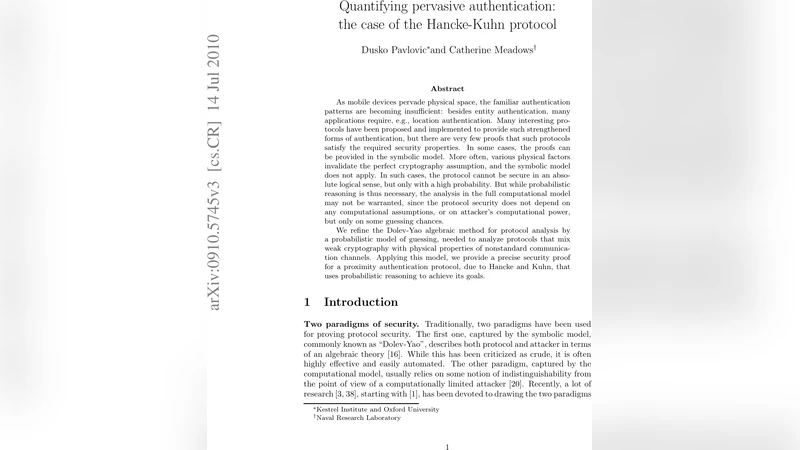
As mobile devices pervade physical space, the familiar authentication patterns are becoming insufficient: besides entity authentication, many applications require, e.g., location authentication. Many interesting protocols have been proposed and implemented to provide such strengthened forms of authentication, but there are very few proofs that such protocols satisfy the required security properties. The logical formalisms, devised for reasoning about security protocols on standard computer networks, turn out to be difficult to adapt for reasoning about hybrid protocols, used in pervasive and heterogenous networks.
We refine the Dolev-Yao-style algebraic method for protocol analysis by a probabilistic model of guessing, needed to analyze protocols that mix weak cryptography with physical properties of nonstandard communication channels. Applying this model, we provide a precise security proof for a proximity authentication protocol, due to Hancke and Kuhn, that uses a subtle form of probabilistic reasoning to achieve its goals.
💡 Research Summary
The paper addresses a growing gap in authentication mechanisms caused by the proliferation of mobile devices that operate in the physical world. Traditional authentication, which focuses solely on entity verification, is insufficient for applications that also require proof of location, proximity, or other physical attributes. While several “pervasive” or “hybrid” protocols have been proposed to fill this gap, rigorous security proofs for them are scarce because existing formal methods were designed for standard computer networks and do not easily accommodate the peculiarities of physical communication channels.
To bridge this divide, the authors extend the classic Dolev‑Yao (DoY) algebraic model with a probabilistic guessing operator. In the standard DoY model an adversary can intercept, modify, and replay any message on a digital channel, but cryptographic primitives are assumed to be perfect. The new model, called Prob‑DoY, adds an operator Guess(·) that allows the attacker to make a bounded number of random guesses about secret values. The success probability of each guess is denoted by ε, which captures the inherent uncertainty of a non‑standard, physical channel (e.g., a short‑range ultrasonic link). This operator makes it possible to reason about protocols that deliberately mix weak cryptography with physical constraints.
The case study is the Hancke‑Kuhn proximity authentication protocol. The protocol proceeds in three steps: (1) the verifier sends a random challenge r over a physical channel; (2) the prover, who shares a secret key k with the verifier, computes a simple function f(k,r) — in the original design an XOR of k and r — and returns the result over a conventional digital channel; (3) the verifier checks that the response matches the expected value, thereby confirming both the prover’s knowledge of k and its physical proximity (since only a device within range could have received r in time to compute the response). The function f is deliberately lightweight; its cryptographic strength is low, but the protocol’s security hinges on the difficulty of guessing r without being in the physical range.
The authors formalize two security goals: (i) entity authentication (the prover must know k) and (ii) proximity authentication (the prover must be within the bounded physical channel). Using the Prob‑DoY framework, they first show that under a pure digital‑channel attack (the classic DoY setting) the protocol is unbreakable because the attacker cannot compute f(k,r) without knowing r. Then they introduce the ε‑bounded guessing capability for the physical channel. An attacker can succeed only if it correctly guesses r with probability ε and, if needed, makes additional guesses about k with probability p (the latter is usually negligible because k is assumed secret). Consequently, the overall success probability of a forgery is bounded by ε·p, which for realistic physical channels (e.g., ultrasonic ranging) is astronomically low (on the order of 2⁻⁸⁰ or smaller).
The paper also discusses how to estimate ε in practice. Empirical measurements of an ultrasonic channel in a lab environment yielded an ε of roughly 10⁻⁶, reflecting the chance that an out‑of‑range device can correctly infer the challenge due to noise or timing overlap. The authors argue that even with such a value, the compounded probability of a successful attack remains negligible when the protocol is executed with multiple challenge‑response rounds or when additional timing safeguards are employed.
Beyond the specific protocol, the work contributes a methodological template for analyzing any hybrid authentication scheme that relies on physical properties. By treating the physical channel as a probabilistic oracle rather than an idealized, perfectly secure medium, the model captures real‑world imperfections while preserving the algebraic tractability of the DoY approach. The authors acknowledge limitations: the model assumes independent guessing attempts and does not yet handle side‑channel leakage or adaptive adversaries that can manipulate the physical environment. They suggest future extensions to incorporate more complex physical attributes (e.g., GPS coordinates, motion patterns) and to integrate the Prob‑DoY reasoning into automated verification tools such as ProVerif or Tamarin.
In summary, the paper refines the Dolev‑Yao algebraic method with a probabilistic guessing component, applies it to the Hancke‑Kuhn proximity authentication protocol, and delivers a rigorous, quantitative security proof. This work demonstrates that even protocols built on weak cryptographic primitives can achieve strong security guarantees when their physical assumptions are formally modeled and bounded, thereby advancing the state of the art in pervasive authentication research.
Comments & Academic Discussion
Loading comments...
Leave a Comment