Comparing the statistics of interstellar turbulence in simulations and observations: Solenoidal versus compressive turbulence forcing
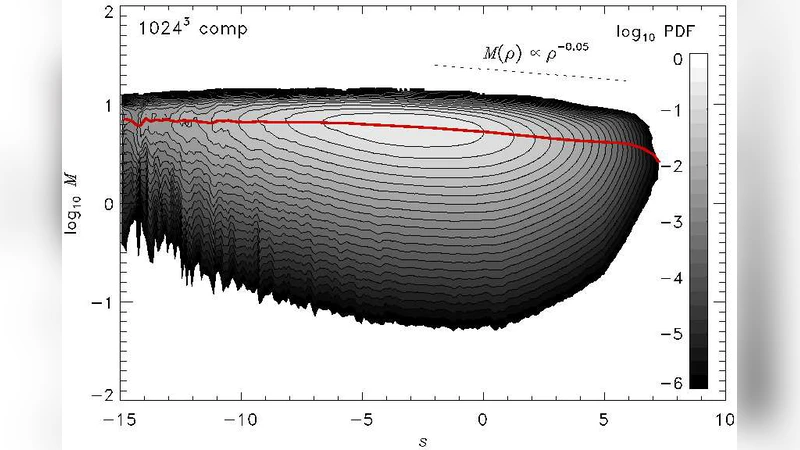
We study two limiting cases of turbulence forcing in numerical experiments: solenoidal (divergence-free) forcing, and compressive (curl-free) forcing, and compare our results to observations reported in the literature. We solve the equations of hydrodynamics on grids with up to 1024^3 cells for purely solenoidal and purely compressive forcing. Eleven lower-resolution models with mixtures of both forcings are also analysed. We find velocity dispersion–size relations consistent with observations and independent numerical simulations, irrespective of the type of forcing. However, compressive forcing yields stronger turbulent compression at the same RMS Mach number than solenoidal forcing, resulting in a three times larger standard deviation of volumetric and column density probability distributions (PDFs). We conclude that the strong dependence of the density PDF on the type of forcing must be taken into account in any theory using the PDF to predict properties of star formation. We supply a quantitative description of this dependence. We find that different observed regions show evidence of different mixtures of compressive and solenoidal forcing, with more compressive forcing occurring primarily in swept-up shells.
💡 Research Summary
The paper investigates how the nature of turbulent forcing—whether solenoidal (divergence‑free) or compressive (curl‑free)—affects the statistical properties of interstellar turbulence and, by extension, theories of star formation that rely on those statistics. Using three‑dimensional hydrodynamic simulations on uniform Cartesian grids up to a resolution of 1024³ cells, the authors drive turbulence in two limiting cases: purely solenoidal forcing, which injects only rotational motions, and purely compressive forcing, which injects only divergent motions. In addition, eleven intermediate models with mixed forcing ratios are simulated to explore a continuum of possible astrophysical conditions. All runs are isothermal, non‑magnetic, and maintain the same root‑mean‑square (RMS) Mach number (𝓜≈5–10) by adjusting the forcing amplitude, ensuring that differences arise solely from the forcing geometry rather than from variations in overall turbulent energy.
The first major result concerns the velocity‑size (σ_v–L) relation. Both solenoidal and compressive runs reproduce a power‑law scaling σ_v∝L^0.5, consistent with the classic Larson relation observed in molecular clouds. This indicates that the cascade of kinetic energy across scales is largely insensitive to the solenoidal‑compressive mix, at least for the isothermal, non‑magnetic regime examined.
The second, more consequential result concerns the probability density function (PDF) of gas density. The authors confirm that the density PDF is approximately log‑normal, but its width, quantified by the standard deviation σ_s of s=ln(ρ/ρ₀), depends strongly on the forcing type. For a fixed Mach number, compressive forcing yields σ_s roughly three times larger than solenoidal forcing (σ_s≈2.7 versus σ_s≈0.9). Consequently, the column‑density PDFs derived from synthetic observations also show significantly broader wings under compressive driving, implying a higher fraction of gas at both very low and very high densities.
To capture this dependence quantitatively, the paper adopts the “b‑parameter” formulation, σ_ρ/ρ₀ = b 𝓜, where b encapsulates the influence of forcing geometry. The simulations find b≈1/3 for pure solenoidal forcing, b≈1 for pure compressive forcing, and intermediate values scaling smoothly with the solenoidal‑compressive mixture. This relationship refines earlier analytic estimates and provides a practical tool for translating observed PDF widths into constraints on the underlying turbulent driving.
The authors then compare their simulation‑derived PDFs with observational PDFs from several well‑studied regions (e.g., Orion A, the Perseus cloud, and various H II region shells). By fitting the observed PDFs with log‑normal functions and extracting σ_s, they infer the effective b‑values for each region. Quiescent molecular clouds tend to exhibit b≈0.4–0.5, indicating a dominance of solenoidal motions, whereas regions dominated by expanding shells, supernova remnants, or strong stellar feedback show b≈0.7–0.9, consistent with a substantial compressive component. This observational validation supports the notion that the turbulent forcing mixture varies across the interstellar medium and is linked to the local energy injection mechanisms.
The paper concludes with a discussion of the implications for star‑formation theories that rely on the density PDF. Since the high‑density tail of the PDF determines the fraction of gas that can collapse into prestellar cores, an inaccurate assumption about b can lead to substantial errors in predicted core mass functions, star‑formation efficiencies, and overall star‑formation rates. The authors argue that any analytic or semi‑analytic model that uses a log‑normal PDF must incorporate the forcing‑dependent b‑parameter, or else risk misrepresenting the impact of turbulence on star formation.
In summary, the study demonstrates that while the velocity scaling of interstellar turbulence is robust against the solenoidal‑compressive mix, the density statistics are highly sensitive to it. By providing a calibrated relationship between the forcing mixture and the PDF width, the work offers a concrete bridge between numerical experiments, observational diagnostics, and theoretical models of star formation, emphasizing that the nature of turbulent driving must be accounted for when interpreting interstellar cloud structure and its role in the birth of stars.
Comments & Academic Discussion
Loading comments...
Leave a Comment