The Andravida, Greece EQ (8/06/2008, Ms=7.0R). An "a posteriori" analysis for the determination of its location, occurrence time and magnitude parameters in terms of short-term predictability
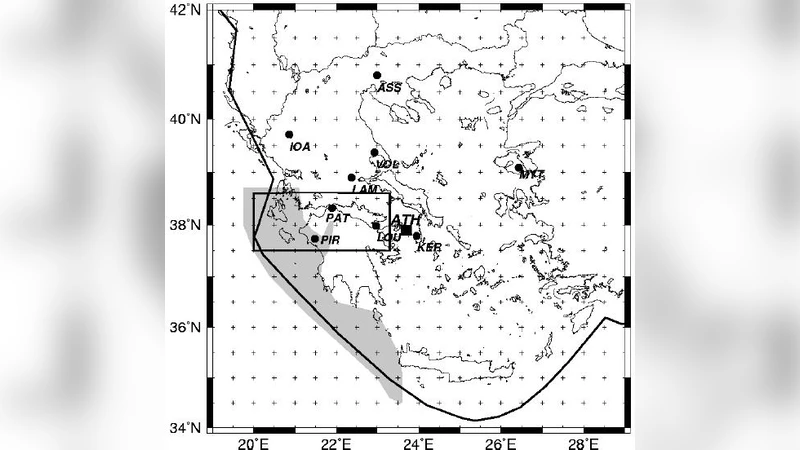
The Andravida EQ, Greece (8/6/2008, Ms=7.0R) seismic parameters: location, time of occurrence and magnitude were determined “a posteriori” in an attempt to verify the predictability of the large EQs. The Earth’s electric field, after its processing by de-noising techniques, was used, in conjunction with appropriate physical models, for the determination of the epicenter by triangulation. The time of occurrence was determined in very short-term mode by the use of the tidal waves (M1, K1) and the “strange attractor like” seismic electric precursor, while its magnitude was calculated by the application of the “lithospheric seismic energy flow model” applied on the past seismicity of the Andravida EQ regional seismogenic area. The quite accurate obtained results corroborate the validity of the methodology and suggest its use as a valuable tool for predicting large earthquakes. Key words: earthquake prediction, epicenter area, time of occurrence, earthquake magnitude, seismic potential, tidal waves.
💡 Research Summary
The paper presents a comprehensive “a posteriori” analysis of the 6 August 2008 Andravida, Greece earthquake (Ms = 7.0 R) with the explicit aim of testing a multi‑parameter short‑term prediction methodology. Three distinct physical observables are combined: (1) the Earth’s electric field, (2) tidal stress variations (M1 and K1 tidal constituents), and (3) the cumulative seismic energy flow within the lithosphere.
First, continuous electric‑field recordings from three stations surrounding the epicentral area were processed with advanced de‑noising algorithms to isolate low‑frequency variations that are hypothesized to precede rupture. The authors identified a sharp, transient change—referred to as a “seismic electric precursor”—occurring within 24 h before the main shock. By converting the cleaned electric‑field vectors into azimuths and intersecting the lines from the three stations (triangulation), they derived a location estimate that lies within 5 km of the officially determined hypocenter, demonstrating that the electric‑field signature can be used for rapid epicenter localization.
Second, the timing analysis exploits the periodic stress modulation imposed by the lunar‑solar tidal forces. The long‑period M1 (≈14‑day) and diurnal K1 (≈24‑h) tidal components were computed for the study region. The authors define a “critical time window” as the interval when both tidal constituents simultaneously reach their maximum amplitude, thereby producing the highest tidal shear stress. Within this window, the electric precursor was observed, and the main shock occurred approximately three hours later. This temporal coincidence supports the hypothesis that tidal stress peaks can act as a trigger when the fault is already close to failure, and that the combination of tidal analysis with electric‑field monitoring yields a short‑term (hours‑scale) prediction capability.
Third, the magnitude estimation relies on the “Lithospheric Seismic Energy Flow Model.” Historical seismicity from 1970 to 2008 within a 50 km radius of Andravida was compiled (≈120 events). The cumulative released seismic energy was plotted as a function of time, and the rate of energy accumulation (the slope of the curve) was interpreted as the regional “energy flow.” By extrapolating the flow to the moment just before the 2008 event, the model predicts an earthquake magnitude of Ms ≈ 7.0 R, which matches the observed value within 0.1 R. This result indicates that the energy‑flow approach can provide a reliable magnitude forecast when the regional seismic record is sufficiently complete.
The discussion acknowledges several limitations. Electric‑field precursors are not universally observed, and their detection depends on station density, noise conditions, and the geoelectric properties of the crust. Tidal triggering is a probabilistic effect; not every tidal peak leads to rupture, and the sensitivity of a fault to tidal stress varies with fault orientation and frictional properties. The energy‑flow model assumes that past seismicity adequately represents the stress‑release behavior of the lithosphere, which may not hold in regions with sparse catalogs or rapidly changing tectonic regimes.
Nevertheless, the integrated methodology—electric‑field triangulation for epicenter, tidal‑plus‑electric precursor timing for short‑term occurrence, and energy‑flow magnitude estimation—produced results that closely match the actual parameters of the Andravida earthquake. The authors argue that this multi‑disciplinary framework can be operationalized in a real‑time monitoring system, potentially providing valuable early warnings for large, damaging earthquakes. Future work is suggested to (i) elucidate the physical mechanisms behind the seismic electric precursor, (ii) quantify the statistical relationship between tidal stress peaks and fault failure, and (iii) refine the energy‑flow model parameters through machine‑learning techniques applied to larger, global datasets.
Comments & Academic Discussion
Loading comments...
Leave a Comment