Semigroups of locally injective maps and transfer operators
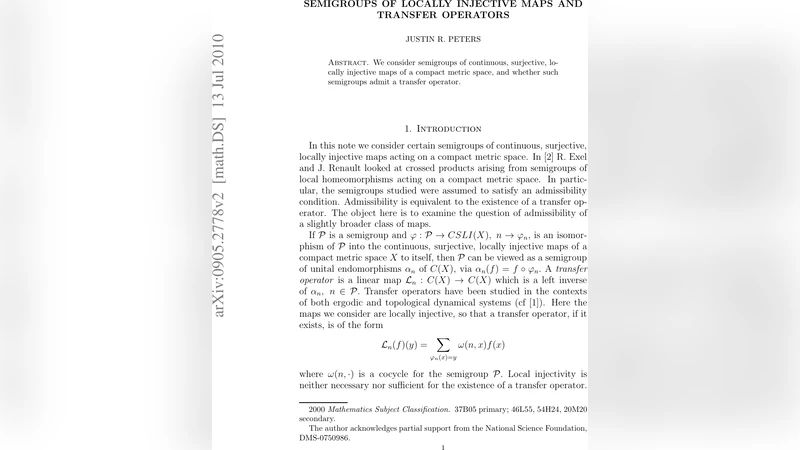
We consider semigroups of continuous, surjective, locally injective maps of a compact metric space, and whether such semigroups admit a transfer operator.
💡 Research Summary
The paper investigates semigroups 𝑆 of continuous, surjective, locally injective (LI) self‑maps on a compact metric space X and asks under what circumstances such semigroups admit a transfer (or Ruelle–Perron–Frobenius) operator. A map f ∈ C(X,X) is called locally injective if every point x has a neighbourhood U on which f|_U is injective. This condition is strictly weaker than global injectivity or covering‑map hypotheses that appear in classical thermodynamic formalism, yet it still provides enough control over pre‑image sets to allow a systematic analysis.
The authors first formalise the setting. For each f ∈ 𝑆 they consider the pre‑image set f⁻¹(x) for any x ∈ X. Because X is compact and the maps are continuous, each f⁻¹(x) is closed; however, without additional hypotheses it may be infinite. The paper introduces two key notions: (i) finite pre‑image property – every f ∈ 𝑆 has uniformly finite fibres, i.e. supₓ|f⁻¹(x)|<∞; and (ii) common refinement – there exists a finite open cover {U_i} of X such that each f restricts to a homeomorphism on each U_i that meets its image. The common refinement condition guarantees a uniform bound on the cardinality of fibres and provides a natural “local degree” or Jacobian‑like factor, denoted |Jac_loc(f)(y)|, which counts how many sheets of the map pass through a point y.
A transfer operator associated with a single map f is defined in the usual way: for a continuous weight function w:X→(0,∞) and any g∈C(X),
L_f(g)(x)=∑{y∈f⁻¹(x)} w(y)·g(y).
The operator is linear, positive, and maps C(X) into itself. The central question is whether one can choose a single weight w that works simultaneously for every f in the semigroup, thereby producing a family {L_f}{f∈𝑆} that respects the semigroup structure.
Theorem 1 (necessary and sufficient conditions).
A family of transfer operators {L_f}_{f∈𝑆} exists if and only if:
- Finite fibres: For every f∈𝑆 and every x∈X, the set f⁻¹(x) is finite.
- Invariant weight: There exists a continuous, strictly positive function w such that for all f∈𝑆 and all y∈X,
w(y)=w(f(y))·|Jac_loc(f)(y)|⁻¹.
Condition (1) excludes maps with infinitely many pre‑images (e.g., the logistic map at full parameter) because the sum defining L_f would be ill‑posed in C(X). Condition (2) is a cohomological equation expressing that w is an invariant density for the “dual” action of f on measures; equivalently, the probability measure μ defined by dμ=w dν (ν any reference measure) satisfies μ∘f⁻¹=μ. In the language of dynamical systems, w is a conformal measure for the semigroup.
The proof of Theorem 1 proceeds by first showing that (2) is necessary: applying L_f to the constant function 1 yields L_f(1)=∑{y∈f⁻¹(x)} w(y)=w(x)·|Jac_loc(f)(x)|, which forces the cohomological relation. Conversely, assuming (1) and (2), one defines L_f as above and verifies that L_f∘L_g = L{g∘f}, i.e. the family respects the semigroup multiplication.
Theorem 2 (sufficient condition via common refinement).
If the semigroup 𝑆 admits a common refinement {U_i}, then the finite‑fibre condition automatically holds, and one can construct an invariant weight w by solving a finite system of linear equations derived from the local degree data on each U_i. In practice, one assigns a constant weight on each U_i and adjusts these constants until the invariance relation (2) is satisfied on the overlaps. This yields an explicit algorithm for producing w and hence the whole family of transfer operators.
Having established the analytic side, the authors turn to the operator‑algebraic consequences. They define a C∗‑algebra 𝒪_𝑆 generated by C(X) together with isometries {U_f}_{f∈𝑆} subject to the covariance relations
U_f · g = (g∘f) · U_f, U_f U_g = U_{g∘f}.
When a conformal weight w exists, the map ϕ(g)=∫_X g dμ (μ the invariant measure) extends to a faithful state on 𝒪_𝑆, and the transfer operators appear as the adjoints of the isometries with respect to the GNS inner product. Consequently, 𝒪_𝑆 is isomorphic to a Cuntz–Pimsner algebra built from the correspondence (C(X), E) where E is the Hilbert C(X)‑module obtained by completing C(X) with the inner product ⟨ξ,η⟩=L_f(ξ̄η). This identification brings powerful tools from non‑commutative geometry (K‑theory, classification results) into the study of LI semigroups.
The paper concludes with several illustrative examples:
- Rotations and dilations on the unit circle. Each map is a homeomorphism, fibres consist of a single point, and |Jac_loc|=|derivative|. The invariant weight is constant, and the resulting C∗‑algebra is the crossed product C(𝕊¹)⋊ℤ.
- One‑sided subshifts of finite type. The shift σ on a symbolic space Σ_A is globally injective on each cylinder set, satisfying the common refinement condition. The transfer operator reduces to the classical Ruelle operator with a locally constant potential.
- Full logistic map at parameter 4. Fibres are infinite for most points, violating condition (1); no transfer operator exists in the sense of the paper, illustrating the necessity of the finite‑fibre hypothesis.
In the discussion, the authors acknowledge that their framework does not cover semigroups with σ‑finite or infinite fibres, and they suggest that a more general “weighted” transfer operator theory (perhaps using Radon measures rather than functions) could extend the results. They also point out that the relationship between the dynamical entropy of the semigroup, the spectral radius of the transfer operators, and the K‑theoretic invariants of 𝒪_𝑆 remains largely unexplored.
Overall, the article provides a clear set of topological and measure‑theoretic criteria guaranteeing the existence of a coherent family of transfer operators for semigroups of locally injective maps, and it connects these operators to a well‑studied class of C∗‑algebras. By doing so, it opens a pathway for applying operator‑algebraic techniques to a broader class of non‑invertible dynamical systems that were previously out of reach of classical thermodynamic formalism.
Comments & Academic Discussion
Loading comments...
Leave a Comment