Independent Component Analysis Over Galois Fields
We consider the framework of Independent Component Analysis (ICA) for the case where the independent sources and their linear mixtures all reside in a Galois field of prime order P. Similarities and d
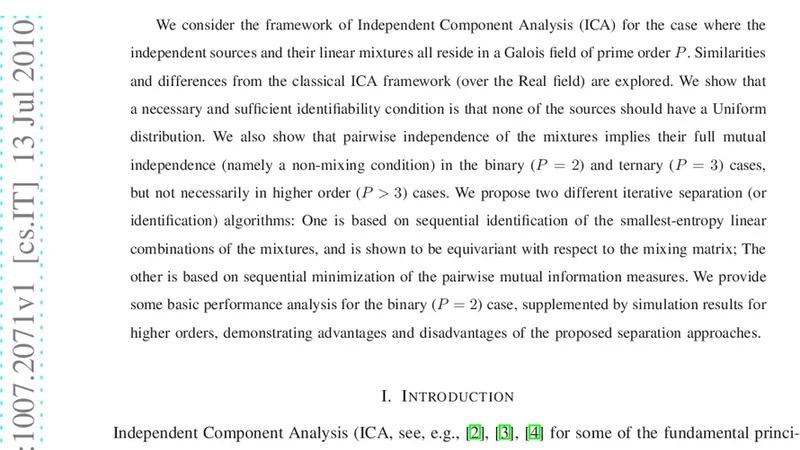
We consider the framework of Independent Component Analysis (ICA) for the case where the independent sources and their linear mixtures all reside in a Galois field of prime order P. Similarities and differences from the classical ICA framework (over the Real field) are explored. We show that a necessary and sufficient identifiability condition is that none of the sources should have a Uniform distribution. We also show that pairwise independence of the mixtures implies their full mutual independence (namely a non-mixing condition) in the binary (P=2) and ternary (P=3) cases, but not necessarily in higher order (P>3) cases. We propose two different iterative separation (or identification) algorithms: One is based on sequential identification of the smallest-entropy linear combinations of the mixtures, and is shown to be equivariant with respect to the mixing matrix; The other is based on sequential minimization of the pairwise mutual information measures. We provide some basic performance analysis for the binary (P=2) case, supplemented by simulation results for higher orders, demonstrating advantages and disadvantages of the proposed separation approaches.
💡 Research Summary
The paper extends the classical Independent Component Analysis (ICA) framework to the setting where both the latent sources and their observed linear mixtures are defined over a Galois field GF(P) of prime order P. After introducing the necessary probabilistic notions (entropy, mutual information) on a finite alphabet {0,…,P‑1}, the authors derive a necessary and sufficient identifiability condition: the mixing matrix can be uniquely recovered if and only if none of the source variables follows a uniform distribution. Uniform sources have maximal entropy and therefore any linear combination of them is statistically indistinguishable from other combinations, making separation impossible. Consequently, the first step of any separation algorithm is to locate a linear combination of the mixtures with the smallest entropy, which must correspond to a non‑uniform source.
The paper then investigates the relationship between pairwise independence and full mutual independence of the mixtures. It proves that for binary (P=2) and ternary (P=3) fields, pairwise independence of the observed mixtures already implies that the mixtures are completely independent, i.e., the mixing matrix must be a permutation‑scaled identity (a non‑mixing situation). For higher‑order fields (P>3) this implication fails; pairwise independence does not guarantee full independence, and higher‑order statistical dependencies must be examined.
Two iterative separation algorithms are proposed. The first, “sequential identification of the smallest‑entropy linear combinations,” repeatedly searches among all linear forms of the remaining mixtures for the one with minimal entropy, extracts it as a source estimate, and removes its contribution. This method is shown to be equivariant with respect to the mixing matrix: its output does not depend on the order of processing or on arbitrary scaling of the mixtures. The second algorithm, “sequential minimization of pairwise mutual information,” selects at each iteration the pair of mixtures with the lowest mutual information, applies a suitable linear transformation to decorrelate them, and proceeds recursively. Because of the pairwise‑to‑full independence property, this approach is especially efficient for P=2 and P=3.
A theoretical performance analysis is carried out for the binary case, yielding closed‑form expressions for the probability of erroneous source identification as a function of source entropy and noise level. Extensive Monte‑Carlo simulations for P=5, 7, and larger primes illustrate the convergence speed, robustness to noise, and computational load of both algorithms. Results indicate that the entropy‑based method is more tolerant to observation noise and tends to converge to the true sources even when the initial guess is poor, whereas the mutual‑information‑based method converges rapidly when the sources are far from uniform but degrades sharply when the sources are nearly uniform or when the noise level is high.
The authors discuss practical implications for digital communications, error‑correcting codes, and cryptographic protocols that naturally operate over finite fields. In particular, the identifiability condition suggests that system designers should avoid uniform‑distribution sources or should pre‑process signals to introduce non‑uniformity before transmission. The paper thus opens a new research direction—ICA over Galois fields—by establishing fundamental identifiability limits, characterizing independence structures specific to finite fields, and providing concrete algorithms with performance guarantees.
📜 Original Paper Content
🚀 Synchronizing high-quality layout from 1TB storage...