Community Structure in Time-Dependent, Multiscale, and Multiplex Networks
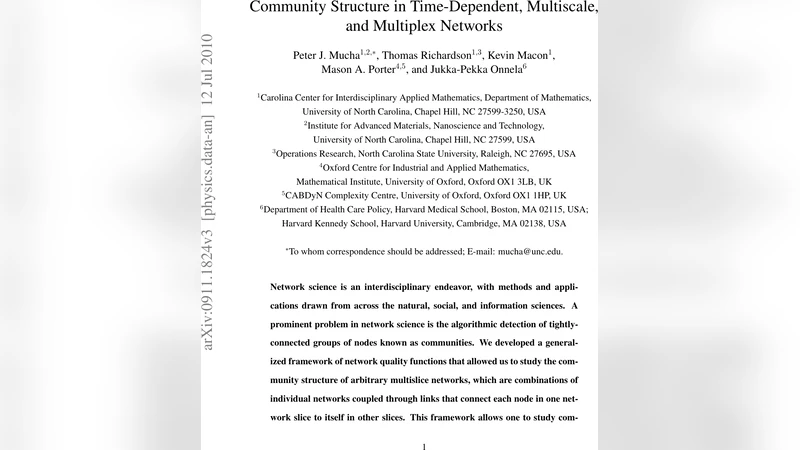
Network science is an interdisciplinary endeavor, with methods and applications drawn from across the natural, social, and information sciences. A prominent problem in network science is the algorithmic detection of tightly-connected groups of nodes known as communities. We developed a generalized framework of network quality functions that allowed us to study the community structure of arbitrary multislice networks, which are combinations of individual networks coupled through links that connect each node in one network slice to itself in other slices. This framework allows one to study community structure in a very general setting encompassing networks that evolve over time, have multiple types of links (multiplexity), and have multiple scales.
💡 Research Summary
The paper presents a unified methodological framework for detecting community structure in complex networks that evolve over time, operate at multiple scales, or consist of several types of relationships (multiplex networks). The authors introduce the concept of a “multislice” network, in which each slice represents an independent graph—such as a snapshot at a particular time, a network at a specific spatial resolution, or a layer corresponding to a particular type of edge (e.g., friendship vs. professional ties). Nodes are duplicated across slices, and each duplicate is linked to its counterparts in other slices by inter‑slice edges with a tunable weight ω. This construction preserves the identity of each physical entity while allowing the analyst to control how strongly the community assignments should be consistent across slices.
To evaluate community quality, the authors generalize the classic modularity function. For each slice s they introduce a resolution parameter γₛ that determines the preferred size and density of communities within that slice. The multislice modularity Q is then defined as the sum of two contributions: (1) the usual intra‑slice modularity term, weighted by γₛ, and (2) an inter‑slice coupling term that rewards identical community labels for the same node across different slices, weighted by ωₛᵣ. Formally,
Q = Σₛ Σᵢⱼ
Comments & Academic Discussion
Loading comments...
Leave a Comment