From the advent of the application of satellite imagery to land cover mapping, one of the growing areas of research interest has been in the area of image classification. Image classifiers are algorithms used to extract land cover information from satellite imagery. Most of the initial research has focussed on the development and application of algorithms to better existing and emerging classifiers. In this paper, a paradigm shift is proposed whereby a committee of classifiers is used to determine the final classification output. Two of the key components of an ensemble system are that there should be diversity among the classifiers and that there should be a mechanism through which the results are combined. In this paper, the members of the ensemble system include: Linear SVM, Gaussian SVM and Quadratic SVM. The final output was determined through a simple majority vote of the individual classifiers. From the results obtained it was observed that the final derived map generated by an ensemble system can potentially improve on the results derived from the individual classifiers making up the ensemble system. The ensemble system classification accuracy was, in this case, better than the linear and quadratic SVM result. It was however less than that of the RBF SVM. Areas for further research could focus on improving the diversity of the ensemble system used in this research.
Deep Dive into An svm multiclassifier approach to land cover mapping.
From the advent of the application of satellite imagery to land cover mapping, one of the growing areas of research interest has been in the area of image classification. Image classifiers are algorithms used to extract land cover information from satellite imagery. Most of the initial research has focussed on the development and application of algorithms to better existing and emerging classifiers. In this paper, a paradigm shift is proposed whereby a committee of classifiers is used to determine the final classification output. Two of the key components of an ensemble system are that there should be diversity among the classifiers and that there should be a mechanism through which the results are combined. In this paper, the members of the ensemble system include: Linear SVM, Gaussian SVM and Quadratic SVM. The final output was determined through a simple majority vote of the individual classifiers. From the results obtained it was observed that the final derived map generated by an
One of the means through which land cover classes can be extracted from satellite imagery is by the use of algorithms called image classifiers. Image classification may be categorized into supervised or unsupervised, parametric or nonparametric, contextual or noncontextual classification (Keuchela et al, 2003). This paper explores the use of nonparametric supervised classification algorithms called Support Vector Machines (SVMs). SVMs are nonparametric in the sense that they do not attempt to model the distribution of the training data, but try to separate the different classes by directly searching for adequate boundaries between them (Keuchel, 2003). This is unlike traditional classifiers such as maximum likelihood and minimum-distance-to-means classifiers which fall under the category of parametric classifiers. The interest in the exploration of new and emerging classifiers stems from the importance of land cover information to various disciplines such as forestry, precision agriculture, disaster management etc. How accurate a land cover map is derived has implications on how well the various application areas will be effected, be it at policy or operational level. Most of the current research in the area tends to focus on the application of new algorithms to land cover mapping with an emphasis on how they compare or if they are better than existing methods. In this paper a paradigm shift is proposed whereby instead of looking at which classifier is better than the traditional and/or emerging classifiers, there is an interest in how the classifiers can be considered collectively. The final land cover class assigned to a pixel is dependent on a vote between the 'committee' of classifiers. Hence the name -ensemble classifiers. This paper gives an overview on SVMs which are the subject of this paper. The paper then continues to highlight the issues pertaining to ensemble classification, the developed methodology and the results thereof.
Portland, Oregon ♦ April 28 -May 2, 2008
SVMs, like other nonparametric classifiers such as Artificial Neural Networks, boast a robustness that has spearheaded its application into many areas. Having started off as a Statistical Learning Theory (Vapnik, 1995), SVMs have continued to be used in machine vision fields such as character, handwriting digit and text recognition (Vapnik, 1995;Joachims, 1998). More recently, their application to land cover mapping has been vigorously explored (Huang et al, 2002;Mahesh andMather, 2003, Gidudu et al, 2007). Like other supervised classifiers, training data is a prerequisite to define the decision boundaries within the feature space, based upon which classification decision rules are made. For SVMs, this decision boundary is a linear discriminant placed midway between the classes of interest. Unfortunately, land cover classes when projected to the input space are rarely linearly separable. SVMs handle such datasets by nonlinearly projecting the training data in the input space to a feature space of higher (infinite) dimension by use of a kernel function. This results in the previously nonlinear datasets becoming linearly separable. Placing a linear discriminant in this high (infinite) dimension will be equivalent to placing a non linear discriminant in the previous input space. Some examples of functions (also called kernels) used to this effect include: polynomial, gaussian (more commonly referred to as radial basis functions) and sigmoid functions. Each function has parameters which have to be determined prior to classification and they are usually determined through a cross validation process. Operating in high dimension potentially renders the risk of overfitting in the input space possible. SVMs control this through the principle of Structural Risk Minimization (Vapnik, 1995). The empirical risk of misclassification is controlled by maximizing the margin between the training data and the decision boundary (Mashao, 2004). In practice this criterion is softened to the minimization of a cost factor involving both the complexity of the classifier and the degree to which marginal points are misclassified, and the tradeoff between these factors is managed through a margin of error parameter (usually designated C). Like the respective function parameters, this C parameter is tuned through cross-validation procedures (Mashao, 2004). Some of the classical literature relating to SVMs can be found in Vapnik (1995), Campbell (2000) and Christianini (2002).
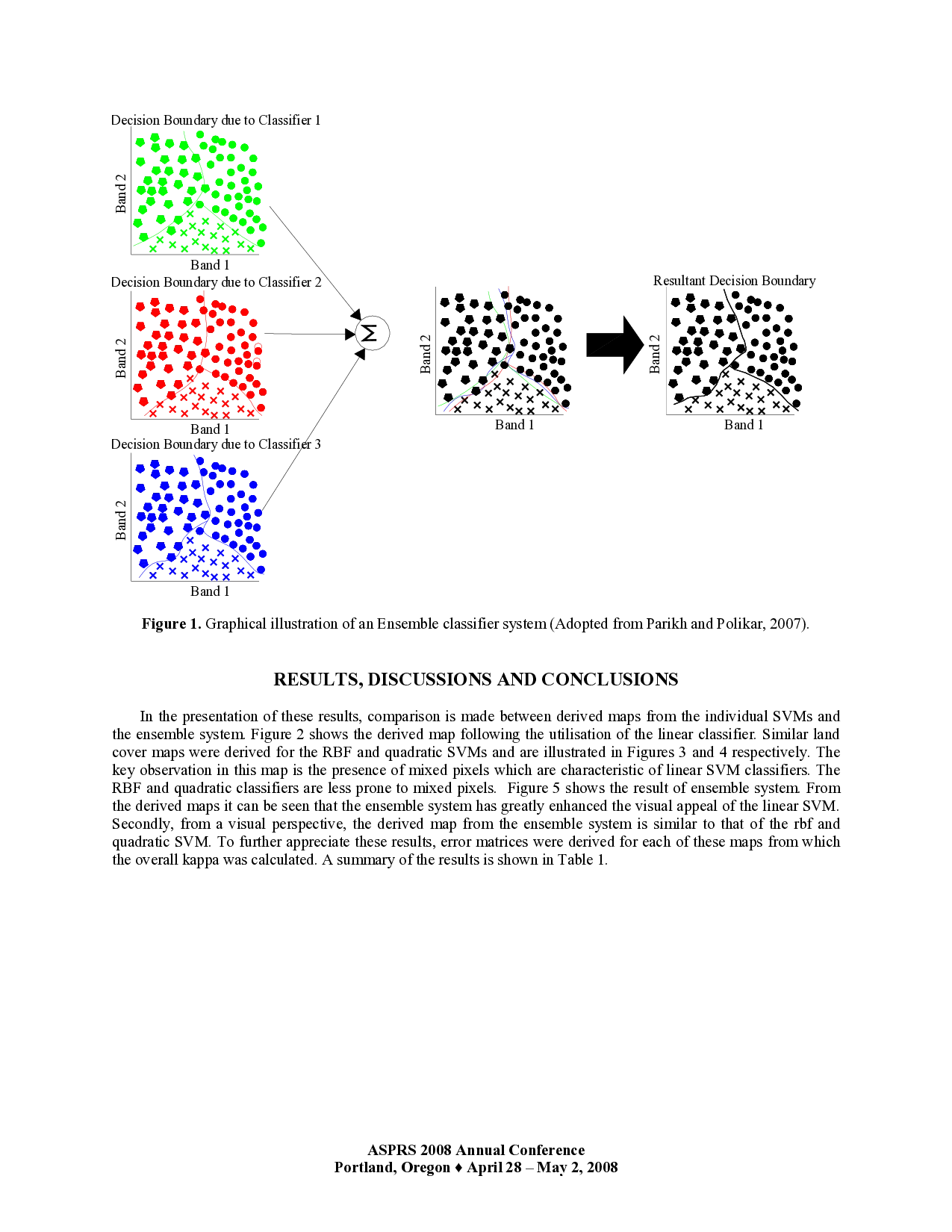
Ensemble systems come under different names such as multiple classifier systems, committee of classifiers or mixture of experts. The idea behind ensemble systems is to have the final classification result dependant on a pool of classifiers. Of importance to the generation of an ensemble system is that each individual classifier must be unique in how it generates decision boundaries (Polikar, 2006). The term used in ensemble systems is that there must be diversity in the ensemble system. T
…(Full text truncated)…
This content is AI-processed based on ArXiv data.