Twisting structures and strongly homotopy morphisms
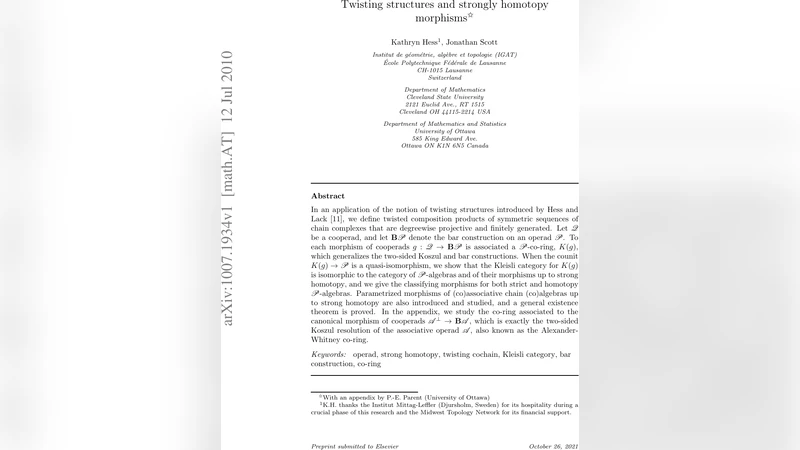
In an application of the notion of twisting structures introduced by Hess and Lack, we define twisted composition products of symmetric sequences of chain complexes that are degreewise projective and finitely generated. Let Q be a cooperad and let BP be the bar construction on the operad P. To each morphism of cooperads g from Q to BP is associated a P-co-ring, K(g), which generalizes the two-sided Koszul and bar constructions. When the co-unit from K(g) to P is a quasi-isomorphism, we show that the Kleisli category for K(g) is isomorphic to the category of P-algebras and of their morphisms up to strong homotopy, and we give the classifying morphisms for both strict and homotopy P-algebras. Parametrized morphisms of (co)associative chain (co)algebras up to strong homotopy are also introduced and studied, and a general existence theorem is proved. In the appendix, we study the particular case of the two-sided Koszul resolution of the associative operad.
💡 Research Summary
The paper builds on the notion of twisting structures introduced by Hess and Lack and applies it to symmetric sequences of chain complexes that are degreewise projective and finitely generated. The authors define a twisted composition product for such sequences, which serves as the foundation for constructing a P‑co‑ring K(g) associated to any cooperad morphism g : Q → BP, where Q is a cooperad and BP is the bar construction on an operad P. This construction simultaneously generalizes the classical two‑sided Koszul resolution and the bar construction, because when g is the Koszul twisting morphism the resulting co‑ring recovers the usual Koszul complex, while for a general g it yields a new homotopical object.
A central result is that if the counit ε : K(g) → P is a quasi‑isomorphism, then the Kleisli category of K(g) is equivalent to the category of P‑algebras together with their morphisms up to strong homotopy (often called ∞‑morphisms). In concrete terms, objects of the Kleisli category are ordinary P‑algebras, while a morphism from A to B is a K(g)‑module map A → K(g)⊗B, which encodes an infinite sequence of higher homotopies satisfying the appropriate coherence relations. This equivalence provides a clean categorical description of strong homotopy P‑algebras and clarifies how higher operations arise from the co‑ring structure.
The authors also construct explicit classifying morphisms for both strict and homotopy P‑algebras. For strict algebras the classifying map is essentially the unit of the co‑ring, whereas for homotopy algebras it involves the full co‑action of K(g) on the endomorphism operad of a given algebra, thereby encoding all higher multiplications mₙ (n ≥ 2). These constructions make it possible to pass back and forth between algebraic data (operations and relations) and categorical data (Kleisli morphisms).
Beyond operadic algebras, the paper introduces parametrized strong homotopy morphisms for (co)associative chain (co)algebras. By allowing an external chain complex M to act as a parameter, one obtains families of ∞‑morphisms that vary functorially with M. The authors prove a general existence theorem: whenever M is degreewise projective and finitely generated, there exists a parametrized strong homotopy morphism extending any given chain map, and this extension is unique up to homotopy. The proof relies on model‑category arguments and the projectivity assumptions to lift homotopies through the twisted composition product.
The appendix treats the concrete case of the associative operad Ass. Here Q is taken to be the co‑associative cooperad CoAss and g is the standard Koszul twisting morphism CoAss → BAss. The resulting co‑ring K(g) is computed explicitly and shown to coincide with the classical two‑sided Koszul resolution of Ass. This example illustrates how the general theory recovers known constructions and validates the abstract framework.
Overall, the paper provides a robust categorical machinery for handling strong homotopy algebraic structures. By interpreting ∞‑morphisms as Kleisli morphisms of a suitably twisted co‑ring, it unifies several classical resolutions, offers new parametrized homotopy constructions, and opens the way for further applications in homotopical algebra and higher category theory.
Comments & Academic Discussion
Loading comments...
Leave a Comment