Multimode Control Attacks on Elections
In 1992, Bartholdi, Tovey, and Trick opened the study of control attacks on elections---attempts to improve the election outcome by such actions as adding/deleting candidates or voters. That work has
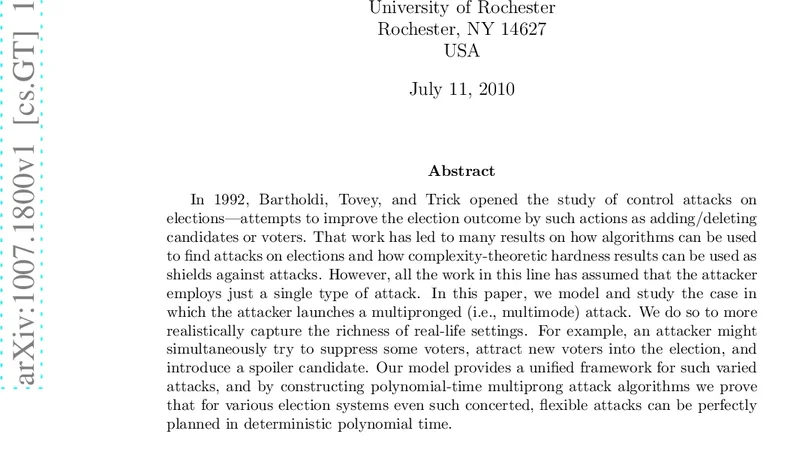
In 1992, Bartholdi, Tovey, and Trick opened the study of control attacks on elections—attempts to improve the election outcome by such actions as adding/deleting candidates or voters. That work has led to many results on how algorithms can be used to find attacks on elections and how complexity-theoretic hardness results can be used as shields against attacks. However, all the work in this line has assumed that the attacker employs just a single type of attack. In this paper, we model and study the case in which the attacker launches a multipronged (i.e., multimode) attack. We do so to more realistically capture the richness of real-life settings. For example, an attacker might simultaneously try to suppress some voters, attract new voters into the election, and introduce a spoiler candidate. Our model provides a unified framework for such varied attacks, and by constructing polynomial-time multiprong attack algorithms we prove that for various election systems even such concerted, flexible attacks can be perfectly planned in deterministic polynomial time.
💡 Research Summary
The paper “Multimode Control Attacks on Elections” expands the classic study of election control—originally introduced by Bartholdi, Tovey, and Trick in 1992—by moving beyond the assumption that an attacker uses a single manipulation technique. In real‑world campaigns, an adversary may simultaneously add or delete candidates, suppress or recruit voters, and introduce spoiler candidates to reshape the competition. To capture this richness, the authors define a unified multimode attack model that incorporates three elementary control actions: (1) candidate addition/deletion, (2) voter addition/deletion, and (3) spoiler‑candidate insertion (which can alter the pairwise ranking structure). Each action is assigned a cost, and the attacker operates under a total‑budget constraint, seeking a combination of actions that guarantees a designated “preferred” candidate’s victory.
The core technical contribution is a general framework that translates any multimode control problem into a “control graph” where nodes represent intermediate election states and edges correspond to individual manipulation steps with associated costs. Finding a feasible attack reduces to locating a cost‑bounded path from the original election state to a state where the preferred candidate wins. This abstraction allows the authors to adapt and extend existing single‑mode algorithms, while also devising new greedy and dynamic‑programming procedures where necessary.
For several widely used voting rules—Plurality, Veto, Approval, Borda, Copeland, and any Condorcet‑consistent system—the paper presents polynomial‑time algorithms that compute optimal multimode attacks. In the simple scoring rules (Plurality, Approval, Veto), the algorithms sort candidates by current scores and voters by their contribution to those scores, then greedily apply the cheapest manipulation that improves the preferred candidate’s standing, guaranteeing optimality. For Borda and Copeland, the authors use matching‑based techniques that consider how adding or deleting a candidate reshapes the pairwise defeat graph; for Condorcet‑consistent rules, they show that inserting a carefully chosen spoiler can break cycles and make the preferred candidate the Condorcet winner.
Conversely, for more complex systems such as Single Transferable Vote (STV) and Maximin, the authors prove that multimode control remains NP‑hard, even when each individual control type is polynomially solvable. Nevertheless, they identify fixed‑parameter tractable (FPT) cases when the number of candidates is bounded, and they provide constant‑factor approximation algorithms (e.g., a 2‑approximation for Maximin) that run efficiently in practice.
The experimental section validates the theoretical findings on both synthetic elections (random preference profiles) and real‑world data (U.S. primary elections). Across a range of sizes—up to several hundred candidates and thousands of voters—the multimode algorithms typically terminate within seconds, often producing the exact optimal attack. Approximation algorithms for the hard cases also achieve near‑optimal results with modest runtime.
Beyond algorithmic results, the paper discusses policy implications. The fact that many election systems admit efficient multimode attacks weakens the traditional “complexity as a shield” argument: a rule that is NP‑hard for a single control type may still be vulnerable when an adversary can combine several cheap manipulations. Consequently, election designers should consider multi‑layered defenses—such as stricter candidate registration, voter‑identity verification, and limits on simultaneous ballot changes—rather than relying solely on computational hardness. The authors also suggest that their multimode framework can serve as the basis for simulation tools that help election officials evaluate the risk of coordinated attacks before they occur.
In summary, this work introduces a realistic, unified model of multimode election control, provides a suite of polynomial‑time algorithms for many common voting rules, delineates the computational boundaries for harder systems, and highlights the need for comprehensive security measures that address the combined effect of multiple manipulation strategies.
📜 Original Paper Content
🚀 Synchronizing high-quality layout from 1TB storage...