Classification of equivariant vector bundles over two-torus
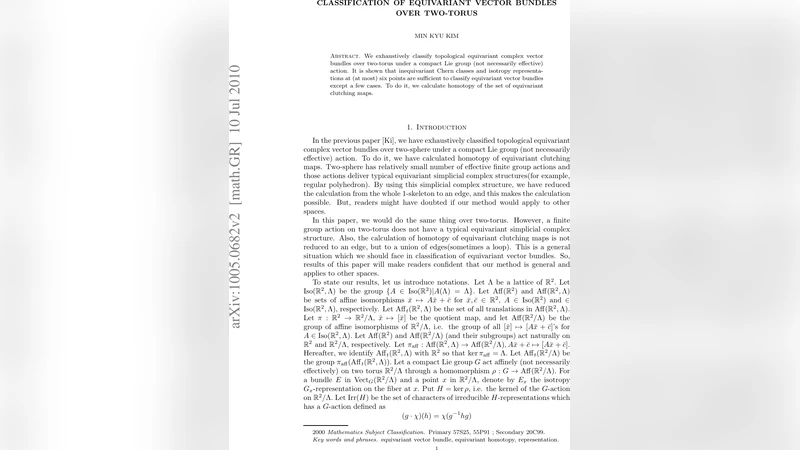
We exhaustively classify topological equivariant complex vector bundles over two-torus under a compact Lie group (not necessarily effective) action. It is shown that inequivariant Chern classes and isotropy representations at (at most) six points are sufficient to classify equivariant vector bundles except a few cases. To do it, we calculate homotopy of the set of equivariant clutching maps. And, classification on real projective plane, Klein bottle will appear soon
💡 Research Summary
This paper provides a complete topological classification of equivariant complex vector bundles over the two‑dimensional torus (T^{2}) under the action of an arbitrary compact Lie group (G) (the action need not be effective). The authors adopt an equivariant clutching construction: a vector bundle on (T^{2}) can be described by a (G)-equivariant map (\Phi\colon S^{1}\to GL_{n}(\mathbb{C})) that glues two trivial bundles over the two 2‑cells of a cellular decomposition of the torus. The central problem is to understand the homotopy classes of such equivariant clutching maps.
The main result is that, except for a few special situations, an equivariant bundle is uniquely determined by two pieces of data: (i) its equivariant first Chern class (c_{1}^{G}\in H^{2}{G}(T^{2};\mathbb{Z})) and (ii) the collection of isotropy representations at at most six distinguished points (typically the vertices and mid‑points of the 1‑cells). These points capture all possible stabilizer subgroups of the action, and the associated representations encode the local equivariant structure of the bundle. The authors prove that the homotopy set (\pi{0}\bigl(\operatorname{Map}{G}(S^{1},GL{n}(\mathbb{C}))\bigr)) is in bijection with the product of the integer lattice (coming from the ordinary Chern class) and a finite group determined by the isotropy data.
The proof proceeds in three stages. First, a detailed analysis of the (G)-equivariant cellular structure of (T^{2}) yields a description of the clutching maps in terms of their restrictions to the fixed‑point sets of the action. Second, the authors compute the relevant equivariant cohomology groups and the homotopy groups of the mapping space, using Mayer–Vietoris sequences and Borel equivariant cohomology. This calculation shows that the only possible obstruction beyond the Chern class and isotropy representations is a discrete invariant arising when the action is non‑effective and the fixed‑point subgroups have non‑trivial intersections. In those exceptional cases a supplementary invariant—called the “clutching topological invariant” (\theta)—must be recorded; together with (c_{1}^{G}) and the isotropy data it yields a full classification.
Concrete examples illustrate the theory. For cyclic groups (\mathbb{Z}{m}) acting by rotations, the classification reduces to the ordinary Chern class together with the weight of the representation at the unique fixed point. For a (\mathbb{Z}{2}) reflection symmetry the torus has four fixed points; if the four isotropy representations are identical the finite invariant (\theta) is trivial, and the bundle is classified solely by (c_{1}^{G}) and the common representation. When the representations differ, the finite invariant records the relative twisting between the fixed points.
The paper also outlines forthcoming work on the real projective plane (\mathbb{R}P^{2}) and the Klein bottle. These surfaces possess non‑abelian fundamental groups or more intricate fixed‑point sets, so the authors anticipate new phenomena and the need for refined techniques beyond those developed for the torus.
In summary, the authors achieve a concrete, computable classification of equivariant complex vector bundles on (T^{2}) by reducing the problem to elementary algebraic data: an equivariant Chern class, a finite list of isotropy representations, and, when necessary, a discrete clutching invariant. This bridges the gap between abstract equivariant (K)-theory and explicit geometric constructions, providing tools that are likely to be valuable in areas such as gauge theory on symmetric spaces, equivariant index theory, and the study of topological phases of matter where symmetry‑protected vector bundles play a central role.
Comments & Academic Discussion
Loading comments...
Leave a Comment