On the duality between trees and disks
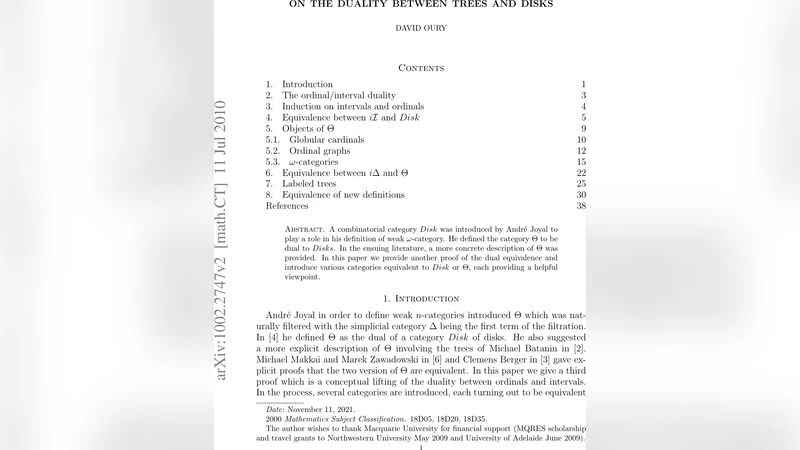
A combinatorial category Disks was introduced by Andr'e Joyal to play a role in his definition of weak omega-category. He defined the category Theta to be dual to Disks. In the ensuing literature, a more concrete description of Theta was provided. In this paper we provide another proof of the dual equivalence and introduce various categories equivalent to Disk or Theta, each providing a helpful viewpoint. In this second version the paper’s contents have been reorganized with the goal of a more readable presentation. We define augmented categories and their reduced counterparts (which lack a single trivial object of the augmented category). These augmented categories are more suitable for inductive arguments and their reduced counterparts are equivalent to Disk and Theta. The equivalence between Disk and Theta is demonstrated in Sections 4 and 6 using categories inductively defined (in Section 3) from intervals and ordinals. The last two sections take a more categorical perspective, constructing categories of so-called labeled trees and showing that they are equivalent to their inductively defined counterparts, and so to Disk and Theta. The distinction between augmented and reduced categories corrects an error in the first version where the terminal tree was included in the category Disk.
💡 Research Summary
The paper revisits the combinatorial categories introduced by André Joyal—Disks, which serves as a foundational structure in his definition of weak ω‑categories, and its dual Θ. While the original literature provided a concrete description of Θ, the authors of this work supply a new proof of the dual equivalence and, in the process, clarify several subtle points that were previously ambiguous or even erroneous.
The central innovation is the introduction of augmented categories and their reduced counterparts. An augmented category is obtained by adjoining a single trivial object (often denoted by a star) to a given category. This extra object greatly simplifies inductive constructions because it provides a uniform base case and a convenient “null” morphism at each stage. The reduced category is simply the augmentation with that trivial object removed; it is precisely the category that corresponds to the original Disks or Θ. By separating these two notions, the authors can conduct inductive arguments cleanly while still obtaining the correct final objects after reduction.
In Section 3 the authors build two families of intermediate categories from the elementary combinatorial structures of intervals and ordinals. The interval‑based categories (denoted Iₙ) model the “input” side of trees, whereas the ordinal‑based categories (denoted Oₙ) model the “output” side. Both families start from a trivial base (I₀ and O₀ each contain a single object and identity morphism) and are defined recursively: Iₙ₊₁ is generated from Oₙ‑trees, and Oₙ₊₁ from Iₙ‑trees. At each recursive step the authors explicitly construct the augmented version (with the trivial object) and its reduced version (without it).
Sections 4 and 6 contain the heart of the duality proof. The authors exhibit natural bijections between the objects and morphisms of Iₙ and Oₙ that respect the augmentation. By carefully tracking how the trivial object propagates through the recursion, they show that the augmented Iₙ‑category is equivalent to the augmented Disks, and dually that the augmented Oₙ‑category is equivalent to the augmented Θ. After applying the reduction functor (which removes the trivial object), they obtain genuine equivalences between the reduced Iₙ‑category and Disks, and between the reduced Oₙ‑category and Θ. This argument also corrects a mistake in the first version of the paper, where the terminal tree was inadvertently retained inside Disk; the reduction step eliminates that spurious object.
Sections 7 and 8 adopt a more categorical viewpoint by introducing labeled trees. Each node of a tree is equipped with a “type” and an “arity” label, and the labeling rules are designed to mirror the interval and ordinal structures used earlier. The authors define two functors: an inclusion functor that embeds a labeled tree into the augmented category, and a projection functor that discards the trivial object, landing in the reduced category. These functors are shown to be inverse equivalences, establishing that the category of labeled trees is simultaneously equivalent to the augmented Iₙ‑/Oₙ‑categories and, after reduction, to Disks and Θ.
The paper’s contributions can be summarized as follows:
- Conceptual Clarification – By distinguishing augmented from reduced categories, the authors provide a clean inductive framework that avoids the pitfalls of earlier treatments.
- New Intermediate Models – The interval‑based and ordinal‑based categories give concrete, combinatorial models that make the duality between trees (Disks) and disks (Θ) transparent.
- Error Correction – The reduction step precisely removes the erroneously included terminal tree, thereby restoring the intended definition of Disk.
- Unified Labeled‑Tree Perspective – The labeled‑tree construction unifies the various incarnations of the dual categories under a single categorical structure, opening the door for further applications in higher‑dimensional category theory and the concrete modeling of weak ω‑categories.
Overall, the paper not only supplies a rigorous and more readable proof of the dual equivalence between Disks and Θ but also enriches the toolbox available to researchers working with higher‑dimensional categorical structures.
Comments & Academic Discussion
Loading comments...
Leave a Comment