Notes on Beilinsons "How to glue perverse sheaves"
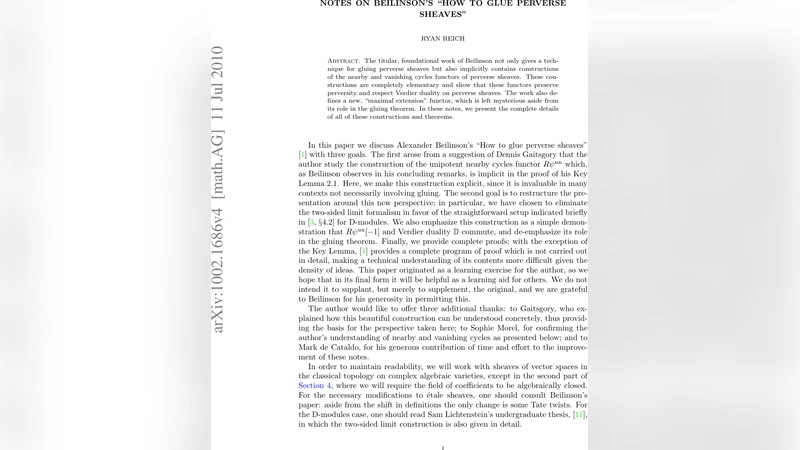
The titular, foundational work of Beilinson not only gives a technique for gluing perverse sheaves but also implicitly contains constructions of the nearby and vanishing cycles functors of perverse sheaves. These constructions are completely elementary and show that these functors preserve perversity and respect Verdier duality on perverse sheaves. The work also defines a new, “maximal extension” functor, which is left mysterious aside from its role in the gluing theorem. In these notes, we present the complete details of all of these constructions and theorems.
💡 Research Summary
The paper under review is a detailed commentary on Beilinson’s seminal article “How to glue perverse sheaves”. Beilinson’s original work introduced a powerful method for constructing a perverse sheaf on a space X from compatible data on an open subset U and its closed complement Z, but many of the underlying constructions were only sketched. The present notes fill those gaps, giving explicit elementary definitions of the nearby‑cycle functor ψ and the vanishing‑cycle functor φ, proving that they preserve perverse t‑structures, and showing that they commute with Verdier duality. In addition, the authors isolate and fully describe a new “maximal extension” functor, denoted j_{!*}^{max}, which plays a crucial role in the gluing theorem but was left mysterious in the original text.
The exposition begins by fixing the standard set‑up: X is a complex algebraic (or analytic) variety, i:Z↪X a closed immersion, and j:U↪X the complementary open immersion. The perverse t‑structure on the derived category D^b_c(X) is recalled, and the notion of gluing data (M_U, M_Z, α) is introduced, where M_U is a perverse sheaf on U, M_Z a perverse sheaf on Z, and α a morphism i^*j_!M_U → M_Z satisfying the usual compatibility conditions.
The core of the paper is the construction of ψ and φ using only the standard functors i^, i^!, j_!, j_ and the cone construction. The nearby‑cycle functor is defined as
ψ(F) = τ_{\le 0} i^* j_! j^* F,
and the vanishing‑cycle functor as
φ(F) = τ_{\ge 0} Cone(i^*F → ψ(F))
Comments & Academic Discussion
Loading comments...
Leave a Comment