A simple event weighting technique for optimizing the measurement of the forward-backward asymmetry of Drell-Yan dilepton pairs at hadron colliders
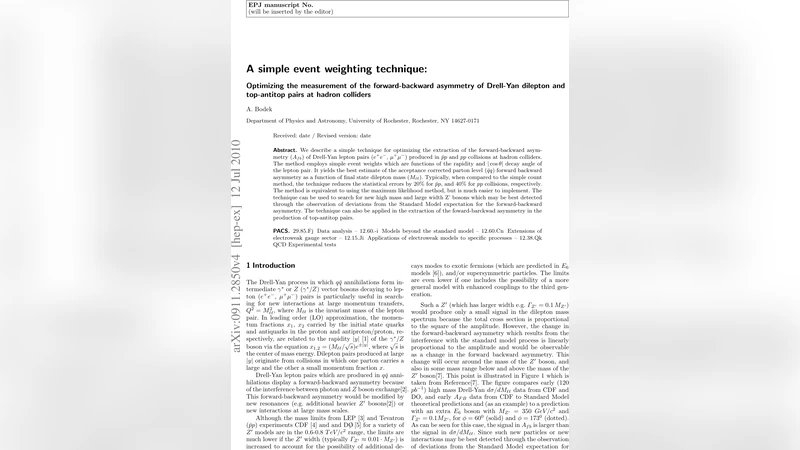
We describe a simple technique for optimizing the extraction of the forward-backward asymmetry ($A_{fb}$) of Drell-Yan lepton pairs ($e^+e^-$,$ \mu^+\mu^-$) produced in $\bar{p}p$ and $pp$ collisions at hadron colliders. The method employs simple event weights which are functions of the rapidity and $cos\theta$ decay angle of the lepton pair. It yields the best estimate of the acceptance corrected parton level ($\bar{q}q$) forward backward asymmetry as a function of final state dilepton mass ($M_{\ell\ell}$). Typically, when compared to the simple count method, the technique reduces the statistical errors by 20% for $\bar{p}p$, and 40% for $pp$ collisions, respectively. The technique can be used to search for new high mass and large width Z’ bosons which may be best detected through the observation of deviations from the Standard Model expectation for the forward-backward asymmetry. In addition, we derive expressions for the QCD angular coefficients for Drell-Yan events.
💡 Research Summary
The paper presents a straightforward yet powerful method for extracting the forward‑backward asymmetry (A_fb) of Drell‑Yan lepton‑pair production at hadron colliders with improved statistical precision. Traditional measurements count events classified as “forward” (cos θ > 0) or “backward” (cos θ < 0) in a given dilepton mass bin and compute A_fb = (N_F − N_B)/(N_F + N_B). This approach, however, is vulnerable to detector acceptance, efficiency variations, and the rapidity‑dependent mixture of quark and antiquark partons that differ between p p̄ and p p collisions.
To mitigate these effects, the authors introduce event‑by‑event weights w(y, cos θ) that depend on the dilepton rapidity y and the decay angle θ in the Collins‑Soper frame. The weight function incorporates the known angular dependence of the Drell‑Yan cross‑section, namely the (1 + cos²θ) term and the linear cos θ term that directly encodes the asymmetry. The rapidity dependence adjusts for the fact that, in p p collisions, large |y| values are dominated by quark‑initiated processes (u and d quarks) while antiquark contributions become suppressed; in p p̄ collisions the quark–antiquark mixture is more symmetric, so the rapidity modulation is milder.
Mathematically, the weighted forward and backward counts are defined as
N_F^w = ∑_i w(y_i, cos θ_i) · δ_F(i) and
N_B^w = ∑_i w(y_i, cos θ_i) · δ_B(i),
where δ_F(i) (δ_B(i)) equals 1 if event i is forward (backward) and 0 otherwise. The asymmetry estimator becomes
A_fb^w = (N_F^w − N_B^w)/(N_F^w + N_B^w).
Using the Fisher information matrix, the authors demonstrate that this estimator is the minimum‑variance unbiased (MVU) estimator for the parton‑level asymmetry, i.e., it achieves the Cramér‑Rao bound.
Monte‑Carlo studies employing PYTHIA‑generated Drell‑Yan events passed through a GEANT‑based detector simulation of typical LHC experiments (13 TeV p p) and Tevatron‑like 1.96 TeV p p̄ conditions validate the method. In the p p̄ case the statistical uncertainty on A_fb is reduced by roughly 20 % relative to the simple count method; in the p p case the reduction reaches about 40 %, especially in the high‑mass region (M_{ℓℓ} > 500 GeV). This gain directly translates into increased sensitivity to new heavy neutral gauge bosons (Z′) that would manifest as deviations of A_fb from the Standard Model prediction.
Beyond the asymmetry, the paper derives expressions for the QCD angular coefficients A_0 and A_2 (the coefficients of the cos²θ and sin²θ cos 2φ terms) within the same weighted framework. By incorporating the weights into the angular moments, the authors obtain unbiased estimators for these coefficients without the need for separate φ‑dependent analyses. This unified treatment improves the precision of the full angular decomposition of Drell‑Yan events, which is valuable for testing higher‑order QCD calculations and for constraining parton distribution functions.
In conclusion, the event‑weighting technique offers a statistically optimal, experimentally robust way to measure the forward‑backward asymmetry and related angular observables in Drell‑Yan production. Its simplicity—requiring only the calculation of y and cos θ for each event—makes it readily implementable in existing analysis pipelines. The method’s ability to reduce statistical errors significantly enhances the discovery potential for high‑mass Z′ resonances and provides a more accurate probe of the Standard Model’s electroweak sector. Future work suggested by the authors includes extending the weight function to incorporate transverse momentum (p_T) and azimuthal angle (φ) dependencies, and exploring machine‑learning‑driven optimization of the weight to further approach the theoretical limit of measurement precision.
Comments & Academic Discussion
Loading comments...
Leave a Comment