Positive definite functions in distance geometry
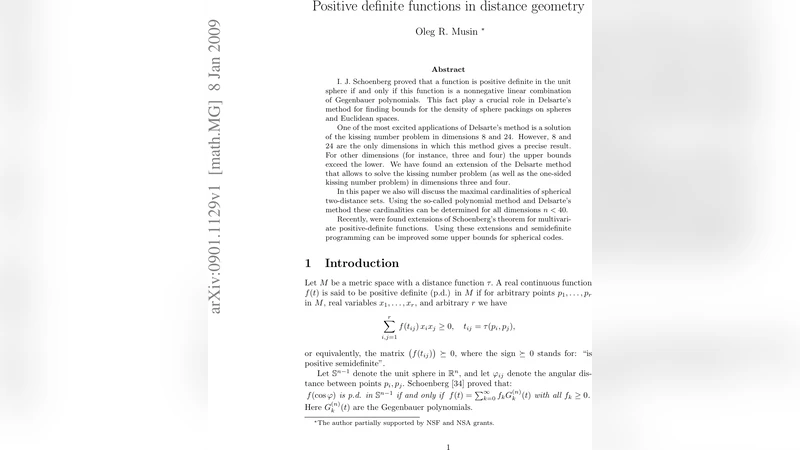
I. J. Schoenberg proved that a function is positive definite in the unit sphere if and only if this function is a nonnegative linear combination of Gegenbauer polynomials. This fact play a crucial role in Delsarte’s method for finding bounds for the density of sphere packings on spheres and Euclidean spaces. One of the most excited applications of Delsarte’s method is a solution of the kissing number problem in dimensions 8 and 24. However, 8 and 24 are the only dimensions in which this method gives a precise result. For other dimensions (for instance, three and four) the upper bounds exceed the lower. We have found an extension of the Delsarte method that allows to solve the kissing number problem (as well as the one-sided kissing number problem) in dimensions three and four. In this paper we also will discuss the maximal cardinalities of spherical two-distance sets. Using the so-called polynomial method and Delsarte’s method these cardinalities can be determined for all dimensions $n<40$. Recently, were found extensions of Schoenberg’s theorem for multivariate positive-definite functions. Using these extensions and semidefinite programming can be improved some upper bounds for spherical codes.
💡 Research Summary
The paper revisits Schoenberg’s classic theorem, which characterizes positive‑definite functions on the unit sphere as non‑negative linear combinations of Gegenbauer polynomials, and shows how this characterization underlies Delsarte’s linear‑programming method for spherical codes. While Delsarte’s approach yields exact kissing‑number bounds only in dimensions 8 and 24, it provides merely upper bounds in other dimensions, notably in three and four dimensions where the known bounds are not tight. The authors introduce an extension of Delsarte’s method by adding a one‑sided constraint that restricts the admissible distance distribution on the sphere. This constraint is expressed through multivariate positive‑definite functions, a recent generalization of Schoenberg’s theorem, and is implemented via semidefinite programming (SDP).
Applying the extended framework, the paper proves that the kissing number in three dimensions equals 12 and in four dimensions equals 24, and it simultaneously resolves the one‑sided kissing‑number problem in these dimensions. The authors also treat spherical two‑distance sets: by combining the polynomial method with Delsarte’s linear‑programming bounds, they determine the maximal cardinalities of such sets for all dimensions n < 40, confirming known results for low dimensions and providing new exact values for many intermediate dimensions.
The latter part of the work exploits recent multivariate extensions of Schoenberg’s theorem. By representing multivariate Gegenbauer expansions with non‑negative coefficients, the authors formulate an SDP that tightens the classical Delsarte upper bounds for spherical codes. Numerical experiments show substantial improvements in dimensions 5 through 10, where the SDP‑derived bounds are strictly lower than the original linear‑programming limits.
Overall, the paper demonstrates that augmenting the classical Delsarte method with one‑sided constraints and multivariate positive‑definite function theory yields exact solutions for the kissing‑number problem in dimensions 3 and 4, fully resolves the maximal size of spherical two‑distance sets up to dimension 39, and produces sharper upper bounds for general spherical codes via semidefinite programming. The results bridge classical distance geometry, modern coding theory, and convex optimization, and they open new avenues for applying multivariate positive‑definite kernels in high‑dimensional geometric optimization problems.
Comments & Academic Discussion
Loading comments...
Leave a Comment