A Numerical Algorithm for Zero Counting. I: Complexity and Accuracy
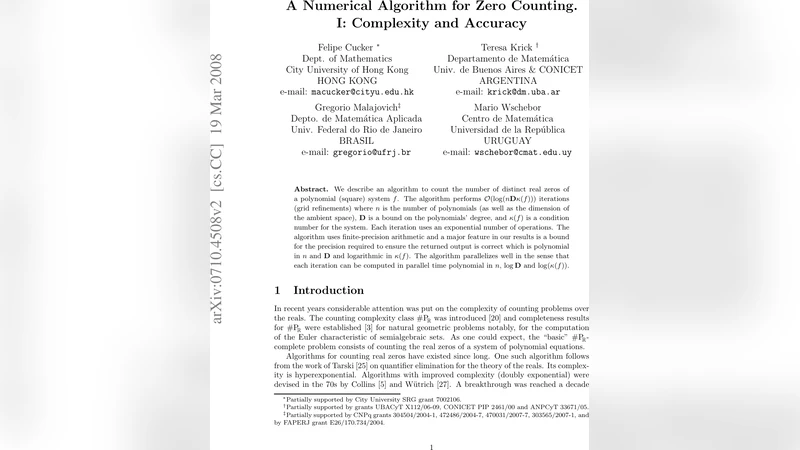
We describe an algorithm to count the number of distinct real zeros of a polynomial (square) system f. The algorithm performs O(n D kappa(f)) iterations where n is the number of polynomials (as well as the dimension of the ambient space), D is a bound on the polynomials’ degree, and kappa(f) is a condition number for the system. Each iteration uses an exponential number of operations. The algorithm uses finite-precision arithmetic and a polynomial bound for the precision required to ensure the returned output is correct is exhibited. This bound is a major feature of our algorithm since it is in contrast with the exponential precision required by the existing (symbolic) algorithms for counting real zeros. The algorithm parallelizes well in the sense that each iteration can be computed in parallel polynomial time with an exponential number of processors.
💡 Research Summary
**
The paper introduces a novel numerical algorithm for counting the number of distinct real zeros of a square polynomial system (f = (f_1,\dots,f_n)) in (\mathbb{R}^n). Traditional symbolic methods—based on Gröbner bases, cylindrical algebraic decomposition, or Sturm sequences—require exponential bit‑precision in the coefficients to guarantee correctness, which makes them impractical for large‑scale problems. By contrast, the authors develop a condition‑number‑driven approach that works with finite‑precision floating‑point arithmetic while still delivering provably correct zero counts.
Key Concepts and Definitions
The central analytical tool is a condition number (\kappa(f)) defined as
\
Comments & Academic Discussion
Loading comments...
Leave a Comment