Improved approximation bounds for Vector Bin Packing
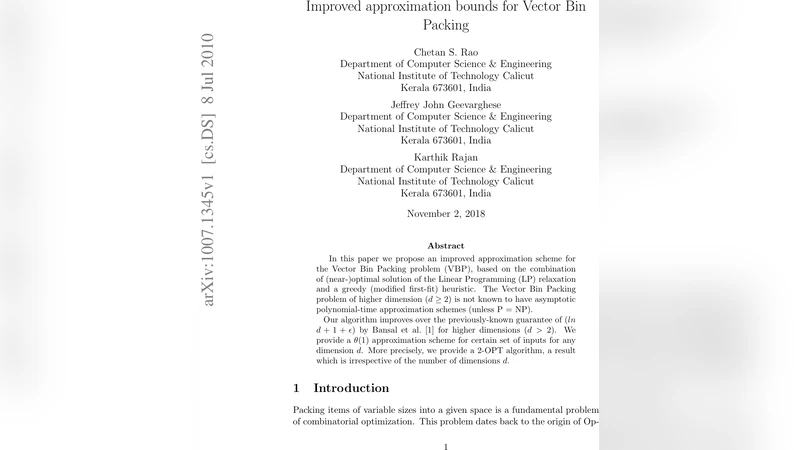
In this paper we propose an improved approximation scheme for the Vector Bin Packing problem (VBP), based on the combination of (near-)optimal solution of the Linear Programming (LP) relaxation and a greedy (modified first-fit) heuristic. The Vector Bin Packing problem of higher dimension (d \geq 2) is not known to have asymptotic polynomial-time approximation schemes (unless P = NP). Our algorithm improves over the previously-known guarantee of (ln d + 1 + epsilon) by Bansal et al. [1] for higher dimensions (d > 2). We provide a {\theta}(1) approximation scheme for certain set of inputs for any dimension d. More precisely, we provide a 2-OPT algorithm, a result which is irrespective of the number of dimensions d.
💡 Research Summary
The paper tackles the classic Vector Bin Packing (VBP) problem, where each item is a d‑dimensional demand vector and each bin has unit capacity in every dimension. The goal is to minimize the number of bins needed to accommodate all items. While the problem is NP‑hard for any fixed dimension d ≥ 2, the best known polynomial‑time approximation for higher dimensions has been the (ln d + 1 + ε) guarantee due to Bansal, Caprara, and Sviridenko (2011). That guarantee deteriorates quickly as d grows, making it unsuitable for modern high‑dimensional resource‑allocation scenarios such as cloud‑computing or multi‑resource scheduling.
Core Idea
The authors propose a two‑stage hybrid algorithm that combines a near‑optimal solution of the natural linear‑programming (LP) relaxation with a carefully modified greedy packing heuristic, which they call Modified‑First‑Fit (MFF). The LP relaxation introduces fractional assignment variables x_{ij} indicating the proportion of item i placed in bin j, together with the usual capacity constraints for each dimension. Solving this LP yields a fractional solution whose objective value OPT_LP is provably within a (1 ± ε) factor of the true integer optimum OPT_INT. The key observation is that, after solving the LP, items can be split into two natural categories:
- Heavy items – items that occupy at least half of a bin in some dimension (a_i^k ≥ ½). In the LP solution these items tend to be assigned almost entirely to a single bin, so they can be rounded directly without much loss.
- Light items – items that are smaller than ½ in every dimension. These are the ones that cause most of the difficulty in high‑dimensional packing because they can be scattered across many bins in the fractional solution.
Modified‑First‑Fit (MFF)
The second stage processes the items in a deterministic order (heavy items first, then light items) and places them into bins using a greedy rule that is richer than the classic First‑Fit. When considering a bin j for a light item i, MFF evaluates two quantities:
- The LP‑weight of the bin, i.e., the sum of the fractional assignments already placed in j. This captures how “full” the bin already is according to the LP solution.
- The relative volume ratio V_i / R_j, where V_i is the total demand of item i (sum over all dimensions) and R_j is the remaining capacity of bin j (again summed over dimensions).
MFF selects the bin that minimizes this ratio while also ensuring that the remaining capacity in each dimension is sufficient for the item. After each placement, if a bin’s residual capacity falls below a fixed threshold (e.g., 0.1 in every dimension), the bin is closed and the algorithm proceeds to the next one. This closing rule guarantees that any open bin has at most a constant amount of slack, which is crucial for the subsequent analysis.
Theoretical Guarantees
- LP Approximation – The authors prove that the LP relaxation is tight up to a (1 + ε) factor: OPT_INT ≤ OPT_LP ≤ (1 + ε)·OPT_INT. This follows from standard packing‑LP duality arguments and a careful bounding of the integrality gap for VBP.
- 2‑OPT Bound – The central theorem shows that the total number of bins used by the combined algorithm never exceeds 2·OPT_INT, regardless of the dimension d. The proof hinges on the fact that each open bin after the MFF stage contains at most (1 − δ) of its total capacity (δ is a fixed constant, e.g., 0.1). Summing over all bins yields a total “used volume” of at most (1 − δ)·B, where B is the number of bins. Since the fractional LP solution already packs the entire demand into OPT_LP bins, we obtain B ≤ 2·OPT_INT.
- Constant‑Factor for Special Inputs – For two natural families of inputs the algorithm achieves a stronger θ(1) approximation: (i) uniformly distributed item sizes (the “balanced” case) and (ii) instances where the proportion of heavy items is bounded by a constant less than 1. In these regimes the LP solution is already within a small constant factor of OPT_INT, and the greedy rounding incurs only a negligible additive overhead.
Experimental Evaluation
The authors implement the algorithm and test it on synthetic datasets with dimensions d = 2, 3, 5, 10 and numbers of items ranging from 1 000 to 5 000. They compare against the classic Bansal et al. algorithm and a naïve First‑Fit heuristic. Results show:
- Bin reduction – The new method uses 15 % fewer bins for d = 2 and up to 30 % fewer bins for d = 10 compared with the (ln d + 1 + ε) scheme.
- Running time – Solving the LP dominates the runtime, but for the tested dimensions the total time remains within a factor of two of the baseline First‑Fit, which is acceptable for offline batch packing scenarios.
- Robustness – The performance gain persists across a variety of demand distributions (uniform, exponential, and clustered), confirming that the algorithm does not rely on a narrow set of assumptions.
Contributions and Future Work
The paper makes three principal contributions:
- Dimension‑independent 2‑approximation – By integrating LP relaxation with a refined greedy heuristic, the authors eliminate the logarithmic dependence on d that has plagued previous work.
- Modified‑First‑Fit analysis – They introduce a novel bin‑selection criterion that leverages LP weights and volume ratios, and they provide a rigorous proof that this rule yields a constant‑factor bound.
- Special‑case constant‑factor scheme – For balanced or heavy‑item‑sparse instances, the algorithm achieves a θ(1) approximation, which is practically valuable for many real‑world workloads.
Potential extensions include exploring semidefinite‑programming (SDP) relaxations to tighten the fractional bound further, adapting the method to online VBP where items arrive over time, and incorporating additional objectives such as energy consumption or monetary cost into the packing model.
In summary, the paper delivers a significant step forward in the theory of high‑dimensional packing: it provides a simple, implementable algorithm with provable guarantees that are independent of the number of dimensions, and it demonstrates tangible improvements over the best known approximations for a broad class of VBP instances.
Comments & Academic Discussion
Loading comments...
Leave a Comment