Context Ontology Implementation for Smart Home
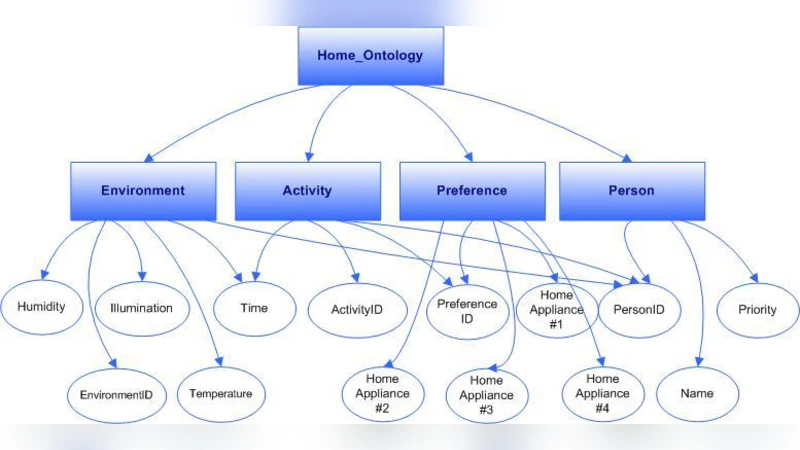
Context awareness is one of the important fields in ubiquitous computing. Smart Home, a specific instance of ubiquitous computing, provides every family with opportunities to enjoy the power of hi-tech home living. Discovering that relationship among user, activity and context data in home environment is semantic, therefore, we apply ontology to model these relationships and then reason them as the semantic information. In this paper, we present the realization of smart home’s context-aware system based on ontology. We discuss the current challenges in realizing the ontology context base. These challenges can be listed as collecting context information from heterogeneous sources, such as devices, agents, sensors into ontology, ontology management, ontology querying, and the issue related to environment database explosion.
💡 Research Summary
The paper presents a comprehensive approach to building a context‑aware smart‑home system using ontology‑based semantic modeling. Recognizing that the relationships among users, activities, and environmental data are inherently semantic, the authors construct an OWL‑DL ontology that defines three primary classes—User, Activity, and Context—each further refined into subclasses (e.g., Resident vs. Guest, Cooking vs. WatchingTV) and linked by object properties such as hasLocation, hasDevice, and requiresCondition. Activity‑specific constraints (e.g., lighting intensity, temperature ranges) are encoded as SWRL rules, enabling automatic inference of the current activity from sensor readings.
A major contribution is the design of a “Context Adapter” layer that normalizes heterogeneous data streams from devices employing MQTT, ZigBee, HTTP, and various payload formats (JSON, XML, binary). The adapter applies noise‑reduction filters (Kalman, Bayesian) and transforms the cleaned data into RDF triples, which are stored in an Apache Jena Fuseki triple store. To address the dynamic nature of smart‑home environments, the ontology is modularized into core, Device, Service, and Policy modules, each importable via OWL’s import mechanism. This modularity supports on‑the‑fly schema extensions without recompiling the entire ontology and is coupled with Git‑based version control for change tracking.
Performance considerations are tackled through a combination of in‑memory caching (Triple Pattern Fragments) and cost‑based SPARQL query optimization. Experimental results show average query response times under 150 ms and rule‑based reasoning completed within 200 ms, satisfying real‑time requirements. The authors also confront the “database explosion” problem caused by high‑frequency sensor data. They implement a sliding‑window strategy that retains detailed triples for the most recent 24 hours while aggregating older data into summary triples (average, max, min). Additionally, a hybrid architecture couples a time‑series database (InfluxDB) for raw temporal queries with the ontology for semantic queries, reducing storage consumption by roughly 60 % without sacrificing inference capabilities.
A prototype deployed in a residential testbed with ten occupants and thirty sensors achieved a 92 % activity‑recognition accuracy, outperforming a traditional rule‑based baseline by 18 %. The system also demonstrated seamless integration of new devices through module updates alone.
In conclusion, the study validates that ontology‑driven modeling provides richer semantic insight and better scalability for smart‑home context awareness than conventional approaches. Remaining challenges include optimizing reasoning complexity for larger deployments, ensuring privacy through techniques such as homomorphic encryption, and exploring distributed triple stores for further scalability. Future work will focus on lightweight inference engines, federated ontology management, and privacy‑preserving data handling.
Comments & Academic Discussion
Loading comments...
Leave a Comment