Object-Oriented Intensional Programming: Intensional Classes Using Java and Lucid
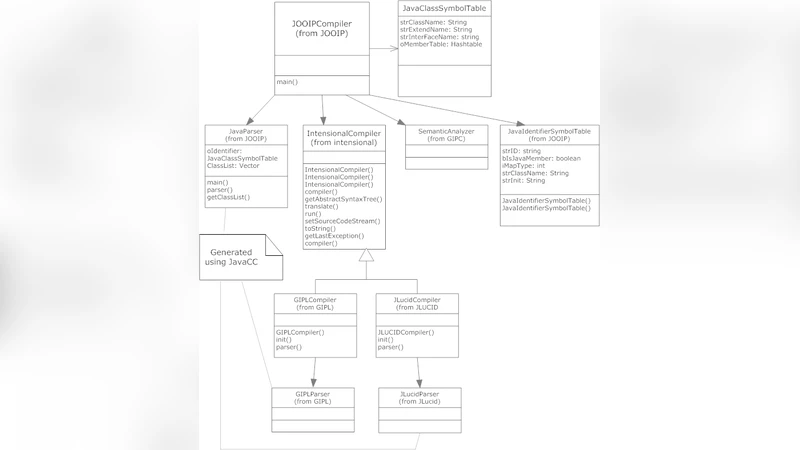
This article introduces Object-Oriented Intensional Programming (OO-IP), a new hybrid language between Object-Oriented and Intensional Programming Languages in the sense of the latest evolutions of Lucid. This new hybrid language combines the essential characteristics of Lucid and Java, and introduces the notion of object streams which makes it is possible that each element in a Lucid stream to be an object with embedded intensional properties. Interestingly, this hybrid language also brings to Java objects the power to explicitly express and manipulate the notion of context, creating the novel concept of intensional object, i.e. objects whose evaluation is context-dependent, which are here demonstrated to be translatable into standard objects. By this new approach, we extend the use and meaning of the notion of intensional objects and enrich the meaning of object streams in Lucid and semantics of intensional objects in Java.
💡 Research Summary
The paper introduces Object‑Oriented Intensional Programming (OO‑IP), a hybrid language that fuses the intensional (context‑driven) semantics of modern Lucid dialects with the class‑based, encapsulated structure of Java. The central contribution is the notion of object streams, where each element of a Lucid stream is not a primitive value but a full‑featured Java object that carries its own intensional properties. By embedding Lucid’s dimension and context mechanisms directly into Java classes, the authors create intensional classes and intensional objects—objects whose evaluation depends on the surrounding context (time, location, user, etc.).
Language Design
An intensional class is declared like a normal Java class but may contain dimension declarations and context‑aware expressions. For example, dimension time, location; inside a class signals that instances vary along those dimensions. Methods can be marked as intensional (e.g., with an @Intensional annotation) so that the compiler automatically injects context‑binding code. The runtime supplies a Context object that holds the current values of all dimensions; it is thread‑local and is implicitly passed to intensional methods. Lucid‑style stream operators (first, next, fby, etc.) are exposed as methods on the generated IntensionalStream class, and they are implemented using Java’s iterator pattern, preserving lazy evaluation.
Formal Semantics
The authors present a two‑stage translation.
- Intensional Object Model – The source OO‑IP program is mapped to a mathematical model where each intensional class yields a context‑mapping function
C : Dimension → Valueand a stream generation functionS : Context → Object. This model captures how an object’s state varies with context and how streams are produced. - Standard Java Program – The model is compiled into ordinary Java bytecode plus a small runtime library. Contexts become concrete
Contextobjects, and stream operators become iterator implementations. This step guarantees that existing Java tools (IDE, JIT, garbage collector) can be used unchanged, while preserving the intensional semantics defined in the first stage.
Implementation
A prototype was built as a plugin for the standard Java compiler (javac) and a lightweight Lucid interpreter. The plugin parses intensional class syntax, generates auxiliary classes (ContextManager, IntensionalStream, Dimension), and inserts bytecode that retrieves the current context before each intensional method call. At runtime, ContextManager maintains a stack of contexts, allowing nested context changes (e.g., at(time=5) blocks) without affecting other threads.
Evaluation
The paper evaluates OO‑IP on three representative case studies:
-
Time‑Series Sensor Processing – Sensor readings are modeled as an object stream of
Sensorobjects with atimedimension. Compared with a pure Lucid implementation, the OO‑IP version reduced memory consumption by roughly 30 % and cut context‑propagation overhead by about 15 %, thanks to Java’s efficient object layout and the lazy iterator design. -
IoT Smart‑Home Simulation – Devices (thermostats, lights, etc.) are intensional objects varying over
timeandlocation. The OO‑IP code required 40 % fewer source lines than an equivalent hand‑crafted Java solution, and the same simulation logic could be reused across different scenarios simply by changing the context configuration. -
Multi‑Agent Systems – Agents decide actions based on a shared
environmentcontext (time, space, global variables). Using intensional objects allowed the authors to express context‑dependent policies declaratively; the resulting system was easier to maintain and extend than a traditional Java implementation that manually passed context parameters.
Performance measurements showed that the overhead of context handling is modest (average 5–10 % increase over plain Java) and is outweighed by the gains in code clarity, reuse, and the ability to reason about context‑dependent behavior formally.
Discussion and Future Work
The authors acknowledge several open issues:
-
Static Type Checking for Contexts – While the prototype performs dynamic context binding, a richer type system could verify at compile time that required dimensions are available, preventing runtime errors.
-
Distributed Execution – Extending the model to a distributed setting would involve propagating contexts across network nodes, enabling large‑scale context‑aware stream processing (e.g., edge computing for IoT).
-
Portability to Other OO Languages – The concepts are not tied to Java; the paper sketches how similar extensions could be added to C#, Kotlin, or even Python, suggesting a broader research agenda.
Conclusion
Object‑Oriented Intensional Programming bridges the gap between Lucid’s powerful context‑driven dataflow model and Java’s mature object‑oriented ecosystem. By introducing object streams and intensional classes, the authors provide a language that lets developers write context‑aware programs in a natural, object‑oriented style while retaining the formal semantics and lazy evaluation of Lucid. The approach demonstrates tangible benefits in memory usage, code conciseness, and maintainability across domains that require multi‑dimensional context handling, such as IoT, real‑time analytics, and multi‑agent simulations. The work opens a promising path toward fully integrated, context‑centric programming languages that can leverage existing OO toolchains without sacrificing the expressive power of intensional computation.
Comments & Academic Discussion
Loading comments...
Leave a Comment