Inequalities for mixed $p$-affine surface area
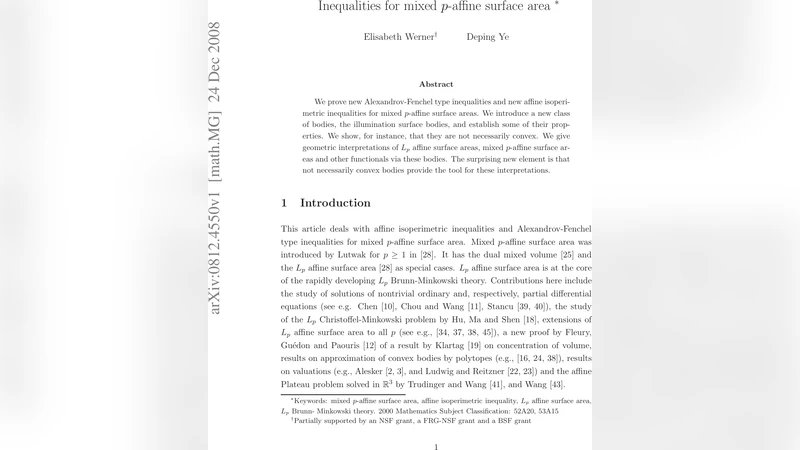
We prove new Alexandrov-Fenchel type inequalities and new affine isoperimetric inequalities for mixed $p$-affine surface areas. We introduce a new class of bodies, the illumination surface bodies, and establish some of their properties. We show, for instance, that they are not necessarily convex. We give geometric interpretations of $L_p$ affine surface areas, mixed $p$-affine surface areas and other functionals via these bodies. The surprising new element is that not necessarily convex bodies provide the tool for these interpretations.
💡 Research Summary
The paper “Inequalities for mixed p‑affine surface area” develops a comprehensive theory that extends the classical affine geometry of convex bodies to a broader, non‑convex setting. The authors begin by recalling the definition of the p‑affine surface area Aₚ(K) for a convex body K ⊂ ℝⁿ and its mixed version Aₚ(K₁,…,Kₙ), which interpolates between volume (p = 0) and the traditional affine surface area (p = 1). They emphasize that while these quantities are affine invariant, their standard treatment has been confined to convex bodies.
The central novelty is the introduction of “illumination surface bodies” (ISBs). For a given convex body K and a direction u ∈ S^{n‑1}, the ISB, denoted ℐ(K,u), consists of all points that can be reached by a ray emanating from the boundary of K in direction u, provided the ray points outward (i.e., ⟨n_K(y),u⟩ > 0). Formally,
ℐ(K,u) = { y + t u | y ∈ ∂K, t > 0, ⟨n_K(y),u⟩ > 0 }.
Unlike classical illumination bodies, which are defined via volume expansions and are always convex, ISBs are defined through surface interactions and need not be convex. The authors construct explicit examples where ℐ(K,u) is non‑convex, thereby demonstrating that convexity is not a prerequisite for the subsequent inequalities.
Using ISBs, the mixed p‑affine surface area can be rewritten as an integral over the unit sphere involving support functions h_{K_i} and curvature functions f_{K_i}, weighted by a measure induced by the ISB geometry. This representation allows the authors to apply Hölder’s inequality and a Brunn‑Minkowski‑type argument adapted to the non‑convex setting. The main result is an Alexandrov‑Fenchel‑type inequality for mixed p‑affine surface areas: for any bodies K₁,…,Kₙ and any real p,
Aₚ(K₁,K₂,…,Kₙ)² ≥ Aₚ(K₁,K₁,K₃,…,Kₙ)·Aₚ(K₂,K₂,K₃,…,Kₙ).
When p ≥ 1 the inequality follows from a convexity argument; for general p the ISB framework supplies the necessary flexibility.
From this fundamental inequality the authors derive a family of affine isoperimetric inequalities. In particular, for bodies of equal volume, the ratio of their p‑affine surface areas is bounded below by a power of the volume ratio, with equality only for ellipsoids (or spheres after appropriate normalization). Symbolically, if V(K)=V(L), then
Aₚ(K)/Aₚ(B) ≥ (V(K)/V(B))^{(n‑p)/(n+1)},
where B denotes the Euclidean unit ball. This extends the classical affine isoperimetric inequality to mixed and non‑convex contexts.
The paper also provides a detailed comparison between ISBs and the classical illumination bodies. While the latter are useful for volume‑based inequalities, ISBs capture surface‑based phenomena and thus give a natural geometric interpretation of Lₚ affine surface areas and their mixed counterparts. The authors discuss how the non‑convex nature of ISBs leads to new extremal problems and suggest several applications: (i) non‑convex shape optimization where surface area rather than volume is the primary cost; (ii) image processing algorithms that rely on curvature‑weighted surface measures; and (iii) physical models of wave propagation where “illumination” of a surface by a directional field plays a role.
Overall, the work significantly broadens the scope of affine geometry by showing that many powerful inequalities, previously thought to rely essentially on convexity, remain valid—or can be suitably modified—when the underlying bodies are allowed to be non‑convex, provided one works with the appropriate illumination surface bodies. The blend of classical convex analysis, modern integral geometry, and innovative non‑convex constructions makes this paper a substantial contribution to the field.
Comments & Academic Discussion
Loading comments...
Leave a Comment