Learning Read-Once Functions Using Subcube Identity Queries
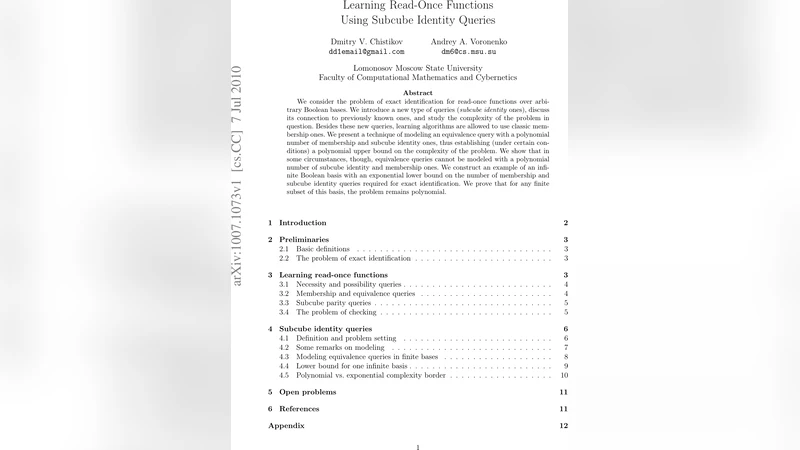
We consider the problem of exact identification for read-once functions over arbitrary Boolean bases. We introduce a new type of queries (subcube identity ones), discuss its connection to previously known ones, and study the complexity of the problem in question. Besides these new queries, learning algorithms are allowed to use classic membership ones. We present a technique of modeling an equivalence query with a polynomial number of membership and subcube identity ones, thus establishing (under certain conditions) a polynomial upper bound on the complexity of the problem. We show that in some circumstances, though, equivalence queries cannot be modeled with a polynomial number of subcube identity and membership ones. We construct an example of an infinite Boolean basis with an exponential lower bound on the number of membership and subcube identity queries required for exact identification. We prove that for any finite subset of this basis, the problem remains polynomial.
💡 Research Summary
The paper addresses the exact identification problem for read‑once Boolean functions defined over arbitrary Boolean bases. A read‑once function is a Boolean expression in which each variable appears exactly once, typically represented as a tree whose internal nodes are basis operations. Traditional learning models for such functions rely on two types of queries: membership queries, where the learner supplies an input vector and receives the function’s output, and equivalence queries, where the learner proposes a hypothesis and receives either confirmation of correctness or a counterexample. While equivalence queries are powerful, they are often unrealistic in practical settings because they require a global oracle that can compare two functions in a single step.
To bridge this gap, the authors introduce a new query type called a subcube identity query. A subcube is defined by fixing a subset of variables to specific values while leaving the remaining variables free; it corresponds to a face of the Boolean hyper‑cube. A subcube identity query asks whether the target function is constant (all‑0 or all‑1) on that subcube, and if so, which constant it is. This query provides more structural information than a plain membership query but is less demanding than an equivalence query.
The main contributions are twofold. First, under certain conditions on the basis—specifically, when the basis is closed under taking subfunctions and each operation is “identifiable” for read‑once functions—the authors show how to simulate an equivalence query using only a polynomial number of membership and subcube identity queries. The simulation proceeds by repeatedly locating a minimal subcube on which the current hypothesis and the target differ (using binary search on the variable set with subcube identity queries) and then extracting a concrete counterexample from that subcube via a membership query. The total number of queries required is bounded by O(n·k·log n), where n is the number of variables and k is the maximum arity of the basis operations. Consequently, any learning algorithm that originally required equivalence queries can be transformed into one that works with the more realistic query set while preserving polynomial‑time complexity.
Second, the paper establishes limits of this approach. The authors construct an infinite Boolean basis (B_{\infty}) that contains operations of every possible arity (e.g., all k‑ary AND, OR, XOR for unbounded k). For read‑once functions over (B_{\infty}), they prove an exponential lower bound: any algorithm that uses only membership and subcube identity queries must ask at least (\Omega(2^{n})) queries in the worst case to identify the target function exactly. The proof leverages information‑theoretic arguments, showing that the number of distinct read‑once functions over such a rich basis grows exponentially, while each query reveals only a limited amount of information. This demonstrates that subcube identity queries cannot universally replace equivalence queries.
Interestingly, the authors also show that for any finite subset (B_{k}) of the infinite basis, the exponential barrier disappears. The same simulation technique applies, yielding a polynomial‑time learning algorithm for read‑once functions over any finite basis. Thus, the finiteness of the basis is the decisive factor: unlimited arity inflates the hypothesis space dramatically, whereas a bounded set of operations keeps it manageable.
The paper’s technical core includes a detailed definition of subcube identity queries, a binary‑search‑style algorithm for finding a minimal distinguishing subcube, and rigorous proofs of both the polynomial simulation and the exponential lower bound. The authors also discuss how the tree structure of read‑once functions guarantees that any disagreement between hypothesis and target must manifest on some subcube, which is crucial for the correctness of the simulation.
From a broader perspective, the work contributes a new query primitive that is both practically implementable and theoretically powerful. It clarifies the relationship between query types in exact learning and highlights how the algebraic properties of the underlying Boolean basis influence learnability. Potential future directions include extending subcube identity queries to richer function classes (e.g., read‑twice or bounded‑depth circuits), exploring randomized or adaptive learning scenarios, and designing hardware or software systems that can efficiently answer subcube identity queries in real‑world applications such as circuit verification and automated reasoning.
Comments & Academic Discussion
Loading comments...
Leave a Comment