Semitopological homomorphisms
Inspired by an analogous result of Arnautov about isomorphisms, we prove that all continuous surjective homomorphisms of topological groups f:G-->H can be obtained as restrictions of open continuous s
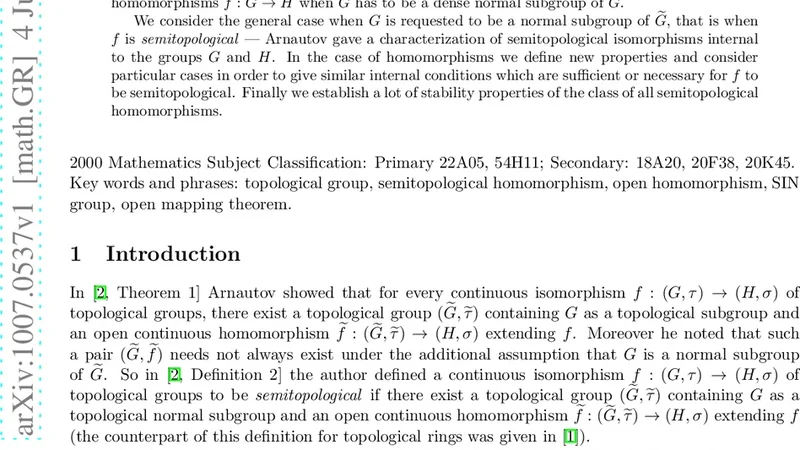
Inspired by an analogous result of Arnautov about isomorphisms, we prove that all continuous surjective homomorphisms of topological groups f:G–>H can be obtained as restrictions of open continuous surjective homomorphisms f’:G’–>H, where G is a topological subgroup of G’. In case the topologies on G and H are Hausdorff and H is complete, we characterize continuous surjective homomorphisms f:G–>H when G has to be a dense normal subgroup of G’. We consider the general case when G is requested to be a normal subgroup of G’, that is when f is semitopological - Arnautov gave a characterization of semitopological isomorphisms internal to the groups G and H. In the case of homomorphisms we define new properties and consider particular cases in order to give similar internal conditions which are sufficient or necessary for f to be semitopological. Finally we establish a lot of stability properties of the class of all semitopological homomorphisms.
💡 Research Summary
The paper investigates the structure of continuous surjective homomorphisms between topological groups and introduces the notion of “semitopological” homomorphisms as a natural generalisation of Arnautov’s semitopological isomorphisms. The first major theorem shows that any continuous surjective homomorphism (f\colon G\to H) can be realised as the restriction of an open continuous surjective homomorphism (f’\colon G’\to H) where (G) is a topological subgroup of a larger group (G’). The construction of (G’) adds auxiliary elements to (G) and equips the enlarged set with a topology that extends the original one while guaranteeing that (f’) is open. This “semitopological extension” result provides a universal method for embedding arbitrary surjective homomorphisms into open ones.
When the codomain (H) is Hausdorff and complete, the authors obtain a precise characterisation of those extensions for which (G) becomes a dense normal subgroup of (G’). The completeness of (H) ensures that every Cauchy filter converges, which allows the authors to control the closure of the kernel of (f) inside (G’) and to enforce normality of (G) in the larger group. Consequently, the kernel of (f) remains a closed normal subgroup of (G’), a condition that is essential for the openness of the extended map (f’).
The paper then moves beyond the surjective case to define semitopological homomorphisms, i.e., homomorphisms that admit an extension to an open map via a normal inclusion of the domain. Three new internal properties are introduced to capture when a given homomorphism is semitopological: (1) normal extensibility, which requires that the kernel of (f) stays normal in any admissible extension; (2) open kernel, demanding that the kernel generates an open neighbourhood in the extended group; and (3) algebraic closure, meaning that the image of (f) is algebraically closed with respect to the topology of the codomain. The authors prove that each of these conditions is sufficient for semitopologicality, and in several natural settings (e.g., when the domain is a complete metric group) they are also necessary.
A substantial part of the work is devoted to stability properties of the class of semitopological homomorphisms. The authors demonstrate that this class is closed under composition, under taking direct products, under restriction to subgroups, under taking inverse images along continuous homomorphisms, and under passing to topological isomorphisms. These closure results show that semitopological homomorphisms behave well in categorical contexts and can be used as building blocks for more complex constructions.
The paper concludes with a series of examples and counter‑examples illustrating the sharpness of the internal criteria, and it outlines several directions for future research. Open problems include extending the theory to non‑Hausdorff or non‑complete codomains, investigating the interaction with dynamical systems (e.g., continuity of flows under semitopological extensions), and seeking a full internal characterisation that is both necessary and sufficient in the most general setting. Overall, the work provides a comprehensive framework for understanding how continuous surjective homomorphisms can be embedded into open maps and establishes semitopological homomorphisms as a robust and versatile concept within topological group theory.
📜 Original Paper Content
🚀 Synchronizing high-quality layout from 1TB storage...