Optimization Under Unknown Constraints
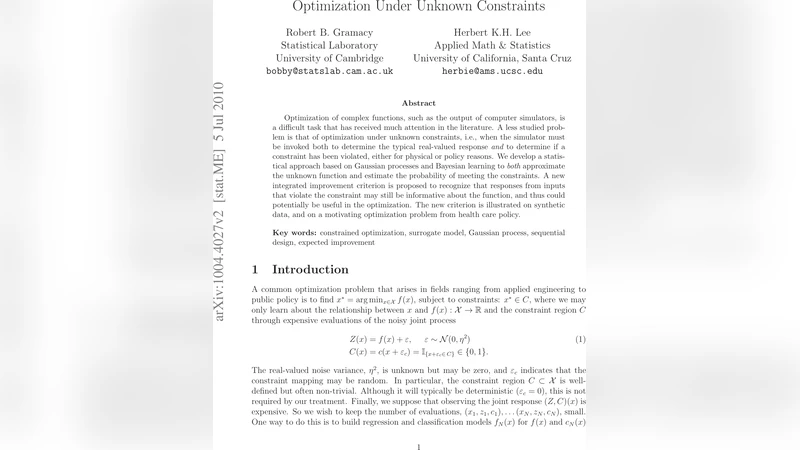
Optimization of complex functions, such as the output of computer simulators, is a difficult task that has received much attention in the literature. A less studied problem is that of optimization under unknown constraints, i.e., when the simulator must be invoked both to determine the typical real-valued response and to determine if a constraint has been violated, either for physical or policy reasons. We develop a statistical approach based on Gaussian processes and Bayesian learning to both approximate the unknown function and estimate the probability of meeting the constraints. A new integrated improvement criterion is proposed to recognize that responses from inputs that violate the constraint may still be informative about the function, and thus could potentially be useful in the optimization. The new criterion is illustrated on synthetic data, and on a motivating optimization problem from health care policy.
💡 Research Summary
The paper tackles a practical yet under‑explored variant of Bayesian optimization: optimizing a costly black‑box simulator when both the objective value and the feasibility of a candidate input are unknown until the simulator is run. In many real‑world settings—policy design, engineering design, health‑care planning—constraints cannot be expressed analytically; they are only revealed by the same simulation that provides the objective. Traditional Bayesian optimization assumes known constraints or treats infeasible points as completely uninformative, which wastes valuable information that could improve the surrogate model of the objective.
To address this, the authors propose a unified statistical framework based on Gaussian processes (GPs). Two independent GPs are fitted: one models the real‑valued objective function f(x), the other models the constraint function c(x). The probability that a candidate x satisfies the constraint, (P_{\text{feas}}(x)=\Phi(-\mu_c(x)/\sigma_c(x))), is derived from the predictive mean (\mu_c) and variance (\sigma_c) of the constraint GP, where (\Phi) is the standard normal CDF.
The central methodological contribution is the Integrated Improvement (II) acquisition function. Classical Expected Improvement (EI) multiplies the expected gain over the current best by the feasibility probability, effectively discarding any gain from infeasible points. II, however, adds a term that quantifies the informational value of infeasible evaluations. Formally,
\
Comments & Academic Discussion
Loading comments...
Leave a Comment