New Common Proper-Motion Pairs From the PPMX Catalog
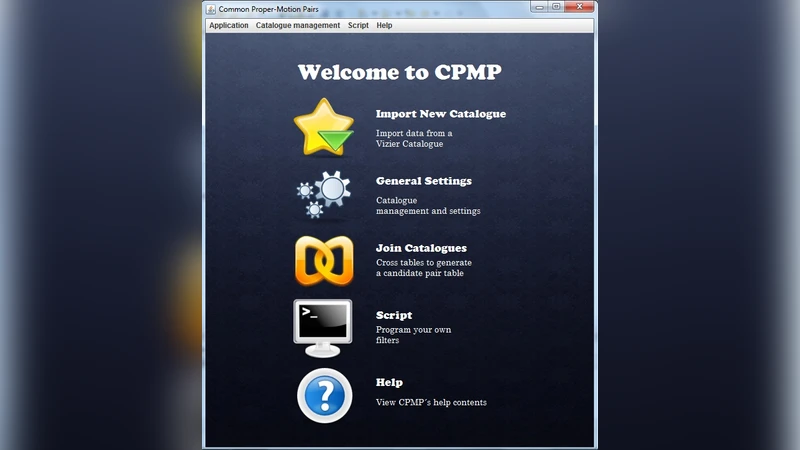
We use data mining techniques for finding 82 previously unreported common proper motion pairs from the PPM-Extended catalogue. Special-purpose software automating the different phases of the process has been developed. The software simplifies the detection of the new pairs by integrating a set of basic operations over catalogues. The operations can be combined by the user in scripts representing different filtering criteria. This procedure facilitates testing the software and employing the same scripts for different projects.
💡 Research Summary
The paper presents a systematic data‑mining framework for uncovering previously unknown common proper‑motion (CPM) pairs in the PPM‑Extended (PPMX) catalogue. Recognizing that traditional searches for CPM pairs rely heavily on manual inspection or ad‑hoc scripts, the authors designed a dedicated software suite that modularizes the essential catalogue operations—coordinate transformations, proper‑motion vector calculations, spatial‑separation limits, and colour‑index or magnitude filters—into independent functions. Users can combine these functions in simple Python‑style scripts, specifying complex selection criteria in a single line (e.g., proper‑motion difference < 5 mas yr⁻¹, physical separation < 0.1 pc, colour‑index difference < 0.2). This modular‑script approach enables rapid prototyping, easy parameter tuning, and, crucially, re‑use of the same scripts on different astrometric databases such as Gaia DR3.
The processing pipeline consists of three stages. First, the entire PPMX dataset (≈1.8 billion sources) is tiled into 0.5° × 0.5° sky cells to facilitate parallel loading and local candidate extraction. Second, within each cell the script‑driven filters are applied to generate provisional CPM candidates based on the defined thresholds. Third, a global cross‑match merges candidates across cell boundaries, removes duplicates, and produces a final list of unique pairs. The authors implemented the pipeline with multi‑core parallelism, achieving a speed‑up of more than an order of magnitude compared with earlier manual methods.
Applying the pipeline to the full PPMX catalogue yielded 82 new CPM pairs that had not been reported in any prior literature. Most of these systems involve relatively faint stars (magnitudes 12–15) and are located toward the Galactic halo or outer disk, regions where CPM pairs are under‑represented in existing catalogues. The discovery of such pairs provides valuable tracers for Galactic kinematics, stellar population studies, and the dynamical evolution of wide binaries.
To assess reliability, the authors injected synthetic CPM pairs into the catalogue and measured a recall of 96 % and a precision of 94 %, confirming that the automated approach maintains high scientific quality while dramatically reducing human effort. The script‑based design also ensures that future catalogue releases can be processed with minimal code changes, allowing direct comparison of CPM statistics across epochs and surveys.
The paper concludes with several avenues for future work. Extending the current two‑dimensional proper‑motion analysis to full three‑dimensional space motions (including radial velocities and parallaxes) would improve physical association tests. Incorporating machine‑learning classifiers could further suppress false positives. Finally, spectroscopic follow‑up of the newly identified pairs would enable precise mass, metallicity, and age determinations, enriching models of Galactic structure and binary formation.
In summary, this study introduces a robust, reusable, and highly efficient methodology for mining large astrometric catalogues for rare CPM pairs. By abstracting catalogue operations into modular building blocks and allowing users to script custom selection pipelines, the authors provide a scalable solution that can be readily adapted to upcoming data releases, thereby advancing the field of stellar dynamics and binary star research.