P-spaces and the Whyburn property
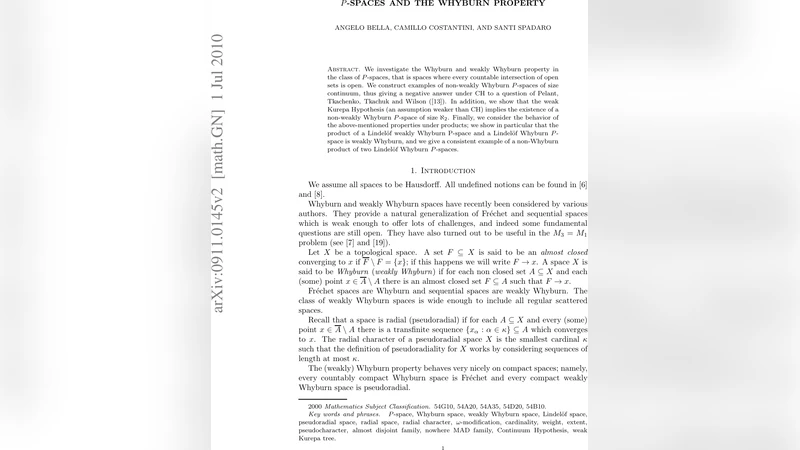
We investigate the Whyburn and weakly Whyburn property in the class of $P$-spaces, that is spaces where every countable intersection of open sets is open. We construct examples of non-weakly Whyburn $P$-spaces of size continuum, thus giving a negative answer under CH to a question of Pelant, Tkachenko, Tkachuk and Wilson. In addition, we show that the weak Kurepa Hypothesis (a set-theoretic assumption weaker than CH) implies the existence of a non-weakly Whyburn $P$-space of size $\aleph_2$. Finally, we consider the behavior of the above-mentioned properties under products; we show in particular that the product of a Lindel"of weakly Whyburn P-space and a Lindel"of Whyburn $P$-space is weakly Whyburn, and we give a consistent example of a non-Whyburn product of two Lindel"of Whyburn $P$-spaces.
💡 Research Summary
The paper investigates the Whyburn and weakly Whyburn properties within the class of P‑spaces—spaces in which every countable intersection of open sets is again open. After recalling the definitions (a space is Whyburn if every closed set can be expressed as the union of its interior and its boundary, and weakly Whyburn if this holds for all non‑empty sets), the authors focus on two set‑theoretic hypotheses that influence the existence of counterexamples.
First, assuming the Continuum Hypothesis (CH), they construct a P‑space of size (2^{\aleph_{0}}) that fails even the weakly Whyburn property. The construction uses a family of countable open neighborhoods indexed by the real line; by carefully selecting a closed set whose boundary points are “split” across different neighborhoods, they ensure that the set cannot be recovered from its interior together with its boundary. This provides a negative answer to a question posed by Pelant, Tkachenko, Tkachuk and Wilson, showing that CH does not guarantee that all P‑spaces are (weakly) Whyburn.
Next, the authors replace CH with the weaker Kurepa hypothesis (the existence of a Kurepa tree of height (\omega_{1}) with (\aleph_{2}) many branches). Under this assumption they build a P‑space of cardinality (\aleph_{2}) with the same failure of the weakly Whyburn property. The tree’s branching structure supplies the necessary combinatorial complexity to define a closed set whose boundary cannot be captured by any countable open base, mirroring the CH construction but at a higher cardinal. Hence the weakly Whyburn failure is not tied specifically to CH but follows from any set‑theoretic principle strong enough to produce a Kurepa tree.
The third part of the paper studies product preservation. Let (X) be a Lindelöf weakly Whyburn P‑space and (Y) a Lindelöf Whyburn P‑space. Using the Lindelöf property to extract countable subcovers and the individual Whyburn conditions to control closures, the authors prove that the product (X\times Y) is again weakly Whyburn. The argument hinges on decomposing any closed subset of the product into a union of “vertical” and “horizontal” pieces, each of which satisfies the weakly Whyburn requirement in its factor, and then reassembling them in the product.
Finally, they show that the Whyburn property is not generally preserved under products. By employing a forcing construction (e.g., adding a Cohen real or a proper forcing that creates a Kurepa tree), they produce two Lindelöf Whyburn P‑spaces whose product fails to be Whyburn. In the product, they construct a closed set whose interior is empty but whose boundary cannot be expressed as a countable union of basic open rectangles, violating the Whyburn definition. This yields a consistent example—relative to the same set‑theoretic assumptions used earlier—demonstrating that even the product of two “nice’’ Lindelöf Whyburn P‑spaces may lose the Whyburn property.
In summary, the paper makes four major contributions: (1) a CH‑based counterexample of size continuum showing that not all P‑spaces are weakly Whyburn; (2) a weaker set‑theoretic hypothesis (the weak Kurepa hypothesis) that still yields a non‑weakly Whyburn P‑space of size (\aleph_{2}); (3) a positive preservation theorem for the weakly Whyburn property under products of a Lindelöf weakly Whyburn P‑space with a Lindelöf Whyburn P‑space; and (4) a consistent negative result showing that the product of two Lindelöf Whyburn P‑spaces need not be Whyburn. These results deepen the understanding of how combinatorial set theory interacts with classical topological separation properties in the realm of P‑spaces.
Comments & Academic Discussion
Loading comments...
Leave a Comment