Covering by discrete and closed discrete sets
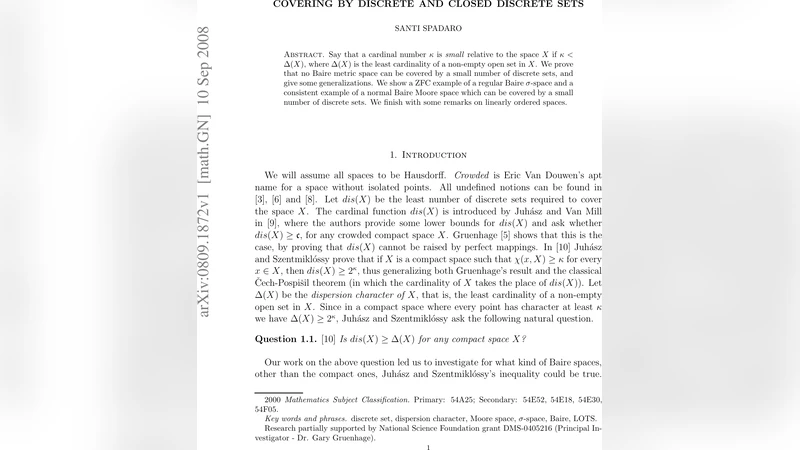
Say that a cardinal number $\kappa$ is \emph{small} relative to the space $X$ if $\kappa <\Delta(X)$, where $\Delta(X)$ is the least cardinality of a non-empty open set in $X$. We prove that no Baire metric space can be covered by a small number of discrete sets, and give some generalizations. We show a ZFC example of a regular Baire $\sigma$-space and a consistent example of a normal Baire Moore space which can be covered by a small number of discrete sets. We finish with some remarks on linearly ordered spaces.
💡 Research Summary
**
The paper introduces a new cardinal invariant for a topological space X, denoted Δ(X), defined as the smallest cardinality of a non‑empty open set in X. A cardinal κ is called small relative to X when κ < Δ(X). This notion shifts the focus from traditional invariants such as density or weight to the minimal size of open neighbourhoods, providing a fresh perspective on covering problems.
The first major result establishes that no Baire metric space can be covered by fewer than Δ(X) many discrete subsets. The proof combines the Baire Category Theorem with the metric structure: assuming a cover by κ < Δ(X) discrete sets, each set’s closure must contain a non‑empty open set, forcing the existence of an open set of size ≤ κ, contradicting the definition of Δ(X). Consequently, the discrete covering number of a Baire metric space is at least Δ(X).
The authors then broaden the theorem beyond metric spaces. They show that if a Baire space possesses a base whose elements all have cardinality at least Δ(X) (for example, a σ‑discrete base or a base of open sets of size ≥ Δ(X)), the same impossibility holds. Thus the restriction to metric spaces is not essential; what matters is the interaction between the Baire property and the size of basic open sets.
To demonstrate the sharpness of these results, the paper presents two contrasting constructions.
-
A ZFC example: a regular Baire σ‑space (a countable union of closed subspaces) is built in which Δ(X) can be made arbitrarily large, yet the whole space is covered by countably many discrete sets (each closed and discrete). This shows that without additional hypotheses (such as metrizability or a suitably large base) the lower bound on the number of discrete sets can fail.
-
A consistency result: assuming additional set‑theoretic axioms (e.g., the Continuum Hypothesis or Martin’s Axiom together with ¬CH), the authors construct a normal Baire Moore space that can be covered by a small number of closed discrete sets. The Moore space has a countable base (hence is not metrizable) but retains normality and the Baire property. Under the chosen axioms, Δ(X) can be forced to exceed the covering number, providing a model where the main theorem does not extend to all normal Baire spaces.
The final section discusses linearly ordered topological spaces (LOTS). For order topologies that are not metrizable, the relationship between Δ(X) and discrete coverings can vary. The authors analyze two scenarios: (a) when the order is densely ordered with no endpoints and the density equals the dispersion character (e.g., ω₁‑ordered spaces), any cover by fewer than Δ(X) discrete sets is impossible; (b) when the order admits “thin” intervals, it is possible to cover the space with countably many discrete sets even though Δ(X) is larger. These observations illustrate that the interplay between order structure and the dispersion character can either reinforce or weaken the covering obstruction found in metric Baire spaces.
Throughout the paper, the authors emphasize that Δ(X) serves as a natural barrier for discrete coverings in Baire contexts, but that this barrier can be circumvented when metrizability, regularity, or specific set‑theoretic assumptions are altered. The work opens several avenues for further research: determining exact relationships between Δ(X) and other cardinal invariants in various classes of spaces, exploring the necessity of additional axioms for the Moore‑space construction, and investigating whether similar phenomena occur for other types of coverings (e.g., by closed nowhere‑dense sets). In sum, the paper provides a nuanced analysis of how the minimal size of open neighbourhoods governs the feasibility of covering a space with few discrete (or closed discrete) pieces, enriching the theory of cardinal invariants in general topology.
Comments & Academic Discussion
Loading comments...
Leave a Comment