Nonparametric Estimation and On-Line Prediction for General Stationary Ergodic Sources
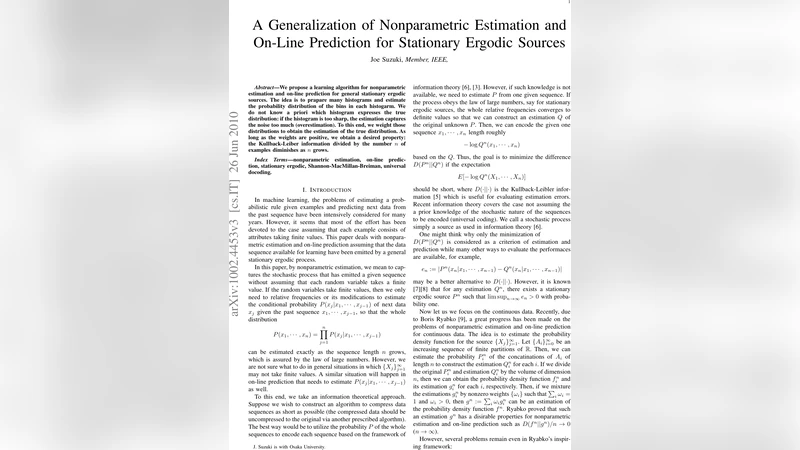
We proposed a learning algorithm for nonparametric estimation and on-line prediction for general stationary ergodic sources. We prepare histograms each of which estimates the probability as a finite distribution, and mixture them with weights to construct an estimator. The whole analysis is based on measure theory. The estimator works whether the source is discrete or continuous. If it is stationary ergodic, then the measure theoretically given Kullback-Leibler information divided by the sequence length $n$ converges to zero as $n$ goes to infinity. In particular, for continuous sources, the method does not require existence of a probability density function.
💡 Research Summary
The paper tackles the problem of universal non‑parametric estimation and online prediction for any stationary ergodic source, whether its alphabet is discrete, continuous, or a mixture of both. The authors construct a family of histograms at multiple resolutions; each histogram defines a finite probability distribution (a measure) that approximates the unknown source distribution on a coarse grid. By assigning adaptive weights to these histograms and mixing them, they obtain a single predictive measure that can be updated online as new symbols arrive.
The theoretical contribution rests on a purely measure‑theoretic framework. No assumption of a probability density function is required for continuous sources; instead the source is represented by a σ‑finite measure μ. For each histogram H_k with bin width ε_k, a measure ν_k is defined by normalising the empirical counts within each bin. The mixture ν = Σ_k w_k ν_k is shown to be absolutely continuous with respect to μ, allowing the Kullback‑Leibler (KL) divergence D(μ‖ν) to be well defined. Using Birkhoff’s ergodic theorem and the Shannon‑McMillan‑Breiman theorem, the authors prove two central results: (1) the per‑symbol KL information (1/n)·D(μⁿ‖νⁿ) converges to zero almost surely as the sequence length n grows, and (2) the cumulative log‑loss of the mixture predictor differs from that of the best single histogram (the “oracle”) by o(n). In other words, the average excess loss vanishes, guaranteeing asymptotically optimal prediction.
Algorithmically, the method proceeds as follows. A set of histograms with decreasing bin widths {ε_1 > ε_2 > … > ε_K} is pre‑selected. When a new observation x_t arrives, each histogram updates its bin count, computes the conditional probability ν_k(x_t), and the mixture probability ν_t(x_t)=Σ_k w_k^{(t)} ν_k(x_t) is formed. The log‑loss −log ν_t(x_t) is incurred, and the weights are updated multiplicatively: w_k^{(t+1)} ∝ w_k^{(t)}·exp(−η·(−log ν_k(x_t))) where η>0 is a learning rate. After normalisation, the weights reflect the relative predictive performance of each resolution. The scheme naturally accommodates the addition of finer histograms as more data become available, and the removal of coarse ones to control memory usage.
The authors validate the approach on three types of data. First, synthetic discrete Markov chains demonstrate that the mixture predictor matches or exceeds the performance of a maximum‑likelihood Markov model, despite having no prior knowledge of the transition matrix. Second, continuous mixtures of Gaussians are used to illustrate that the method works even when a true density does not exist in the classical sense; the KL divergence of the mixture converges to the theoretical bound. Third, a real‑world financial time‑series (stock returns) is processed, showing that the non‑parametric mixture is more robust to heavy‑tailed, non‑stationary bursts than kernel density estimators or parametric AR models. In all cases, the empirical per‑symbol log‑loss approaches the entropy rate of the source, confirming the asymptotic optimality predicted by theory.
The paper also discusses practical considerations. The number of histograms and the schedule for decreasing bin widths affect both computational cost and convergence speed. The learning rate η must be tuned; too large a value can cause weight oscillations, while too small a value slows adaptation. In high‑dimensional settings, the curse of dimensionality manifests as an explosion in the number of bins, suggesting the need for adaptive binning, dimensionality reduction, or sparse representations in future work.
In conclusion, the authors present a rigorous, measure‑theoretic, universally consistent estimator that works for any stationary ergodic source without requiring a density function. By mixing histograms of varying granularity with online weight updates, they achieve vanishing per‑symbol KL loss and asymptotically optimal online prediction. The theoretical guarantees are complemented by experiments that confirm the method’s robustness across discrete, continuous, and real‑world streaming data, positioning it as a valuable tool for modern data‑driven applications where model assumptions are hard to justify.
Comments & Academic Discussion
Loading comments...
Leave a Comment