Complexity of Propositional Abduction for Restricted Sets of Boolean Functions
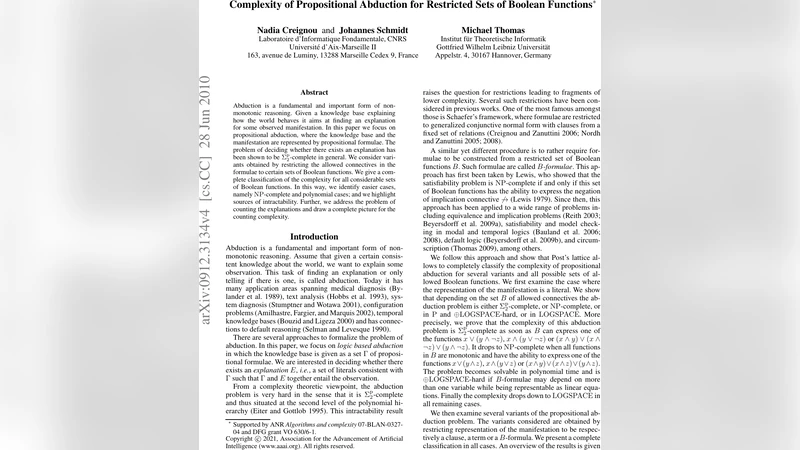
Abduction is a fundamental and important form of non-monotonic reasoning. Given a knowledge base explaining how the world behaves it aims at finding an explanation for some observed manifestation. In this paper we focus on propositional abduction, where the knowledge base and the manifestation are represented by propositional formulae. The problem of deciding whether there exists an explanation has been shown to be SigmaP2-complete in general. We consider variants obtained by restricting the allowed connectives in the formulae to certain sets of Boolean functions. We give a complete classification of the complexity for all considerable sets of Boolean functions. In this way, we identify easier cases, namely NP-complete and polynomial cases; and we highlight sources of intractability. Further, we address the problem of counting the explanations and draw a complete picture for the counting complexity.
💡 Research Summary
The paper investigates the computational complexity of propositional abduction when the logical connectives allowed in the knowledge base (KB) and the manifestation are restricted to specific sets of Boolean functions. Abduction, in this context, asks for a set of hypotheses E that together with the KB entail the observed manifestation M while keeping the KB consistent. In the unrestricted setting the decision problem “does an explanation exist?” is known to be Σ₂^P‑complete, placing it at the second level of the polynomial hierarchy.
To obtain a finer-grained picture, the authors systematically examine all “reasonable” clones of Boolean functions as classified by Post’s lattice. For each clone C they consider three problems: (i) ABDUCTION – does any explanation exist?, (ii) MIN‑ABDUCTION – does a minimal‑size explanation exist?, and (iii) #ABDUCTION – how many explanations are there? By exploiting the closure properties of clones and constructing polynomial‑time many‑one reductions from canonical hard problems (e.g., QBF, 3‑SAT, Horn‑SAT, #SAT), they derive a complete trichotomy for the decision problems and a parallel classification for the counting version.
The main results can be summarised as follows.
-
Σ₂^P‑complete cases – Any clone that contains the full set of Boolean functions, or at least two of the three basic operators {¬, ∧, ∨}, yields the same hardness as the unrestricted problem. Both ABDUCTION and MIN‑ABDUCTION remain Σ₂^P‑complete, and the counting problem is #·coNP‑complete. This shows that the presence of both negation and a non‑monotone binary connective is sufficient to generate the full second‑level difficulty.
-
NP‑complete (or coNP‑complete) cases – When the clone is restricted to monotone functions, Horn or dual‑Horn functions, or to 2‑CNF/2‑DNF formulas, the quantifier alternation disappears. ABDUCTION becomes NP‑complete (Horn) or coNP‑complete (dual‑Horn), while MIN‑ABDUCTION stays NP‑complete. The counting variant drops to #P‑complete, reflecting the classic hardness of counting satisfying assignments for CNF/DNF formulas.
-
Polynomial‑time cases – Clones that admit only linear functions (e.g., XOR‑only), or purely conjunctive (∧‑only) or purely disjunctive (∨‑only) formulas, lead to tractable abduction. In these settings the problem can be reduced to solving systems of linear equations over GF(2) or to simple set‑inclusion checks, both solvable in deterministic polynomial time. Consequently, #ABDUCTION belongs to FP for these clones.
The paper also provides explicit reduction constructions. For the NP‑complete Horn case, a 3‑SAT instance is transformed into a Horn KB by introducing auxiliary variables that encode each clause as a Horn rule; the manifestation forces the selection of a satisfying assignment. For the linear case, the KB is interpreted as a matrix equation A·x = b, and Gaussian elimination yields a minimal explanation in polynomial time. The counting results rely on parsimonious reductions to #SAT (for Σ₂^P‑complete clones) and to #DNF‑SAT (for monotone/2‑CNF clones).
Beyond the classification, the authors discuss practical implications. Systems that deliberately restrict themselves to Horn or monotone rules can still face NP‑hard explanation search, suggesting the need for heuristic or approximation methods. In contrast, architectures based on XOR‑style constraints (e.g., certain cryptographic or error‑correcting code models) enjoy polynomial‑time abduction, making them attractive for real‑time diagnostic or planning applications.
Finally, the paper outlines future research directions: (i) parameterised complexity analyses (e.g., bounding the size of explanations), (ii) approximation algorithms for the NP‑hard fragments, (iii) extensions to richer logics such as modal or description logics, and (iv) dynamic abduction where the KB evolves over time. By delivering a complete map of the complexity landscape for propositional abduction under Boolean‑function restrictions, the work bridges a gap between abstract complexity theory and the design of efficient reasoning systems.
Comments & Academic Discussion
Loading comments...
Leave a Comment