Short-time vs. long-time dynamics of entanglement in quantum lattice models
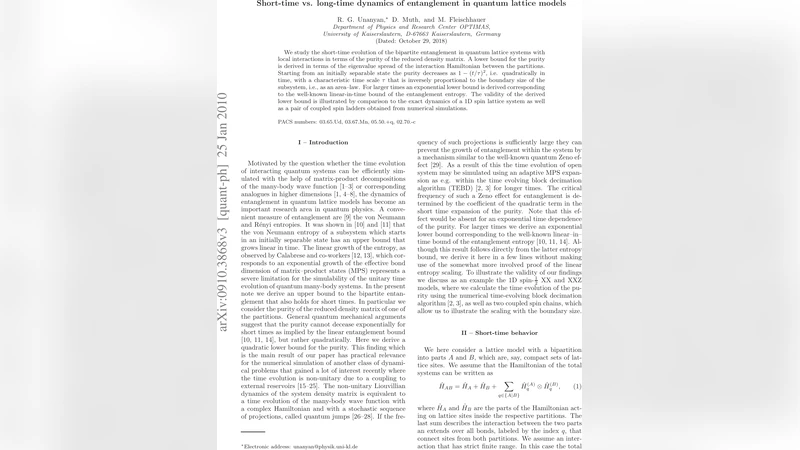
We study the short-time evolution of the bipartite entanglement in quantum lattice systems with local interactions in terms of the purity of the reduced density matrix. A lower bound for the purity is derived in terms of the eigenvalue spread of the interaction Hamiltonian between the partitions. Starting from an initially separable state the purity decreases as $1 - (t/\tau)^2$, i.e. quadratically in time, with a characteristic time scale $\tau$ that is inversly proportional to the boundary size of the subsystem, i.e., as an area-law. For larger times an exponential lower bound is derived corresponding to the well-known linear-in-time bound of the entanglement entropy. The validity of the derived lower bound is illustrated by comparison to the exact dynamics of a 1D spin lattice system as well as a pair of coupled spin ladders obtained from numerical simulations.
💡 Research Summary
The paper investigates how bipartite entanglement evolves in quantum lattice systems with local interactions, using the purity of the reduced density matrix as the primary diagnostic. The authors first decompose the total Hamiltonian into three parts, (H = H_A + H_B + H_{AB}), where (H_{AB}) contains only the interactions that cross the boundary between subsystems (A) and (B). By defining the spectral width of the interaction term, (\Delta\lambda = \lambda_{\max} - \lambda_{\min}), they derive a short‑time expansion of the purity, \
Comments & Academic Discussion
Loading comments...
Leave a Comment