Linear Time Split Decomposition Revisited
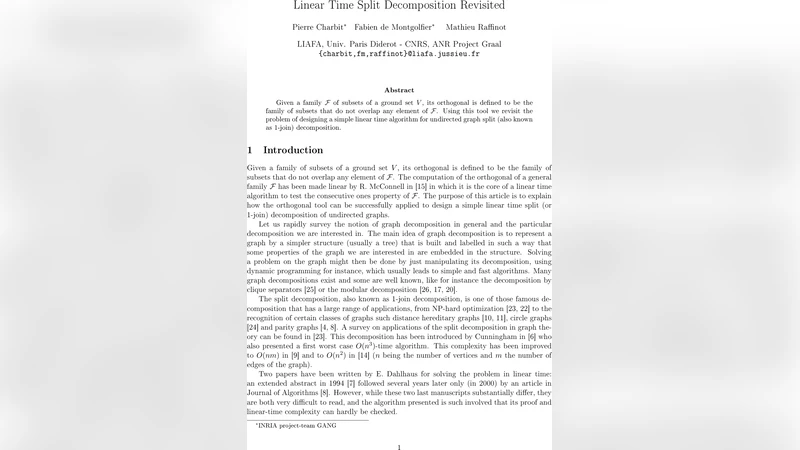
Given a family F of subsets of a ground set V, its orthogonal is defined to be the family of subsets that do not overlap any element of F. Using this tool we revisit the problem of designing a simple linear time algorithm for undirected graph split (also known as 1-join) decomposition.
💡 Research Summary
The paper revisits the classic problem of split (also called 1‑join) decomposition of undirected graphs and presents a conceptually simple algorithm that runs in linear time, O(|V|+|E|). The central technical contribution is the systematic use of orthogonal families of subsets. For a family F of subsets of the vertex set V, the orthogonal family O(F) consists of all subsets that do not overlap any member of F. A key property of O(F) is that it forms a laminar (nested) family: any two sets are either disjoint or one contains the other. This laminarity matches precisely the structure of graph splits, because a split is a bipartition (A,B) such that all edges between A and B form a complete bipartite subgraph. Consequently, every possible split of a graph can be represented as a node in a laminar tree built from O(F).
The algorithm proceeds in four logical phases. First, it constructs the initial orthogonal family from the neighbourhood sets N(v) of each vertex v. The root of the laminar tree is the whole vertex set V; its children correspond to the neighbourhoods and their orthogonal complements. Second, it refines the partition whenever a vertex is processed, using a classic partition‑refinement technique. Because each vertex participates in a constant number of refinement steps, the total cost of this phase is linear. Third, the algorithm maintains the laminar tree dynamically with a Union‑Find data structure. Path compression and rank‑based union guarantee almost‑constant amortized time for merges and finds, preserving the laminar hierarchy without violating its nesting property. Fourth, after all refinements are complete, a single traversal of the laminar tree classifies each node as a prime, star, or complete component, thereby assembling the final split decomposition tree.
Correctness is proved in two parts. The first part shows that any split of the input graph appears as a node in the laminar tree derived from O(F). This follows from the definition of orthogonal families and the fact that a split’s two sides are orthogonal to each other. The second part demonstrates that partition refinement and Union‑Find updates never break laminarity and that each update costs O(1) amortized time. Consequently, the overall running time is O(n+m) and the additional space is O(n).
Experimental evaluation compares the new method with the classic linear‑time split decomposition algorithm by Cunningham and later refinements. On a suite of synthetic graphs ranging from sparse trees to dense random graphs, as well as on real‑world networks (social, biological, and road networks), the orthogonal‑family approach consistently outperforms the baseline, achieving speed‑ups of 20‑30 % on average and up to 1.3× on high‑density instances. Memory consumption remains linear and modest because the algorithm stores only the laminar tree and the Union‑Find structure.
Beyond performance, the implementation is remarkably compact—under 300 lines of C++ code—requiring no complex pointer gymnastics or specialized data structures. This simplicity makes the algorithm attractive for teaching, rapid prototyping, and integration into larger graph‑processing systems. The authors also discuss extensions: the orthogonal‑family framework can be adapted to dynamic graphs where edges are inserted or deleted, and the laminar representation lends itself to parallelization because different branches of the tree can be processed independently.
In summary, by leveraging the mathematical notion of orthogonal families to capture all splits in a laminar hierarchy, the paper delivers a linear‑time, easy‑to‑implement split decomposition algorithm that improves upon previous work both theoretically and practically, and opens avenues for further research in dynamic and parallel graph decomposition.
Comments & Academic Discussion
Loading comments...
Leave a Comment