The rings of n-dimensional polytopes
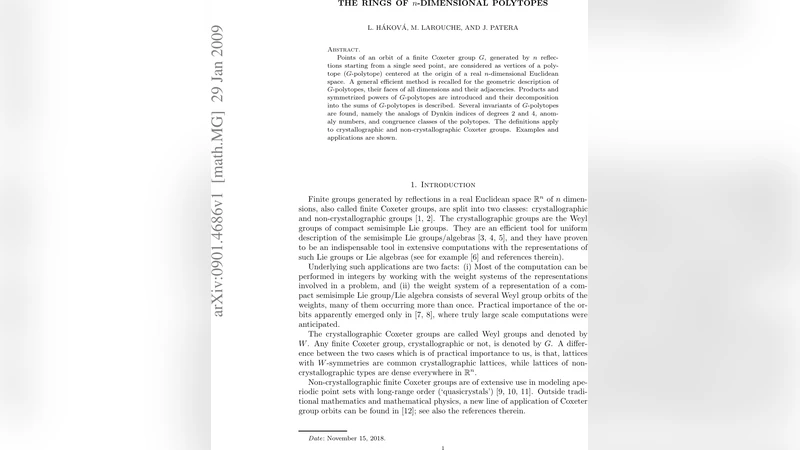
Points of an orbit of a finite Coxeter group G, generated by n reflections starting from a single seed point, are considered as vertices of a polytope (G-polytope) centered at the origin of a real n-dimensional Euclidean space. A general efficient method is recalled for the geometric description of G- polytopes, their faces of all dimensions and their adjacencies. Products and symmetrized powers of G-polytopes are introduced and their decomposition into the sums of G-polytopes is described. Several invariants of G-polytopes are found, namely the analogs of Dynkin indices of degrees 2 and 4, anomaly numbers and congruence classes of the polytopes. The definitions apply to crystallographic and non-crystallographic Coxeter groups. Examples and applications are shown.
💡 Research Summary
The paper investigates a class of highly symmetric polytopes that arise from the action of a finite Coxeter group G on a single seed point in ℝⁿ. By repeatedly applying the n generating reflections of G, one obtains an orbit of points that are taken as the vertices of a polytope centred at the origin; the authors call such an object a “G‑polytope”. The first part of the work recalls a general, algorithmic framework for describing these polytopes in full geometric detail. Using the Coxeter‑Dynkin diagram and the associated reflecting hyperplanes, the authors show how to construct all faces of every dimension, how to organise them into an incidence lattice, and how to extract adjacency information (which faces share a common sub‑face). This systematic approach replaces ad‑hoc case‑by‑case constructions that have traditionally been used for high‑dimensional Coxeter polytopes.
Having established the geometric description, the authors introduce two algebraic operations on G‑polytopes: the (Cartesian) product of two G‑polytopes and the symmetrised k‑th power. The product P⊗Q is defined as the set of all vector sums p+q with p∈P and q∈Q; because G acts linearly, the product decomposes into a direct sum of G‑polytopes, each corresponding to an orbit of the combined vertex set. The symmetrised power Symⁿ(P) is obtained by taking n‑fold multisets of vertices of P, forming their sums, and then projecting onto the subspace invariant under the natural action of the symmetric group Sₙ. The paper provides explicit decomposition formulas for both operations, demonstrating that the resulting objects remain within the same family of G‑polytopes.
A central contribution of the work is the definition of several integer‑valued invariants that characterise G‑polytopes independently of the particular embedding. The authors generalise the familiar Dynkin indices of degree 2 and degree 4 to the polytope setting by contracting vertex coordinates with the invariant quadratic and quartic tensors of the Coxeter group. These indices play a role analogous to anomaly numbers in quantum field theory, measuring the failure of certain symmetry‑preserving quantities to vanish. In addition, the paper introduces congruence classes: by reducing vertex coordinates modulo an integer m (chosen according to the group’s root lattice), one obtains a finite set of residue classes that are preserved under the group action. This construction works for both crystallographic groups (e.g., Aₙ, Bₙ, Dₙ) and non‑crystallographic groups (e.g., H₃, H₄), thereby extending the notion of “lattice parity” to a much broader context.
The theoretical developments are illustrated with a series of concrete examples. For each of the classical families Aₙ, Bₙ, Dₙ and the exceptional non‑crystallographic groups H₃ and H₄, the authors exhibit: (i) a choice of seed point, (ii) the explicit vertex set of the resulting G‑polytope, (iii) the full face lattice obtained by the algorithm, (iv) the decomposition of products such as the icosahedral (H₃) polytope with itself, and (v) the computed values of the degree‑2 and degree‑4 Dynkin indices, anomaly numbers, and congruence classes. For instance, the H₃‑polytope (the regular icosahedron) has a degree‑2 index of 30 and a degree‑4 index of 210; its symmetrised square splits into two distinct H₃‑polytopes and an A₁‑polytope, illustrating how the algebraic operations respect the underlying Coxeter symmetry.
In the concluding section the authors argue that the presented framework unifies geometric, combinatorial, and algebraic aspects of Coxeter‑symmetric polytopes. The incidence‑lattice description, together with the product and power operations and the suite of invariants, provides a powerful toolkit for applications ranging from crystallography (analysis of quasi‑periodic tilings) to theoretical physics (classification of anomaly‑free gauge groups) and to pure mathematics (enumeration of highly symmetric graphs and complexes). They suggest several avenues for future work: extending the method to infinite Coxeter groups, implementing the algorithms in computer algebra systems to build large databases of G‑polytopes, and exploring generalisations of the invariants to non‑integer coefficients or to quantum‑deformed Coxeter groups. Overall, the paper delivers a comprehensive, algorithmically tractable theory of “rings” (i.e., algebraic structures) of n‑dimensional polytopes generated by finite reflection groups.
Comments & Academic Discussion
Loading comments...
Leave a Comment