Combinatorics of labelling in higher dimensional automata
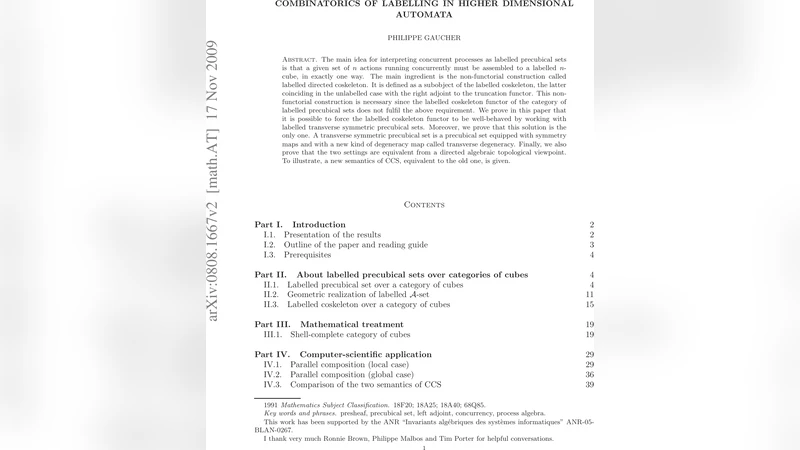
The main idea for interpreting concurrent processes as labelled precubical sets is that a given set of n actions running concurrently must be assembled to a labelled n-cube, in exactly one way. The main ingredient is the non-functorial construction called labelled directed coskeleton. It is defined as a subobject of the labelled coskeleton, the latter coinciding in the unlabelled case with the right adjoint to the truncation functor. This non-functorial construction is necessary since the labelled coskeleton functor of the category of labelled precubical sets does not fulfil the above requirement. We prove in this paper that it is possible to force the labelled coskeleton functor to be well-behaved by working with labelled transverse symmetric precubical sets. Moreover, we prove that this solution is the only one. A transverse symmetric precubical set is a precubical set equipped with symmetry maps and with a new kind of degeneracy map called transverse degeneracy. Finally, we also prove that the two settings are equivalent from a directed algebraic topological viewpoint. To illustrate, a new semantics of CCS, equivalent to the old one, is given.
💡 Research Summary
The paper addresses a long‑standing difficulty in the categorical modelling of concurrent processes using labelled precubical sets. In the unlabelled setting, the truncation functor admits a right adjoint, the coskeleton, which uniquely extends a lower‑dimensional precubical set to higher dimensions: an n‑tuple of independent actions is represented by a single n‑cube. When labels are added, the naïve “labelled coskeleton” functor ceases to be functorial; the same underlying precubical set can be extended in several incompatible ways, violating the principle that a given set of n concurrent actions must be assembled into exactly one labelled n‑cube.
To enforce uniqueness, the authors first introduce a non‑functorial construction called the labelled directed coskeleton, defined as a subobject of the labelled coskeleton. This construction does guarantee a unique labelled n‑cube for each n‑tuple of actions, but its non‑functorial nature makes it unsuitable for the usual categorical tools (e.g., limits, colimits, adjunctions) that are essential for a robust theory of concurrency.
The core contribution of the paper is the definition of a new category: labelled transverse symmetric precubical sets. Objects in this category are ordinary precubical sets equipped with two additional families of maps:
- Symmetry maps that permute the coordinates of a cube, reflecting the fact that the order of independent actions is irrelevant.
- Transverse degeneracy maps, a novel kind of degeneracy that “slides” a dimension into another direction. These maps are designed so that, when labels are present, the labelled coskeleton becomes a genuine right adjoint to truncation, restoring functoriality while preserving the uniqueness of labelled cubes.
The authors prove that within this enriched setting the labelled coskeleton functor behaves exactly as required: it is functorial, it is the right adjoint of the truncation functor, and it yields a unique labelled n‑cube for each concurrent n‑tuple of actions. Moreover, they show that this solution is unique: any other attempt to make the labelled coskeleton functorial without introducing both symmetry and transverse degeneracy fails to satisfy the uniqueness condition.
Beyond the categorical construction, the paper establishes an equivalence between the original non‑functorial labelled precubical framework and the new transverse symmetric framework from the perspective of directed algebraic topology. In other words, the two models have the same directed homotopy types, so no topological information is lost or altered by passing to the richer category.
To illustrate the practical impact, the authors give a new semantics for Milner’s CCS (Communicating Sequential Processes). In the classic semantics, the labelled coskeleton’s non‑functoriality forces the use of auxiliary constructions to interpret parallel composition, making proofs cumbersome. Using transverse symmetric precubical sets, each CCS operator maps directly to a well‑behaved object, and parallel composition is represented by a single labelled n‑cube, exactly matching the intended concurrency intuition. The new semantics is proved equivalent to the traditional one, yet it is conceptually cleaner and more amenable to algebraic‑topological analysis.
In summary, the paper solves a fundamental problem in the theory of labelled higher‑dimensional automata by introducing transverse symmetry and transverse degeneracy, thereby restoring functoriality to the labelled coskeleton, proving the uniqueness of this solution, and demonstrating its equivalence to the classical approach both categorically and topologically. This work paves the way for more robust algebraic‑topological methods in the study of concurrent systems and higher‑dimensional automata.
Comments & Academic Discussion
Loading comments...
Leave a Comment