Classifying spaces for braided monoidal categories and lax diagrams of bicategories
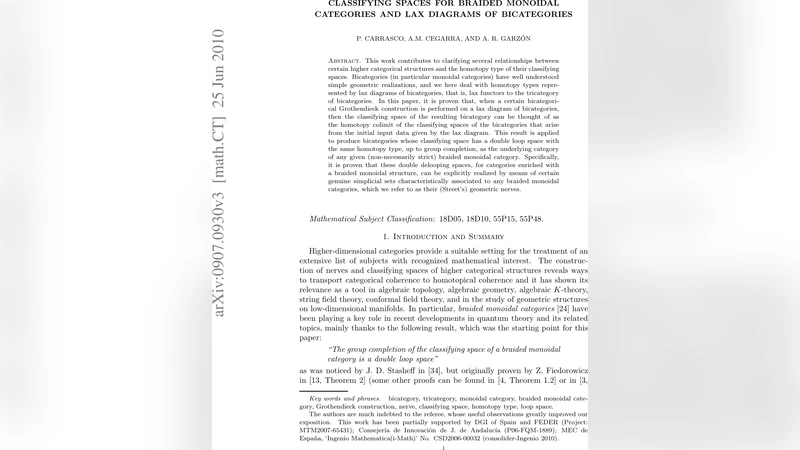
This work contributes to clarifying several relationships between certain higher categorical structures and the homotopy type of their classifying spaces. Bicategories (in particular monoidal categories) have well understood simple geometric realizations, and we here deal with homotopy types represented by lax diagrams of bicategories, that is, lax functors to the tricategory of bicategories. In this paper, it is proven that, when a certain bicategorical Grothendieck construction is performed on a lax diagram of bicategories, then the classifying space of the resulting bicategory can be thought of as the homotopy colimit of the classifying spaces of the bicategories that arise from the initial input data given by the lax diagram. This result is applied to produce bicategories whose classifying space has a double loop space with the same homotopy type, up to group completion, as the underlying category of any given (non-necessarily strict) braided monoidal category. Specifically, it is proven that these double delooping spaces, for categories enriched with a braided monoidal structure, can be explicitly realized by means of certain genuine simplicial sets characteristically associated to any braided monoidal categories, which we refer to as their (Street’s) geometric nerves.
💡 Research Summary
The paper investigates the relationship between higher categorical structures—specifically bicategories, monoidal categories, and their braided variants—and the homotopy types of their classifying spaces. The authors begin by recalling that the classifying space of a bicategory can be obtained via a simple geometric realization of its nerve, and they point out that many constructions in homotopy theory (e.g., loop spaces, group completions) can be expressed in terms of such classifying spaces. The central object of study is a lax diagram of bicategories: a lax functor 𝔽 : I → Bicat, where I is a small ordinary category and Bicat denotes the tricategory of bicategories, homomorphisms, pseudonatural transformations, and modifications. Such a diagram assigns to each object i∈I a bicategory 𝔽(i), to each arrow α:i→j a homomorphism 𝔽(α), and to each composable pair a coherent collection of 2‑cells satisfying the usual laxity constraints.
The first major contribution is the bicategorical Grothendieck construction ∫𝔽, which assembles the data of the lax diagram into a single bicategory. Objects of ∫𝔽 are pairs (i,x) with x∈𝔽(i); 1‑cells are triples (α,f) where α:i→j in I and f:𝔽(α)(x)→y in 𝔽(j); 2‑cells consist of a 2‑cell β:α⇒α′ in I together with a modification θ:f′∘𝔽(β)_x⇒f. The construction respects the tricategorical coherence theorems, ensuring that associativity and unit constraints are satisfied up to coherent isomorphism.
The core theorem (Theorem 3.1) states that the classifying space of the Grothendieck construction is homotopy equivalent to the homotopy colimit of the classifying spaces of the individual bicategories: \
Comments & Academic Discussion
Loading comments...
Leave a Comment