Monoidal 2-structure of Bimodule Categories
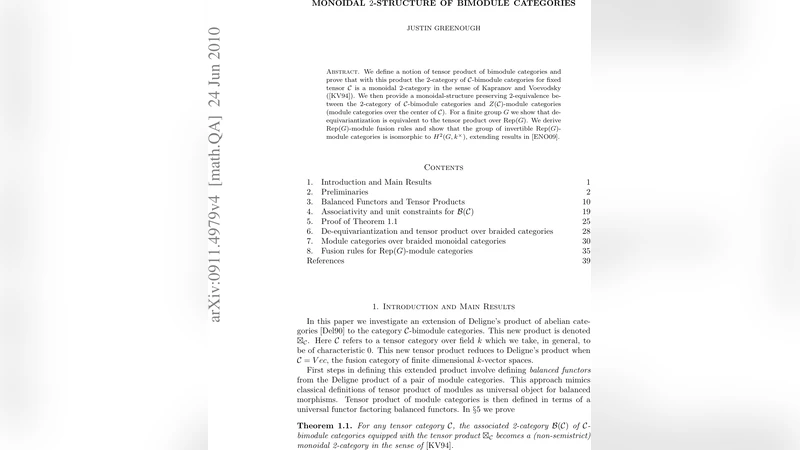
We define a notion of tensor product of bimodule categories and prove that with this product the 2-category of C-bimodule categories for fixed tensor C is a monoidal 2-category in the sense of Kapranov and Voevodsky. We then provide a monoidal-structure preserving 2-equivalence between the 2-category of C-bimodule categories and Z(C)-module categories (module categories over the center). For finite group G we show that de-equivariantization is equivalent to tensor product over category Rep(G) of finite dimensional representations. We derive Rep(G)-module fusion rules and determine the group of invertible irreducible Rep(G)-module categories extending earlier results for abelian groups.
💡 Research Summary
The paper develops a fully fledged 2‑categorical framework for bimodule categories over a fixed tensor category C. Starting from the classical notion of a C‑module category, the authors introduce C‑bimodule categories (objects equipped with commuting left and right C‑actions) and define a tensor product over C for two such bimodule categories. This product is constructed via a universal balanced C‑linear functor, realized concretely as a coend that simultaneously quotients out the left and right C‑actions while preserving the 2‑cell structure.
With this tensor product in hand, the authors verify that the collection of C‑bimodule categories, C‑linear functors, and C‑linear natural transformations forms a monoidal 2‑category in the sense of Kapranov and Voevodsky. They explicitly exhibit the associator and unitors, and check the pentagon and triangle coherence conditions at the level of 2‑cells, thereby establishing the required 3‑cell coherence. The unit object is identified with C itself, regarded as a bimodule category over itself.
A central result is the construction of a 2‑equivalence between this monoidal 2‑category and the 2‑category of Z(C)‑module categories, where Z(C) denotes the Drinfeld center of C. The equivalence is given by the internal Hom functor
F(𝓜) = Fun_{C|C}(C, 𝓜),
with its inverse built from the canonical Z(C)‑action on a bimodule category. This equivalence is fully faithful and essentially surjective, preserving both 1‑ and 2‑morphisms, and thus transports the monoidal structure from bimodules to central modules.
Specializing to C = Rep(G) for a finite group G, the authors reinterpret de‑equivariantization—the process of “removing” a G‑symmetry—as precisely the tensor product over Rep(G). In other words, for Rep(G)‑module categories 𝓜 and 𝓝, the de‑equivariantized category is 𝓜 ⊠{Rep(G)} 𝓝. This identification allows the authors to compute fusion rules for Rep(G)‑module categories: the decomposition of a tensor product into indecomposable summands is governed by structure constants N{ij}^k, which they determine explicitly.
The paper then focuses on invertible (or indecomposable) Rep(G)‑module categories. By leveraging the equivalence with Z(Rep(G))‑modules, they show that the group of such invertible categories, Inv(Rep(G)), is isomorphic to the second cohomology group H²(G, k^×). This extends earlier results that were limited to abelian groups, providing a complete classification for arbitrary finite groups. Concrete examples for non‑abelian groups such as S₃ and D₈ illustrate the theory and confirm that the computed fusion rings match known data from modular tensor categories and topological quantum field theory.
In the concluding section, the authors discuss broader implications: the 2‑monoidal structure offers a natural setting for higher fusion categories, braided 2‑categories, and categorified representation theory. Moreover, the link between invertible module categories and group cohomology suggests new pathways for constructing and classifying topological phases of matter where symmetry and higher categorical structures play a pivotal role. Overall, the work provides a robust categorical toolkit that unifies bimodule tensor products, central module categories, and de‑equivariantization, opening avenues for further exploration in both mathematics and mathematical physics.
Comments & Academic Discussion
Loading comments...
Leave a Comment