We introduce a family of compatible Poisson brackets on the space of $2\times 2$ polynomial matrices, which contains the reflection equation algebra bracket. Then we use it to derive a multi-Hamiltonian structure for a set of integrable systems that includes the $XXX$ Heisenberg magnet with boundary conditions, the generalized Toda lattices and the Kowalevski top.
Deep Dive into The Poisson bracket compatible with the classical reflection equation algebra.
We introduce a family of compatible Poisson brackets on the space of $2\times 2$ polynomial matrices, which contains the reflection equation algebra bracket. Then we use it to derive a multi-Hamiltonian structure for a set of integrable systems that includes the $XXX$ Heisenberg magnet with boundary conditions, the generalized Toda lattices and the Kowalevski top.
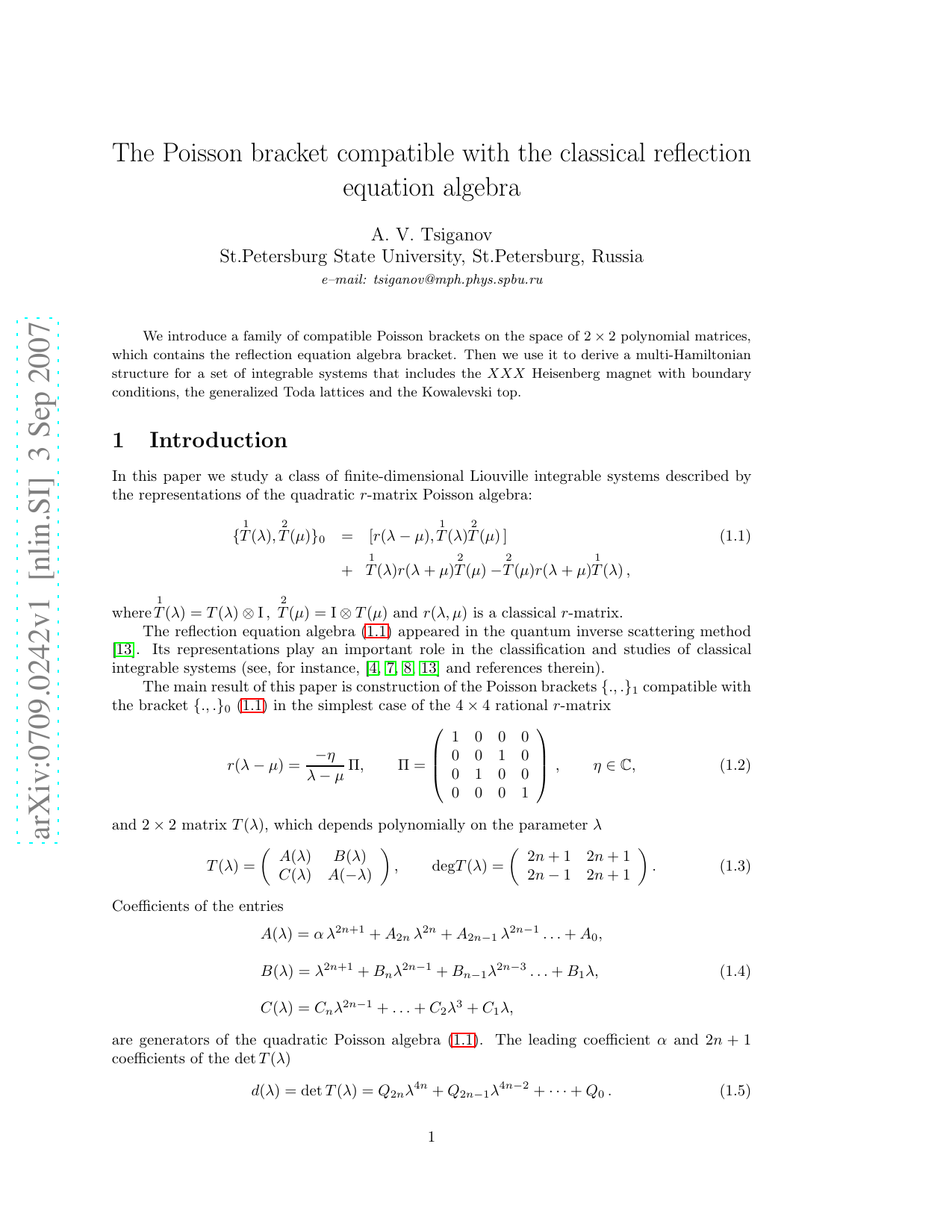
In this paper we study a class of finite-dimensional Liouville integrable systems described by the representations of the quadratic r-matrix Poisson algebra:
,
T (µ) = I ⊗ T (µ) and r(λ, µ) is a classical r-matrix. The reflection equation algebra (1.1) appeared in the quantum inverse scattering method [13]. Its representations play an important role in the classification and studies of classical integrable systems (see, for instance, [4,7,8,13] and references therein).
The main result of this paper is construction of the Poisson brackets {., .} 1 compatible with the bracket {., .} 0 (1.1) in the simplest case of the 4 × 4 rational r-matrix
1 0 0 0 0 0 1 0 0 1 0 0 0 0 0 1
and 2 × 2 matrix T (λ), which depends polynomially on the parameter λ
Coefficients of the entries
are generators of the quadratic Poisson algebra (1.1). The leading coefficient α and 2n + 1 coefficients of the det T (λ)
are Casimirs of the bracket (1.1). Therefore, we have a 4n + 1-dimensional space of the coefficients A 0 , . . . , A 2n , B 1 , . . . , B n , C 1 , . . . , C n (1.6) with 2n + 1 Casimir operators Q i , leaving us with n degrees of freedom. The use of the algebra (1.1) for the theory of the integrable systems is based on the following construction of commutative subalgebras [13,14]. Let us introduce boundary matrix
where entries A(λ), D(λ) are polynomials with numerical coefficients and C(λ) is arbitrary polynomial on λ. If the polynomial
These Poisson involutive integrals of motion H i define the Liouville integrable systems, which are our generic models for the whole paper.
The Poisson brackets {., .} 0 and {., .} 1 are compatible if every linear combination of them is still a Poisson bracket [3,11].
The bracket (1.1) belongs to the following family of compatible Poisson brackets:
Here k = 0, 1 and
is the quotient of polynomials in variable λ over a field, such that ρ 0 = 0, and
Proof: It is sufficient to check the statement on an open dense subset of the reflection equation algebra defined by the assumption that A(λ) and B(λ) are co-prime and all double roots of B(λ) are distinct.
This assumption allows us to construct a separation representation for the reflection equation algebra (1.1). In this special representation one has n pairs of Darboux variables, λ i , µ i , i = 1, . . . , n, having the standard Poisson brackets,
with the λ-variables being n zeros of the polynomial B(λ) and the µ-variables being values of the polynomial A(λ) at those zeros,
The interpolation data (2.3) plus n + 2 identities
allow us to construct the needed separation representation for the whole algebra:
Using this representation we can easy calculate the bracket {., .} 1 (2.1) in (λ, µ)-variables
In order to complete the proof we have to check that brackets (2.5) is compatible with the canonical brackets (2.2). The compatibility of the brackets (2.2),(2.5) implies the compatibility of the brackets (1.1),(2.1) and vice versa. This completes the proof.
Remark 1 The coefficients of the determinant d(λ) (1.5) are the Casimir functions for the both brackets {., .} 0 and {., .} 1 . It means that the Poisson bracket {., .} 1 has the same foliation by symplectic leaves as {., .} 0 .
Proposition 2 The brackets (2.1) may be rewritten in the following r-matrix form
The proof consists of the straightforward calculations.
Using the separated representation (2.4) we can rewrite the higher order Poisson brackets
at the r-matrix form (2.6). As a result we obtain a family of the Poisson brackets compatible with the bracket (1.1). For the Sklyanin r-matrix algebra such family of the brackets has been constructed in [17].
Proposition 3 Integrals of motion H i from trK(λ)T (λ) are in the bi-involution
with respect to the brackets (2.1) or (2.6).
Proof: According to [14] variables λ i , µ i (2.4) are the separated coordinates for the coefficients H i of the polynomial τ =trK(λ)T (λ) and the separated relations look like
Remind that A(λ), D(λ) are numerical polynomials and among all the coefficients τ k we have only n integrals of motion H i .
On the other hand from (2.5) follows that λ i , µ i are the Darboux-Nijenhuis variables for the brackets {., .} 0,1 (2.1). So, integrals of motion H i are in the bi-involution with respect to the brackets (2.1) or (2.6) according to the Theorem 3.2 from [3]. This completes the proof.
Summing up, we have proved a bi-involution of the integrals of motion H i using the Darboux-Nijenhuis variables λ i , µ i and the separation representation (2.4) for the reflection equation algebra.
Another important representations of the quadratic Poisson algebra with the generators A i , B i , C i comes as a consequence of the co-multiplication property of the reflection equation algebra (1.1). Essentially, it means that the matrix T (λ) (1.3) can be factorized into a product of elementary matrices, each containing only one degree of freedom [13]. In this picture, our main model turns out to be an n-site Heisenbe
…(Full text truncated)…
This content is AI-processed based on ArXiv data.