The LCG GRID system is the indispensable infrastructure for large scale computing required for ILC experiments. It had been used extensively for ILD LOI studies and its use will be further increased in coming DBD studies. Experiences during the LOI era and plan towards DBD study in KEK are presented.
Deep Dive into KEK GRID for ILC Experiments.
The LCG GRID system is the indispensable infrastructure for large scale computing required for ILC experiments. It had been used extensively for ILD LOI studies and its use will be further increased in coming DBD studies. Experiences during the LOI era and plan towards DBD study in KEK are presented.
arXiv:1006.3991v1 [physics.ins-det] 21 Jun 2010
KEK GRID for ILC Experiments
Akiya Miyamoto, Go Iwai, and Katsumasa Ikematsu
High Energy Accelerator Research Organization (KEK),
1-1 Oho, Tsukuba, Ibaraki, 305-0801 Japan
The LCG GRID system is the indispensable infrastructure for large scale computing
required for ILC experiments. It had been used extensively for ILD LOI studies and
its use will be further increased in coming DBD studies. Experiences during the LOI
era and plan towards DBD study in KEK are presented.
1
Introduction
International Linear Collider(ILC) is a global project and a good network connection among
participant members through Internet is a crucial infrastructure for the success. A GRID
system is constructed on the Internet and it provides not only CPU and storage for large
scale computing required for ILC experiments, but also sharing of data among ILC experi-
mentalists.
Software bases studies in International Large Detector concept (ILD)[1] has utilized LCG
GRID[2]; It had been used extensively during an era of LOI for Monte Carlo production and
sharing of produced data among members. Especially, there was a strong need in Japan to
access MC DST samples of about 5 TB placed in Europe. LCG GRID had been used for
file transfers successfully.
Experiences during this period are described in the following sections, after describing the
GRID system in KEK. A plan towards Detector Baseline Design is described subsequently.
2
Network feature
A wide-band backbone network has been constructed for HEP community in Japan, which
connects Japanese universities and laboratories participating HEP projects such as Belle,
J-PARC, ATLAS, ILC, and so on. In addition, the network covers non-HEP users such
as material science, bio-chemistry, synchrotron light source and neutron source. KEK is
playing a major role in supporting network services for these activities, including a GRID
deployment and operation.
The network is connected to the outside of Japan though SINET3[3].
The SINET3
provides a connection to Hong Kong and Singapore then to European network such as
GEANT, however the band width to Asian countries is limited to about less than 1 Gbps.
The trans-Pacific network from Japan to US has an order wider bandwidth.
Thus the
network packet between Japan and Europe go through North America, though the actual
path length is longer than a route through Eurasian Continent.
Long distance between Japan and Europe is the limiting factor of fast transfer of network
packets. Typically, we observed a round trip time of packets from KEK to IHEP and KISTI,
which are institutes in China and Korea, to be about 100 msec. On the other hand, those to
FNAL in US is about 200 msec and to DESY/IN2P3 in Germany/France is about 300 msec.
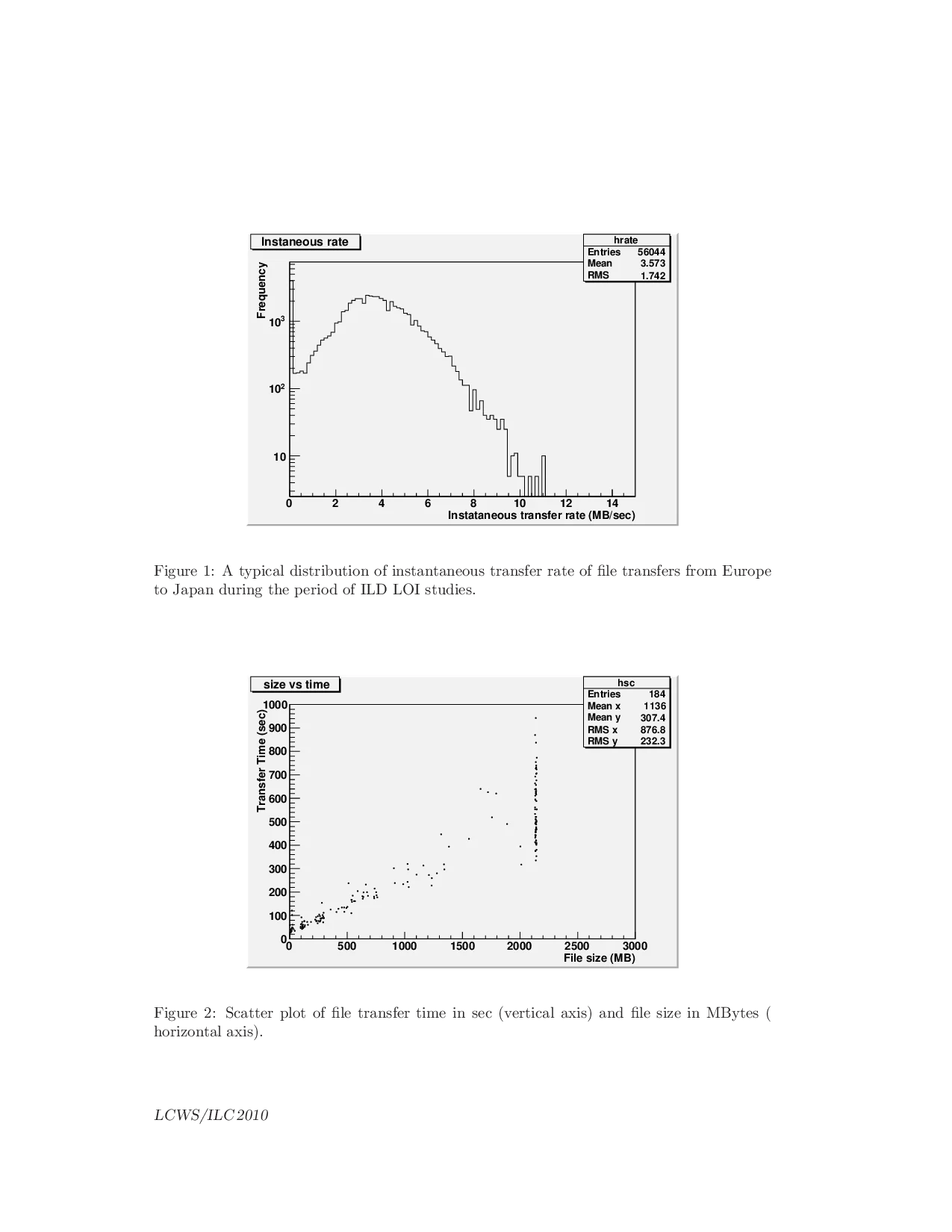
The round trip time is a pedestal time required for every network data transfer, independent
of a packet size, thus it is not efficient to send and receive small files.
LCWS/ILC 2010
3
GRID system in KEK and experiences in LOI period
KEK Computing Center is supporting two GRID system, LCG/gLite and RENKEI/NAREGI.
LCG has been used not only by LHC groups but also other HEP groups such as Belle, J-
PARC and ILC. RENKEI(REsources liNKage for E-science)[4] is a research to link resources
among communities of e-sciences in Japan. It is developing NAREGI GRID middle ware.
For ILC activities, two VOs have been used; CALICE-VO and ILC-VO, which use LCG
GRID middle ware. CALICE-VO has been used by CALICE group[5] for their test beam
data analysis and Monte Carlo simulation. ILC-VO provided CPU resources required for
ILD LOI studies. In Japan, KEK, Kobe university and Tohoku university are joining ILC-
VO. During the LOI study period, CPU resources in Japanese GRID sites were very small; It
was less than two order of magnitude smaller than those available at European institutes and
GRID in Japan had been used mainly for transfers of files produced at European institutes
or at KEK local batch servers.
For ILD LOI studies, about 70 TB data samples were produced mainly at DESY and
IN2P3 site. Sample consisted of simulated, reconstructed and DST samples produced by
processing ILC LOI benchmark processes[6] and Standard Model processes at 500 and 250
GeV center of mass energies. The data size were placed on GRID SEs for international and
inter-regional data accesses. In the period of LOI studies, the time from the production of
MC samples to the completion of data analysis was limited, thus only DST samples were
transferred during the period of about 3 moths, except some samples. The file transfers
were mainly from Europe to Japan but also partially from Japan to Europe.
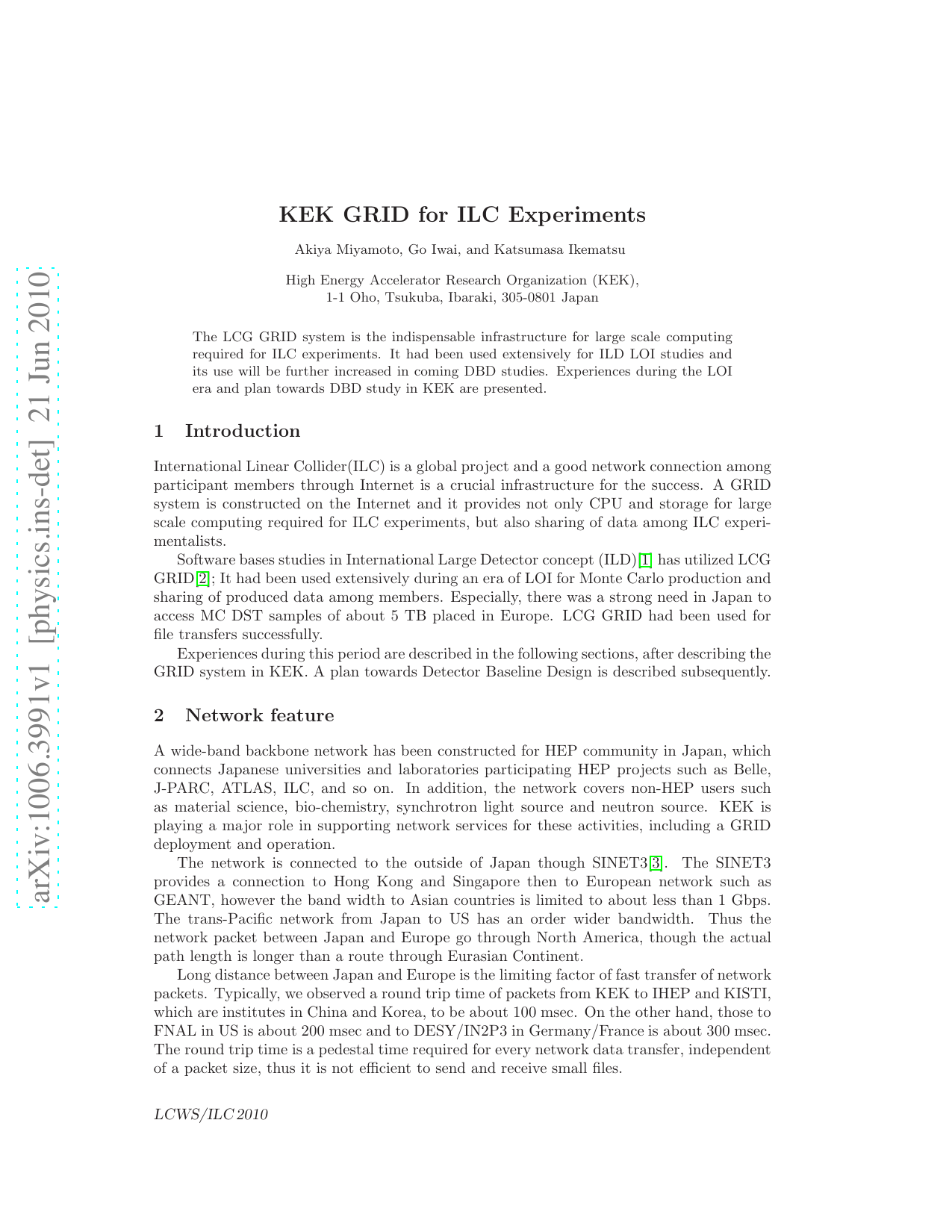
In total, about 5 TB data have been transferred with a typical transfer rate of about
200 kB/sec/port. Due to a limited transfer speed, we experienced a frequent time out of
transfer, which made it difficult to transfer of files with size exceeding 2 GB. The problem
had been cured by removing the time out limit in file copy.
Large round trip tim
…(Full text truncated)…
This content is AI-processed based on ArXiv data.